

Volume 35, Issue 252 (12-2025)
J Mazandaran Univ Med Sci 2025, 35(252): 111-117 |
Back to browse issues page


Download citation:
BibTeX | RIS | EndNote | Medlars | ProCite | Reference Manager | RefWorks
Send citation to:


BibTeX | RIS | EndNote | Medlars | ProCite | Reference Manager | RefWorks
Send citation to:
Davoodi L, Asadi-Aliabadi M, Hossein nia M, Eslami S, Sobhanian P. Comparison of the Epidemiological, Clinical, and Laboratory Characteristics of Tuberculosis Patients Before and During the COVID-19 Pandemic in Sari. J Mazandaran Univ Med Sci 2025; 35 (252) :111-117
URL: http://jmums.mazums.ac.ir/article-1-21428-en.html
URL: http://jmums.mazums.ac.ir/article-1-21428-en.html


Abstract: (840 Views)
Background and purpose: Tuberculosis (TB) is a major infectious disease worldwide, affecting millions of people annually and resulting in substantial mortality. The COVID-19 pandemic has disrupted health systems globally, influencing TB diagnosis and treatment processes. This study aimed to compare the epidemiological, clinical, and laboratory characteristics of TB patients in Sari before and during the COVID-19 pandemic.
Materials and methods: This cross-sectional, analytical study included all TB patients aged 18 years and above in Sari from April 2018 to July 2019 (pre-pandemic) and from April 2020 to July 2021 (during the pandemic). Data were retrieved from health centers and anonymized following coding. Demographic variables, medical history, and diagnostic test results were systematically reviewed. TB diagnosis was based on standard smear microscopy and culture methods. Statistical analyses were performed using SPSS software, employing t-tests and chi-square tests.
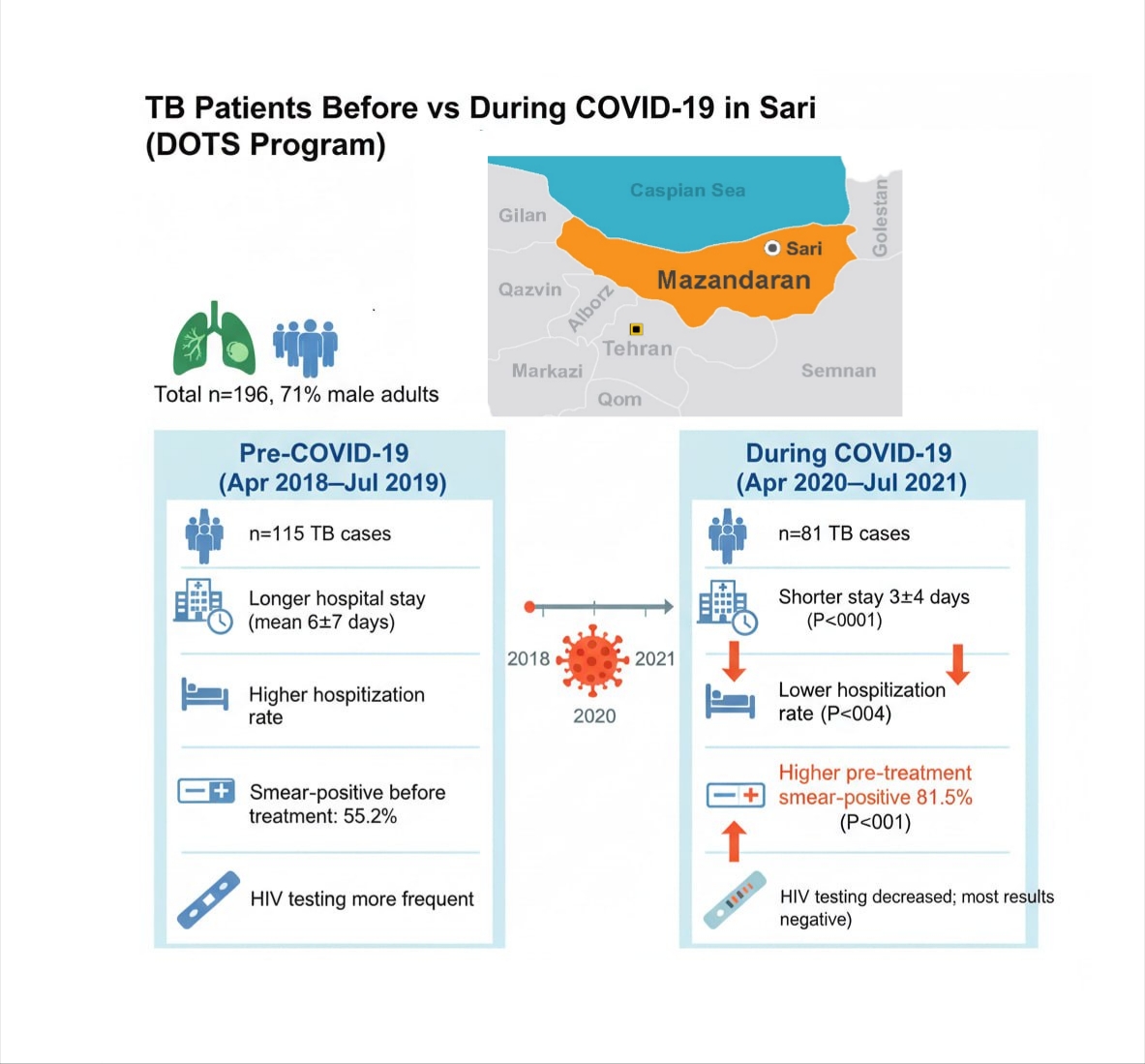
Results: A total of 196 TB patients were included, of whom 71% were male. The pre-pandemic group comprised 115 patients, while the post-pandemic group included 81 patients. No significant differences were observed in demographic characteristics between the two periods. The average hospital stay decreased significantly during the pandemic (P< 0.001). The proportion of positive smear results at diagnosis increased during the pandemic (P= 0.005). Other key variables, including the time interval between diagnosis and treatment initiation, remained unchanged. The rate of HIV co-infection was low. Treatment duration and final treatment outcomes did not differ significantly between the two groups.
Conclusion: The COVID-19 pandemic had a significant impact on certain clinical features and aspects of TB patient management, while essential diagnostic and treatment pathways remained largely maintained. Strengthening healthcare systems is crucial to ensure effective management of infectious diseases during future public health crises.
Materials and methods: This cross-sectional, analytical study included all TB patients aged 18 years and above in Sari from April 2018 to July 2019 (pre-pandemic) and from April 2020 to July 2021 (during the pandemic). Data were retrieved from health centers and anonymized following coding. Demographic variables, medical history, and diagnostic test results were systematically reviewed. TB diagnosis was based on standard smear microscopy and culture methods. Statistical analyses were performed using SPSS software, employing t-tests and chi-square tests.
Results: A total of 196 TB patients were included, of whom 71% were male. The pre-pandemic group comprised 115 patients, while the post-pandemic group included 81 patients. No significant differences were observed in demographic characteristics between the two periods. The average hospital stay decreased significantly during the pandemic (P< 0.001). The proportion of positive smear results at diagnosis increased during the pandemic (P= 0.005). Other key variables, including the time interval between diagnosis and treatment initiation, remained unchanged. The rate of HIV co-infection was low. Treatment duration and final treatment outcomes did not differ significantly between the two groups.
Conclusion: The COVID-19 pandemic had a significant impact on certain clinical features and aspects of TB patient management, while essential diagnostic and treatment pathways remained largely maintained. Strengthening healthcare systems is crucial to ensure effective management of infectious diseases during future public health crises.
Type of Study: Brief Report |
Subject:
infection
Send email to the article author
| Rights and permissions | |
 |
This work is licensed under a Creative Commons Attribution-NonCommercial 4.0 International License. |

Articles Copyright © The Author(s). Owned by Mazandaran University of Medical Sciences.
Contact Us
Address: Journal Office, Building No. 2, Mazandaran University of Medical Sciences, Moallem Square, Sari.Tel: +98 (011)34484874 Postal code: 48175-866 E-Mail: jmums@mazums.ac.ir Telefax: +98 (011)33262679
