

Volume 35, Issue 252 (12-2025)
J Mazandaran Univ Med Sci 2025, 35(252): 97-103 |
Back to browse issues page


Download citation:
BibTeX | RIS | EndNote | Medlars | ProCite | Reference Manager | RefWorks
Send citation to:


BibTeX | RIS | EndNote | Medlars | ProCite | Reference Manager | RefWorks
Send citation to:
Peivandi S, Zamaniyan M, Khademloo M, Arab R K, Sharifi J, Rahmani Z. Prevalence of Preeclampsia and Eclampsia and Associated Maternal and Neonatal Outcomes Among Pregnant Women at Sari Imam Khomeini Hospital (2021–2023). J Mazandaran Univ Med Sci 2025; 35 (252) :97-103
URL: http://jmums.mazums.ac.ir/article-1-21878-en.html
URL: http://jmums.mazums.ac.ir/article-1-21878-en.html
Saloumeh Peivandi 
 , Marzieh Zamaniyan , Mohammad Khademloo , Roghaye Khatoon Arab , Joobin Sharifi , Zahra Rahmani
, Marzieh Zamaniyan , Mohammad Khademloo , Roghaye Khatoon Arab , Joobin Sharifi , Zahra Rahmani
Abstract: (816 Views)
Background and purpose: Preeclampsia occurs in approximately 1–5% of all pregnancies and is responsible for significant maternal and perinatal complications, including maternal mortality. The prevalence of preeclampsia varies across countries. The aim of this study is to assess the prevalence of preeclampsia and eclampsia, as well as their maternal and neonatal outcomes, in pregnant women.
Materials and methods: This retrospective, cross-sectional, descriptive study reviewed the medical records of all pregnant women diagnosed with preeclampsia or eclampsia who were admitted to Imam Hospital. Statistical analyses were conducted using SPSS version 25. Because the data were not normally distributed, non-parametric tests were applied. Categorical variables were summarised as frequencies and percentages, while continuous variables were presented as medians with interquartile ranges, where appropriate.
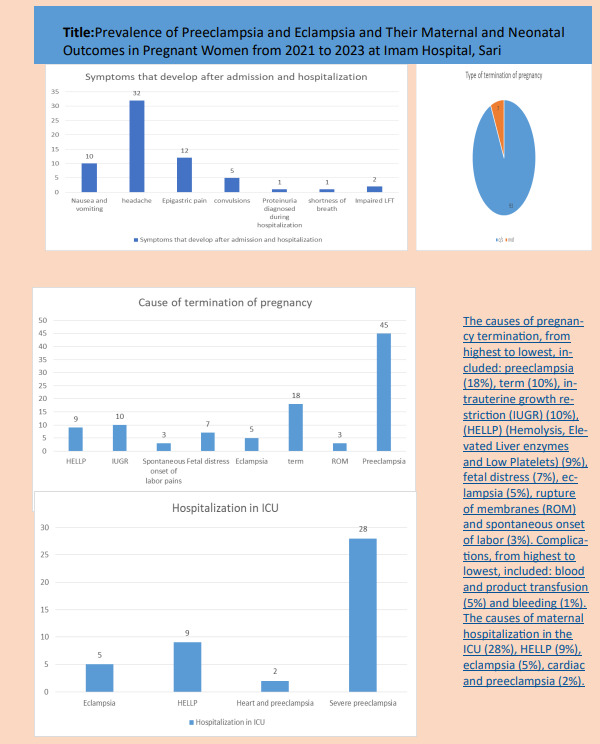
Results: Among the study population, the frequency of preeclampsia was 86% (n = 86), HELLP syndrome occurred in 9% (n = 9), and eclampsia in 5% (n = 5). The rate of ICU admission was 44%. The frequency of intrauterine growth restriction (IUGR) was 10%, and intrauterine fetal death (IUFD) occurred in 1% of cases. NICU admissions and fetal distress were observed in 38% of pregnancies. The mode of delivery was predominantly cesarean section (93%), with normal vaginal delivery in 7% of cases. Preterm delivery accounted for 68%, whereas term delivery occurred in 32% of pregnancies. Postpartum hemorrhage was reported in 1% of cases. A significant association was observed between maternal BMI and fetal IUGR.
Conclusion: The prevalence of preeclampsia, eclampsia, and HELLP syndrome in this study was higher than reported in studies conducted internationally, underscoring the need for enhanced awareness, education, and early detection of danger signs among Iranian mothers. Most participants were nulliparous women aged 30–40 years, reflecting a trend toward delayed childbearing. In severe cases, particularly severe preeclampsia and eclampsia, early delivery is often necessary to safeguard the health of both mother and fetus.
Materials and methods: This retrospective, cross-sectional, descriptive study reviewed the medical records of all pregnant women diagnosed with preeclampsia or eclampsia who were admitted to Imam Hospital. Statistical analyses were conducted using SPSS version 25. Because the data were not normally distributed, non-parametric tests were applied. Categorical variables were summarised as frequencies and percentages, while continuous variables were presented as medians with interquartile ranges, where appropriate.
Results: Among the study population, the frequency of preeclampsia was 86% (n = 86), HELLP syndrome occurred in 9% (n = 9), and eclampsia in 5% (n = 5). The rate of ICU admission was 44%. The frequency of intrauterine growth restriction (IUGR) was 10%, and intrauterine fetal death (IUFD) occurred in 1% of cases. NICU admissions and fetal distress were observed in 38% of pregnancies. The mode of delivery was predominantly cesarean section (93%), with normal vaginal delivery in 7% of cases. Preterm delivery accounted for 68%, whereas term delivery occurred in 32% of pregnancies. Postpartum hemorrhage was reported in 1% of cases. A significant association was observed between maternal BMI and fetal IUGR.
Conclusion: The prevalence of preeclampsia, eclampsia, and HELLP syndrome in this study was higher than reported in studies conducted internationally, underscoring the need for enhanced awareness, education, and early detection of danger signs among Iranian mothers. Most participants were nulliparous women aged 30–40 years, reflecting a trend toward delayed childbearing. In severe cases, particularly severe preeclampsia and eclampsia, early delivery is often necessary to safeguard the health of both mother and fetus.
Type of Study: Brief Report |
Subject:
Gynecology and Infertility
Send email to the article author
| Rights and permissions | |
 |
This work is licensed under a Creative Commons Attribution-NonCommercial 4.0 International License. |

Articles Copyright © The Author(s). Owned by Mazandaran University of Medical Sciences.
Contact Us
Address: Journal Office, Building No. 2, Mazandaran University of Medical Sciences, Moallem Square, Sari.Tel: +98 (011)34484874 Postal code: 48175-866 E-Mail: jmums@mazums.ac.ir Telefax: +98 (011)33262679
