

Volume 36, Issue 260 (9-2026)
J Mazandaran Univ Med Sci 2026, 36(260): 185-198 |
Back to browse issues page



Download citation:
BibTeX | RIS | EndNote | Medlars | ProCite | Reference Manager | RefWorks
Send citation to:


BibTeX | RIS | EndNote | Medlars | ProCite | Reference Manager | RefWorks
Send citation to:
valipoursorkhkolaee N, Arefinia F. Identification and Prioritisation of Barriers, Drivers, and Enablers of Artificial Intelligence Adoption in the Health System. J Mazandaran Univ Med Sci 2026; 36 (260) :185-198
URL: http://jmums.mazums.ac.ir/article-1-22060-en.html
URL: http://jmums.mazums.ac.ir/article-1-22060-en.html


Abstract: (29 Views)
Background and purpose: With the rapid expansion of artificial intelligence (AI) technologies, health systems worldwide have an unprecedented opportunity to improve the efficiency, effectiveness, and equity of service delivery. Accordingly, the adoption of AI has become a strategic necessity in digital health policymaking. This study sought to identify and rank the drivers, enablers, and barriers associated with the adoption of AI in the health system.
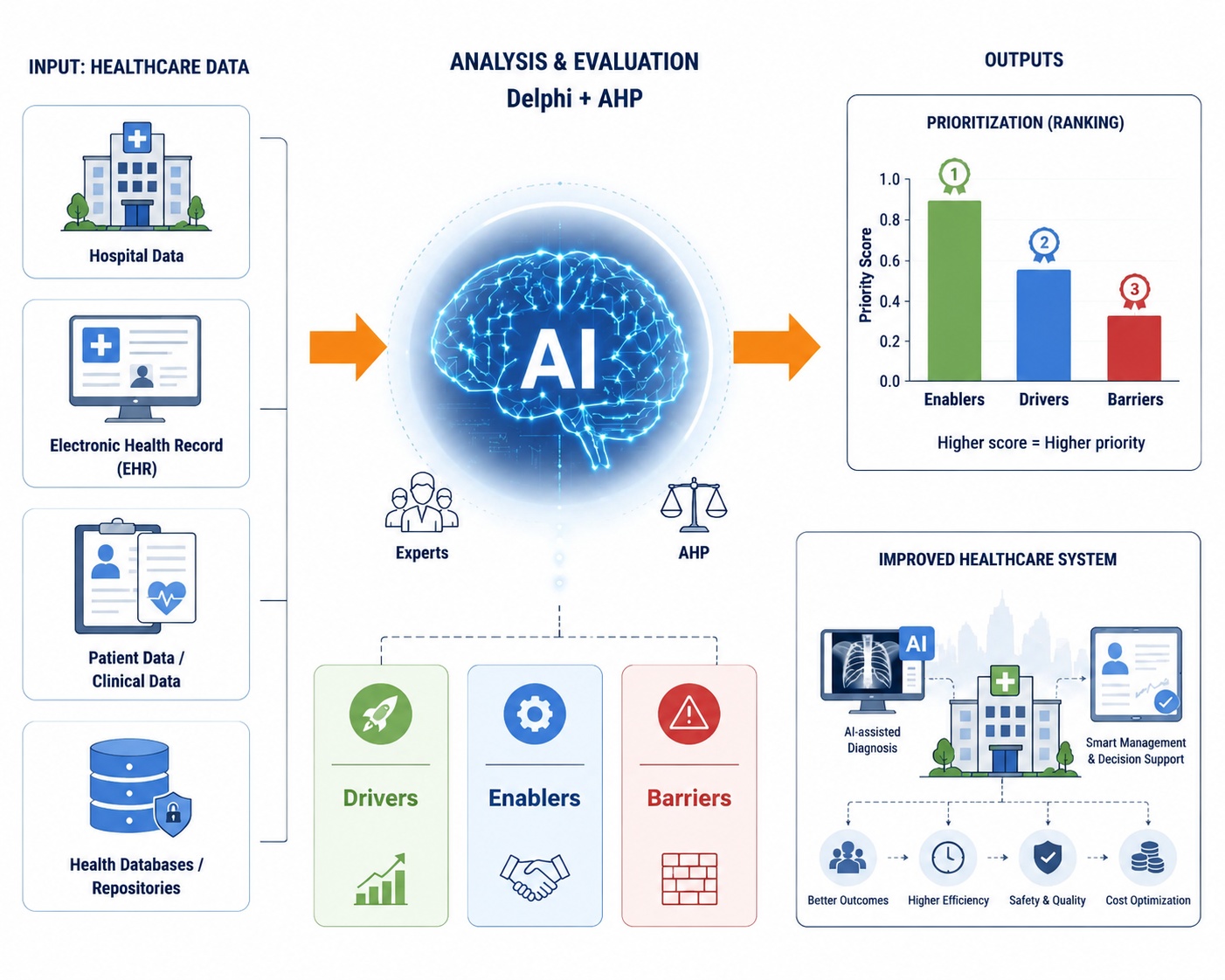
Materials and methods: This mixed-methods study was conducted in multiple phases. First, a structured literature review was undertaken to identify the initial set of drivers, enablers, and barriers relevant to AI adoption within the health system. These components were then validated, refined, and expanded through a Delphi process involving expert opinion. In the final stage, the identified components were prioritised using the group analytic hierarchy process (AHP). Using purposive sampling, 18 stakeholders participated in the qualitative phase, and 15 stakeholders were recruited for the quantitative phase. Data were collected and analysed using an expert evaluation checklist in SPSS and an AHP pairwise comparison questionnaire in Expert Choice software.
Results: The systematic review identified 23 initial components across three categories: drivers, enablers, and barriers to AI adoption in the health system. After four Delphi rounds, 34 final components, comprising 11 drivers, 11 enablers, and 12 barriers, were confirmed through a high level of expert consensus. The AHP results identified "the ability to integrate insurance and electronic health record data," "the presence of a strategic digital health plan," and "standardisation of data exchange" as the most important factors influencing AI adoption in the health system.
Conclusion: The findings suggested that "advancements in AI algorithms for medicine" and "the ability to integrate insurance and electronic health record data" were among the most important drivers and enablers of AI adoption within the local context and could inform future health system planning, policy development, and implementation strategies.
Materials and methods: This mixed-methods study was conducted in multiple phases. First, a structured literature review was undertaken to identify the initial set of drivers, enablers, and barriers relevant to AI adoption within the health system. These components were then validated, refined, and expanded through a Delphi process involving expert opinion. In the final stage, the identified components were prioritised using the group analytic hierarchy process (AHP). Using purposive sampling, 18 stakeholders participated in the qualitative phase, and 15 stakeholders were recruited for the quantitative phase. Data were collected and analysed using an expert evaluation checklist in SPSS and an AHP pairwise comparison questionnaire in Expert Choice software.
Results: The systematic review identified 23 initial components across three categories: drivers, enablers, and barriers to AI adoption in the health system. After four Delphi rounds, 34 final components, comprising 11 drivers, 11 enablers, and 12 barriers, were confirmed through a high level of expert consensus. The AHP results identified "the ability to integrate insurance and electronic health record data," "the presence of a strategic digital health plan," and "standardisation of data exchange" as the most important factors influencing AI adoption in the health system.
Conclusion: The findings suggested that "advancements in AI algorithms for medicine" and "the ability to integrate insurance and electronic health record data" were among the most important drivers and enablers of AI adoption within the local context and could inform future health system planning, policy development, and implementation strategies.
Type of Study: Research(Original) |
Subject:
Artificial Intelligence
| Rights and permissions | |
 |
This work is licensed under a Creative Commons Attribution-NonCommercial 4.0 International License. |

Articles Copyright © The Author(s). Owned by Mazandaran University of Medical Sciences.
Contact Us
Address: Journal Office, Building No. 2, Mazandaran University of Medical Sciences, Moallem Square, Sari.Tel: +98 (011)34484874 Postal code: 48175-866 E-Mail: jmums@mazums.ac.ir Telefax: +98 (011)33262679
