

Volume 35, Issue 252 (12-2025)
J Mazandaran Univ Med Sci 2025, 35(252): 45-58 |
Back to browse issues page


Download citation:
BibTeX | RIS | EndNote | Medlars | ProCite | Reference Manager | RefWorks
Send citation to:


BibTeX | RIS | EndNote | Medlars | ProCite | Reference Manager | RefWorks
Send citation to:
Sheikh M, Gholipour S, Mirhendi Z, Nikaeen M. Simultaneous Resistance of Bacteria to Antibiotics and Disinfectants: A Threat to Vulnerable Patients in Intensive Care Units. J Mazandaran Univ Med Sci 2025; 35 (252) :45-58
URL: http://jmums.mazums.ac.ir/article-1-22401-en.html
URL: http://jmums.mazums.ac.ir/article-1-22401-en.html


Abstract: (903 Views)
Background and purpose: Hospital surfaces can serve as reservoirs for pathogenic microorganisms; therefore, disinfectants play a pivotal role in reducing the microbial load and controlling healthcare-associated infections in healthcare environments. However, the emergence of simultaneous resistance to antibiotics and disinfectants has posed a major challenge to infection control efforts in hospital settings. Considering the importance of environmental monitoring of resistant bacteria within the One Health framework, this study aimed to investigate the presence of antibiotic-resistant bacteria and their patterns of concurrent resistance to antibiotics and disinfectants on surfaces in intensive care units (ICUs).
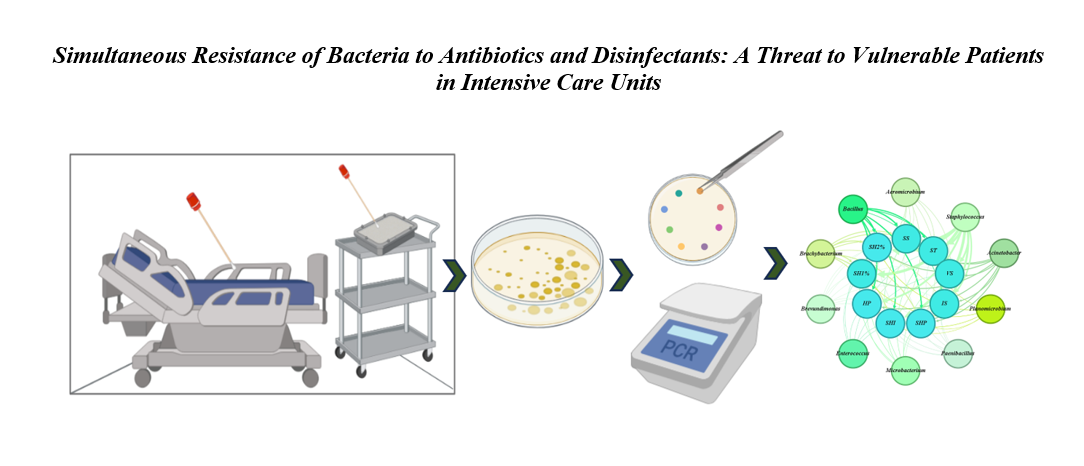
Materials and methods: Thirty surface samples were collected from the ICUs of six hospitals in Isfahan. The samples were tested for the presence of bacteria resistant to ampicillin, ceftazidime, meropenem, tetracycline, gentamicin, and vancomycin. The susceptibility or resistance of antibiotic-resistant isolates to nine commonly used hospital disinfectants was then assessed using the disk diffusion method. To evaluate the potential risk posed by concurrently resistant bacteria to vulnerable patients, isolates were identified using species-specific primers or 16S rRNA gene sequencing.
Results: In this study, among the 30 surface samples collected, a high proportion (67%) contained antibiotic-resistant bacteria, particularly those resistant to β-lactam antibiotics. From the 30 samples, a total of 101 antibiotic-resistant bacterial colonies were isolated, with the highest resistance observed to β-lactam antibiotics, including ampicillin and ceftazidime. Notably, resistance to at least one disinfectant was demonstrated by 97% of the antibiotic-resistant isolates, and a significant proportion of these isolates (95%) were resistant to three or more disinfectants. Staphylococcus and Bacillus were detected as the predominant genera exhibiting simultaneous resistance.
Conclusion: The results of this study indicate a considerable prevalence of simultaneous bacterial resistance to antibiotics and disinfectants in hospital settings. These findings highlight the need to revise and strengthen infection control protocols, including the continuous monitoring of disinfectant efficacy and the rational use of antibiotics.
Materials and methods: Thirty surface samples were collected from the ICUs of six hospitals in Isfahan. The samples were tested for the presence of bacteria resistant to ampicillin, ceftazidime, meropenem, tetracycline, gentamicin, and vancomycin. The susceptibility or resistance of antibiotic-resistant isolates to nine commonly used hospital disinfectants was then assessed using the disk diffusion method. To evaluate the potential risk posed by concurrently resistant bacteria to vulnerable patients, isolates were identified using species-specific primers or 16S rRNA gene sequencing.
Results: In this study, among the 30 surface samples collected, a high proportion (67%) contained antibiotic-resistant bacteria, particularly those resistant to β-lactam antibiotics. From the 30 samples, a total of 101 antibiotic-resistant bacterial colonies were isolated, with the highest resistance observed to β-lactam antibiotics, including ampicillin and ceftazidime. Notably, resistance to at least one disinfectant was demonstrated by 97% of the antibiotic-resistant isolates, and a significant proportion of these isolates (95%) were resistant to three or more disinfectants. Staphylococcus and Bacillus were detected as the predominant genera exhibiting simultaneous resistance.
Conclusion: The results of this study indicate a considerable prevalence of simultaneous bacterial resistance to antibiotics and disinfectants in hospital settings. These findings highlight the need to revise and strengthen infection control protocols, including the continuous monitoring of disinfectant efficacy and the rational use of antibiotics.
Type of Study: Research(Original) |
Subject:
health
Send email to the article author
| Rights and permissions | |
 |
This work is licensed under a Creative Commons Attribution-NonCommercial 4.0 International License. |

Articles Copyright © The Author(s). Owned by Mazandaran University of Medical Sciences.
Contact Us
Address: Journal Office, Building No. 2, Mazandaran University of Medical Sciences, Moallem Square, Sari.Tel: +98 (011)34484874 Postal code: 48175-866 E-Mail: jmums@mazums.ac.ir Telefax: +98 (011)33262679
