

Volume 36, Issue 257 (5-2026)
J Mazandaran Univ Med Sci 2026, 36(257): 133-140 |
Back to browse issues page



Download citation:
BibTeX | RIS | EndNote | Medlars | ProCite | Reference Manager | RefWorks
Send citation to:


BibTeX | RIS | EndNote | Medlars | ProCite | Reference Manager | RefWorks
Send citation to:
Houshmand G, Pahamli D, Mahmoudi M, Kargar-Soleimanabad S, Ghorbanzadeh B. Evaluating the Effects of Oleuropein on Perphenazine-Induced Pseudoparkinsonism. J Mazandaran Univ Med Sci 2026; 36 (257) :133-140
URL: http://jmums.mazums.ac.ir/article-1-22461-en.html
URL: http://jmums.mazums.ac.ir/article-1-22461-en.html
Gholamreza Houshmand * 
 , Danial Pahamli , Mitra Mahmoudi , Saeed Kargar-Soleimanabad , Behnam Ghorbanzadeh
, Danial Pahamli , Mitra Mahmoudi , Saeed Kargar-Soleimanabad , Behnam Ghorbanzadeh
Abstract: (224 Views)
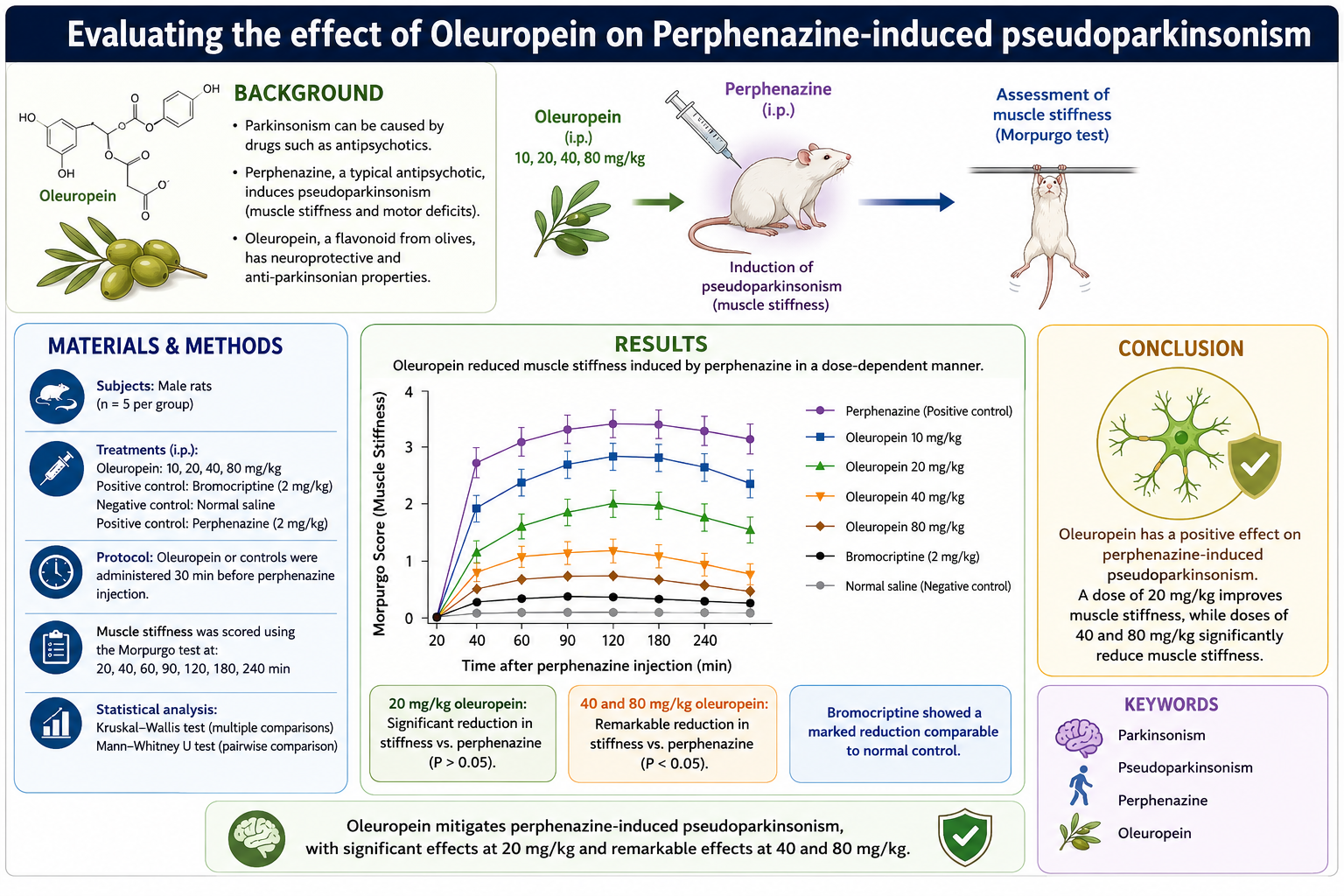
Background and purpose: Parkinson's disease is recognised as the second most common neurodegenerative disorder after Alzheimer's disease. Parkinsonism is most commonly caused by idiopathic Parkinson's disease, while drug-induced parkinsonism represents the second most common cause of this condition. Flavonoids are naturally occurring polyphenolic compounds found in many plants. Oleuropein, a flavonoid present in olives and olive-derived products, has been shown to exert a range of neuroprotective effects. This study aimed to investigate the effects of oleuropein on perphenazine-induced pseudoparkinsonism in rats.
Materials and methods: Rats were divided into six groups of five animals each. Oleuropein was administered intraperitoneally at doses of 10, 20, 40, and 80 mg/kg. The rats received perphenazine 30 minutes after the administration of different doses of oleuropein, normal saline, or bromocriptine. The rats were assessed using the Morpurgo test to evaluate muscle stiffness at 20, 40, 60, 90, 120, 180, and 240 minutes after perphenazine injection. A Kruskal-Wallis test was performed to examine differences among the groups, and the Mann-Whitney U test was used to compare differences between two independent groups.
Results: The reduction in muscle stiffness in the group receiving oleuropein at a dose of 20 mg/kg was significant compared with the positive control group (P < 0.05). Reductions in muscle stiffness observed following oleuropein administration at doses of 40 and 80 mg/kg were also significant compared with the positive control group.
Conclusion: Oleuropein exerted a positive effect on perphenazine-induced pseudoparkinsonism at a dose of 20 mg/kg, while administration at doses of 40 and 80 mg/kg resulted in a significant reduction in muscle stiffness.
Materials and methods: Rats were divided into six groups of five animals each. Oleuropein was administered intraperitoneally at doses of 10, 20, 40, and 80 mg/kg. The rats received perphenazine 30 minutes after the administration of different doses of oleuropein, normal saline, or bromocriptine. The rats were assessed using the Morpurgo test to evaluate muscle stiffness at 20, 40, 60, 90, 120, 180, and 240 minutes after perphenazine injection. A Kruskal-Wallis test was performed to examine differences among the groups, and the Mann-Whitney U test was used to compare differences between two independent groups.
Results: The reduction in muscle stiffness in the group receiving oleuropein at a dose of 20 mg/kg was significant compared with the positive control group (P < 0.05). Reductions in muscle stiffness observed following oleuropein administration at doses of 40 and 80 mg/kg were also significant compared with the positive control group.
Conclusion: Oleuropein exerted a positive effect on perphenazine-induced pseudoparkinsonism at a dose of 20 mg/kg, while administration at doses of 40 and 80 mg/kg resulted in a significant reduction in muscle stiffness.
Type of Study: Brief Report |
Subject:
pharmacology
Send email to the article author
| Rights and permissions | |
 |
This work is licensed under a Creative Commons Attribution-NonCommercial 4.0 International License. |

Articles Copyright © The Author(s). Owned by Mazandaran University of Medical Sciences.
Contact Us
Address: Journal Office, Building No. 2, Mazandaran University of Medical Sciences, Moallem Square, Sari.Tel: +98 (011)34484874 Postal code: 48175-866 E-Mail: jmums@mazums.ac.ir Telefax: +98 (011)33262679
