

Volume 36, Issue 257 (5-2026)
J Mazandaran Univ Med Sci 2026, 36(257): 120-132 |
Back to browse issues page



Download citation:
BibTeX | RIS | EndNote | Medlars | ProCite | Reference Manager | RefWorks
Send citation to:


BibTeX | RIS | EndNote | Medlars | ProCite | Reference Manager | RefWorks
Send citation to:
Hadinejad Z, Gohardehi F, Rostami M, Talebi H, Ashkpour Z, Hashemi Amrei M, et al . Timeliness of Stroke Code Activation in Pre-Hospital and Hospital Settings at Mazandaran University of Medical Sciences in 2024: A Descriptive-Analytical Cross-Sectional Study. J Mazandaran Univ Med Sci 2026; 36 (257) :120-132
URL: http://jmums.mazums.ac.ir/article-1-22569-en.html
URL: http://jmums.mazums.ac.ir/article-1-22569-en.html
Zoya Hadinejad 
 , Farzad Gohardehi , Mehdi Rostami , Hassan Talebi , Zakaria Ashkpour , Masomeh Hashemi Amrei , Kobra Gholami , Afsaneh Fenderski , Leila Meskini *
, Farzad Gohardehi , Mehdi Rostami , Hassan Talebi , Zakaria Ashkpour , Masomeh Hashemi Amrei , Kobra Gholami , Afsaneh Fenderski , Leila Meskini *
Abstract: (209 Views)
Background and purpose: Stroke, after ischaemic heart disease, is the fourth leading cause of death in Iran as of 2021. The present study was conducted to evaluate the timeliness of pre-hospital emergency services and medical centers of Mazandaran University of Medical Sciences in activating the Stroke Code in 2024 (1403 in the Iranian calendar).
Materials and methods: In this descriptive-analytical cross-sectional study, demographic information and stroke-related clinical characteristics of all patients hospitalized in medical centers affiliated with Mazandaran University of Medical Sciences in 2024 were reviewed using the Ministry of Health and Medical Education checklist available through the provincial Medical Care Monitoring Center (MCMC) database. The extracted data were analyzed using SPSS statistical software and descriptive statistical methods.
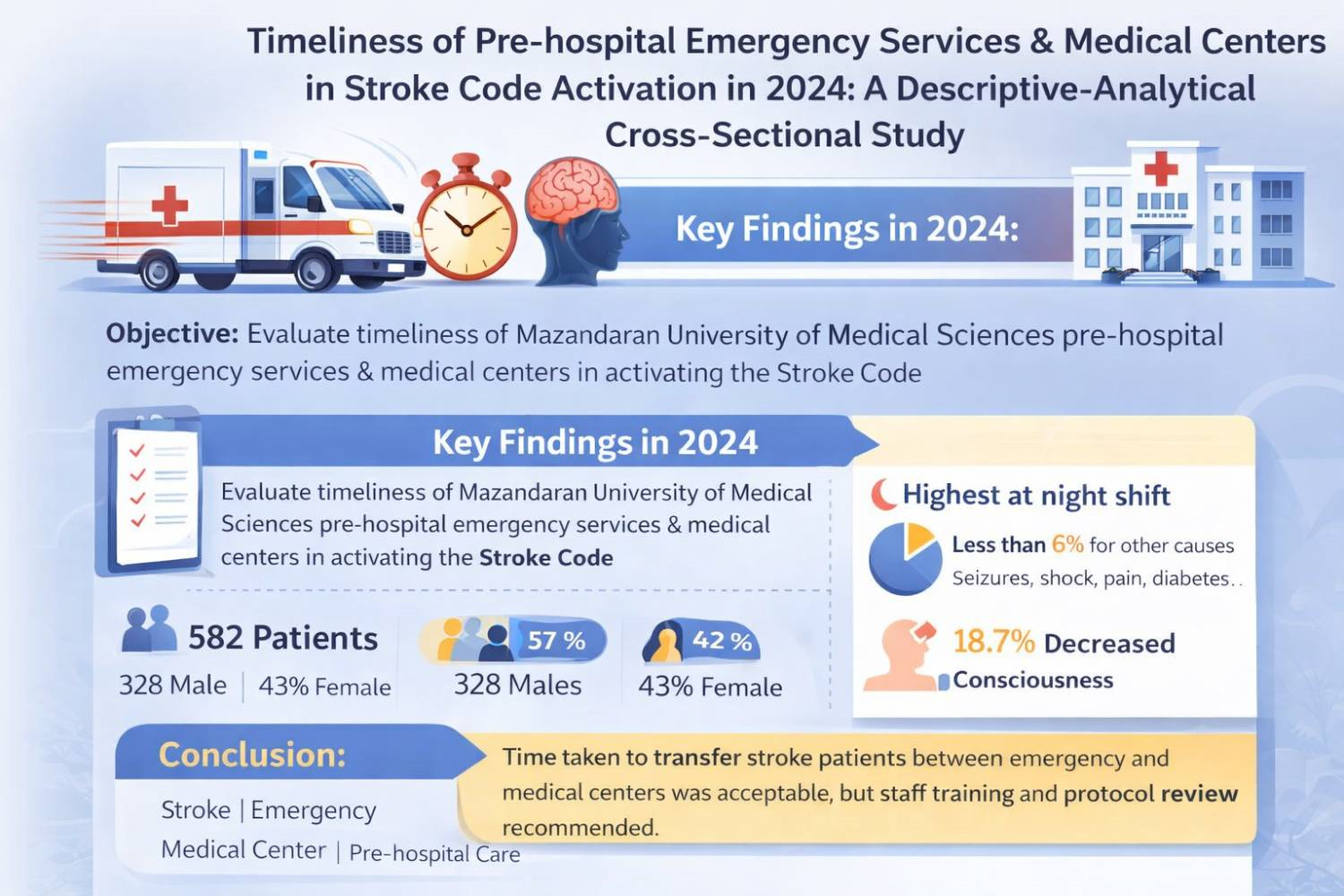
Results: A total of 582 patients were included, of whom 328 (57%) were male and the remainder were female. More than half of the cases were suspected stroke, and 18.7% were due to reduced level of consciousness. Less than 6% of calls were attributed to other causes, including seizures, electric shock, headache, back pain, abdominal pain, psychological distress, diabetes, and other conditions. In the first six months of the year, the frequencies of stroke, transient ischaemic attack (TIA), and suspected stroke were significantly higher. In addition, the highest proportion of inter-hospital transfers occurred during the night shift (42%).
Conclusion: The findings of this study indicate that pre-hospital and inter-facility transfer times for patients with stroke were generally acceptable. However, it is recommended that current protocols be reviewed and healthcare staff be trained further to optimise these time intervals.
Materials and methods: In this descriptive-analytical cross-sectional study, demographic information and stroke-related clinical characteristics of all patients hospitalized in medical centers affiliated with Mazandaran University of Medical Sciences in 2024 were reviewed using the Ministry of Health and Medical Education checklist available through the provincial Medical Care Monitoring Center (MCMC) database. The extracted data were analyzed using SPSS statistical software and descriptive statistical methods.
Results: A total of 582 patients were included, of whom 328 (57%) were male and the remainder were female. More than half of the cases were suspected stroke, and 18.7% were due to reduced level of consciousness. Less than 6% of calls were attributed to other causes, including seizures, electric shock, headache, back pain, abdominal pain, psychological distress, diabetes, and other conditions. In the first six months of the year, the frequencies of stroke, transient ischaemic attack (TIA), and suspected stroke were significantly higher. In addition, the highest proportion of inter-hospital transfers occurred during the night shift (42%).
Conclusion: The findings of this study indicate that pre-hospital and inter-facility transfer times for patients with stroke were generally acceptable. However, it is recommended that current protocols be reviewed and healthcare staff be trained further to optimise these time intervals.
Type of Study: Research(Original) |
Subject:
Neurology
Send email to the article author
| Rights and permissions | |
 |
This work is licensed under a Creative Commons Attribution-NonCommercial 4.0 International License. |

Articles Copyright © The Author(s). Owned by Mazandaran University of Medical Sciences.
Contact Us
Address: Journal Office, Building No. 2, Mazandaran University of Medical Sciences, Moallem Square, Sari.Tel: +98 (011)34484874 Postal code: 48175-866 E-Mail: jmums@mazums.ac.ir Telefax: +98 (011)33262679
