

Volume 36, Issue 257 (5-2026)
J Mazandaran Univ Med Sci 2026, 36(257): 110-119 |
Back to browse issues page



Download citation:
BibTeX | RIS | EndNote | Medlars | ProCite | Reference Manager | RefWorks
Send citation to:


BibTeX | RIS | EndNote | Medlars | ProCite | Reference Manager | RefWorks
Send citation to:
Moslemi F, Doroudian M, Karimi M, Ebrahimi Ranjbar M, Mahrooz A, Khonakdar-Tarsi A et al . Comparison of Nail Molybdenum and Plasma Malondialdehyde Levels Between Patients with Esophageal Cancer from the High-Risk Region of Gonbad-e Kavus and Healthy Individuals from the Low-Risk Region of Sari. J Mazandaran Univ Med Sci 2026; 36 (257) :110-119
URL: http://jmums.mazums.ac.ir/article-1-22738-en.html
URL: http://jmums.mazums.ac.ir/article-1-22738-en.html
Fateme Moslemi 
 , Mohammad Doroudian , Masoumeh Karimi , Mohammad Ebrahimi Ranjbar , Abdolkarim Mahrooz , Abbas Khonakdar-Tarsi , Hadis Musavi
, Mohammad Doroudian , Masoumeh Karimi , Mohammad Ebrahimi Ranjbar , Abdolkarim Mahrooz , Abbas Khonakdar-Tarsi , Hadis Musavi
Abstract: (261 Views)
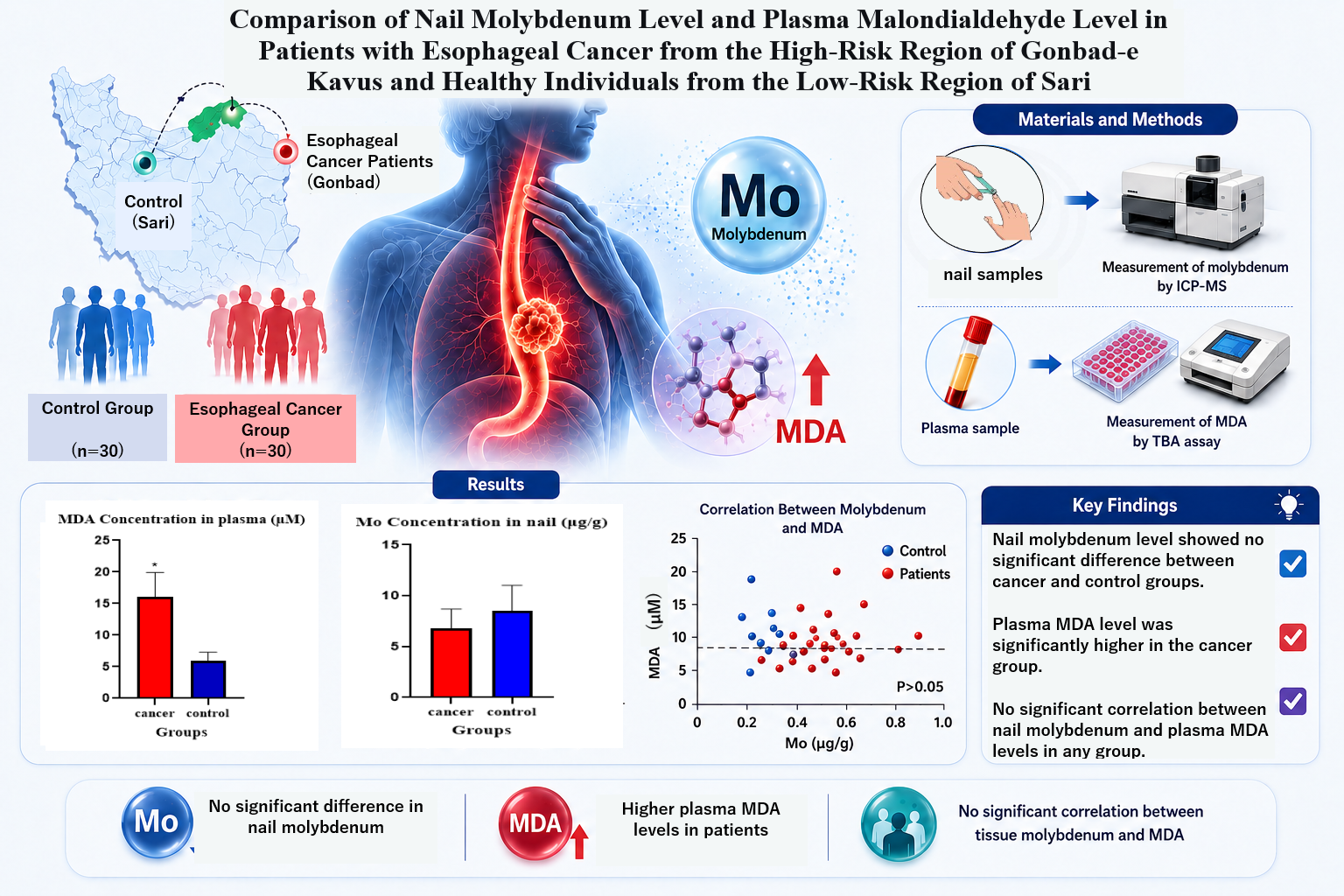
Background and purpose: Esophageal cancer is a prevalent malignancy with a high mortality rate in Iran. Golestan Province, particularly Gonbad-e Kavus, is considered one of the major geographic hotspots for this disease. Molybdenum, an essential trace element involved in the activity of several enzymes, and malondialdehyde (MDA), a biomarker of oxidative stress, may play important roles in cancer-related biological mechanisms. This study aimed to investigate the relationship between nail molybdenum levels and oxidative stress, as measured by malondialdehyde levels, in patients with esophageal cancer compared with healthy individuals.
Materials and methods: This case-control study was conducted among 30 patients with esophageal cancer from Gonbad-e Kavus and 30 healthy individuals from Sari, Iran. The molybdenum content of fingernail and toenail samples was measured using inductively coupled plasma mass spectrometry (ICP-MS). Additionally, plasma malondialdehyde levels were assessed using a spectrophotometric method based on the reaction between malondialdehyde and thiobarbituric acid. Statistical analyses were performed using GraphPad Prism software.
Results: The mean concentration of molybdenum in the nail samples of cancer patients was lower than that of the control group; however, this difference was not statistically significant (P> 0.05). In contrast, malondialdehyde levels in the patient group were significantly higher than those in the control group (P< 0.05). Correlation analysis revealed no significant association between these two parameters in either the healthy or patient groups (P> 0.05).
Conclusion: This study found no evidence of significantly reduced nail molybdenum concentrations in patients with esophageal cancer compared with healthy individuals. However, the elevated MDA levels observed among patients support the hypothesis that oxidative stress may contribute to the pathogenesis of esophageal cancer. Future studies with larger sample sizes, preferably using prospective cohort designs and incorporating assessments of additional trace elements and their interactions, are recommended.
Materials and methods: This case-control study was conducted among 30 patients with esophageal cancer from Gonbad-e Kavus and 30 healthy individuals from Sari, Iran. The molybdenum content of fingernail and toenail samples was measured using inductively coupled plasma mass spectrometry (ICP-MS). Additionally, plasma malondialdehyde levels were assessed using a spectrophotometric method based on the reaction between malondialdehyde and thiobarbituric acid. Statistical analyses were performed using GraphPad Prism software.
Results: The mean concentration of molybdenum in the nail samples of cancer patients was lower than that of the control group; however, this difference was not statistically significant (P> 0.05). In contrast, malondialdehyde levels in the patient group were significantly higher than those in the control group (P< 0.05). Correlation analysis revealed no significant association between these two parameters in either the healthy or patient groups (P> 0.05).
Conclusion: This study found no evidence of significantly reduced nail molybdenum concentrations in patients with esophageal cancer compared with healthy individuals. However, the elevated MDA levels observed among patients support the hypothesis that oxidative stress may contribute to the pathogenesis of esophageal cancer. Future studies with larger sample sizes, preferably using prospective cohort designs and incorporating assessments of additional trace elements and their interactions, are recommended.
Type of Study: Research(Original) |
Subject:
Sports biomechanics
Send email to the article author
| Rights and permissions | |
 |
This work is licensed under a Creative Commons Attribution-NonCommercial 4.0 International License. |

Articles Copyright © The Author(s). Owned by Mazandaran University of Medical Sciences.
Contact Us
Address: Journal Office, Building No. 2, Mazandaran University of Medical Sciences, Moallem Square, Sari.Tel: +98 (011)34484874 Postal code: 48175-866 E-Mail: jmums@mazums.ac.ir Telefax: +98 (011)33262679
