

Volume 36, Issue 258 (7-2026)
J Mazandaran Univ Med Sci 2026, 36(258): 14-25 |
Back to browse issues page



Download citation:
BibTeX | RIS | EndNote | Medlars | ProCite | Reference Manager | RefWorks
Send citation to:


BibTeX | RIS | EndNote | Medlars | ProCite | Reference Manager | RefWorks
Send citation to:
Marzban S, Moudi E, Ranaei M, Gholinia Ahangar H, Kamrani G. Renal Cell Carcinoma Subtypes and Outcomes Following Radical and Partial Nephrectomy: A Retrospective Cohort Study in Teaching Hospitals in Babol, 2011-2021. J Mazandaran Univ Med Sci 2026; 36 (258) :14-25
URL: http://jmums.mazums.ac.ir/article-1-21864-en.html
URL: http://jmums.mazums.ac.ir/article-1-21864-en.html


Abstract: (16 Views)
Background and purpose: Renal cell carcinoma (RCC) is one of the most common forms of kidney cancer and presents significant challenges in diagnosis and treatment due to its unique biological and tumour characteristics. Selecting the appropriate surgical approach, whether radical or partial nephrectomy, is crucial for improving patient prognosis and quality of life. This study aimed to investigate the frequency of different RCC subtypes in Babol and to evaluate survival and tumour recurrence among patients who underwent radical or partial nephrectomy.
Materials and methods: This historical cohort study included 75 patients. Data on age, sex, type of nephrectomy, RCC subtype, TNM stage, and pathological grade were obtained from pathology records and follow-up telephone interviews with patients. Patients were divided into partial nephrectomy and radical nephrectomy groups, and overall survival and tumour recurrence were compared between the two groups.
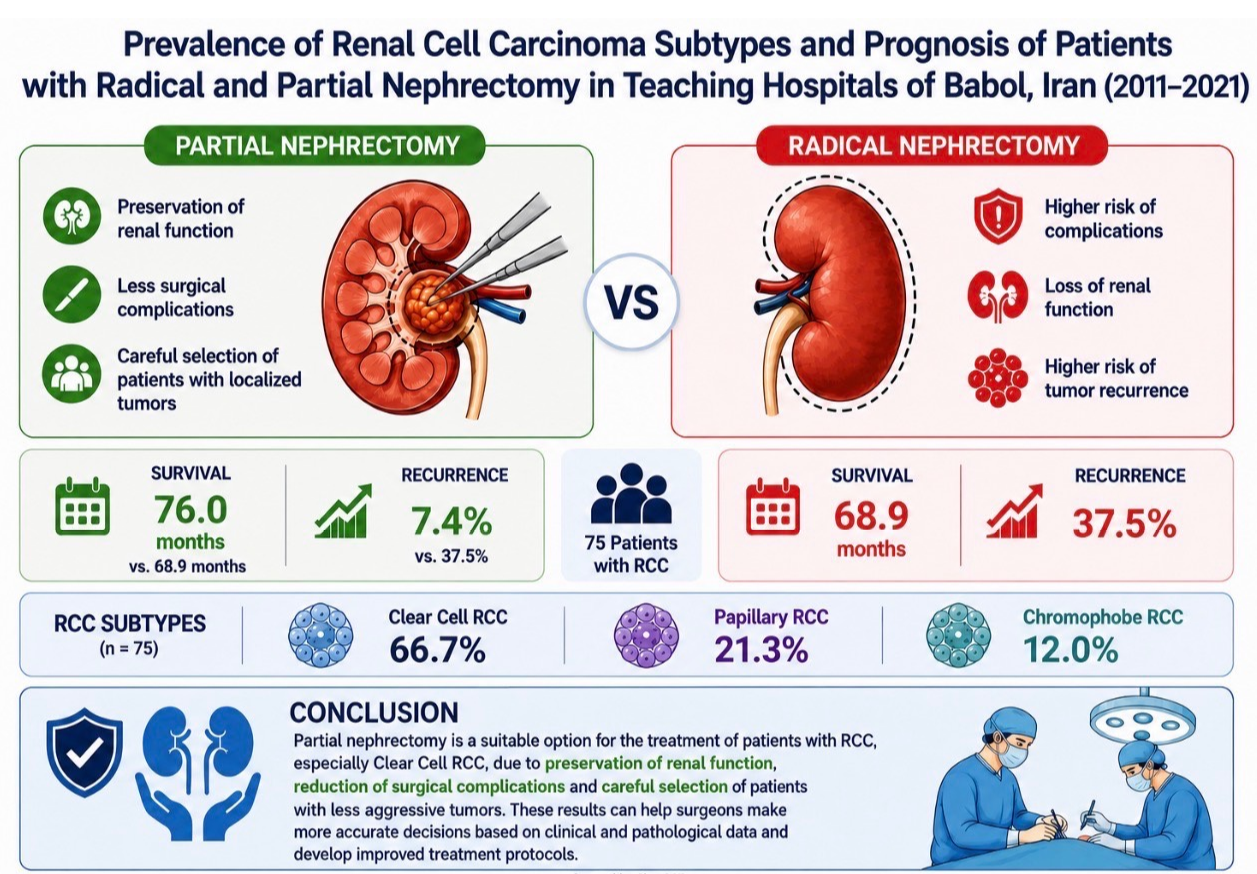
Results: The mean age of the patients was 59.53 years, and 68% were male. The most common RCC subtype was clear cell RCC (66.7%). Twenty-seven patients (36%) underwent partial nephrectomy. During follow-up, 20 patients (26.7%) died. The mean survival time was 76.0 months in the partial nephrectomy group and 68.9 months in the radical nephrectomy group. Tumour recurrence occurred in 20 patients, with recurrence rates of 7% in the partial nephrectomy group and 37.5% in the radical nephrectomy group.
Conclusion: Partial nephrectomy may represent an appropriate treatment option for patients with RCC, particularly those with clear cell RCC, because it preserves renal function, reduces surgical morbidity, and can achieve favourable oncological outcomes when patients with less aggressive tumours are appropriately selected.
Materials and methods: This historical cohort study included 75 patients. Data on age, sex, type of nephrectomy, RCC subtype, TNM stage, and pathological grade were obtained from pathology records and follow-up telephone interviews with patients. Patients were divided into partial nephrectomy and radical nephrectomy groups, and overall survival and tumour recurrence were compared between the two groups.
Results: The mean age of the patients was 59.53 years, and 68% were male. The most common RCC subtype was clear cell RCC (66.7%). Twenty-seven patients (36%) underwent partial nephrectomy. During follow-up, 20 patients (26.7%) died. The mean survival time was 76.0 months in the partial nephrectomy group and 68.9 months in the radical nephrectomy group. Tumour recurrence occurred in 20 patients, with recurrence rates of 7% in the partial nephrectomy group and 37.5% in the radical nephrectomy group.
Conclusion: Partial nephrectomy may represent an appropriate treatment option for patients with RCC, particularly those with clear cell RCC, because it preserves renal function, reduces surgical morbidity, and can achieve favourable oncological outcomes when patients with less aggressive tumours are appropriately selected.
Type of Study: Research(Original) |
Subject:
Hematology and Oncology
Send email to the article author
| Rights and permissions | |
 |
This work is licensed under a Creative Commons Attribution-NonCommercial 4.0 International License. |

Articles Copyright © The Author(s). Owned by Mazandaran University of Medical Sciences.
Contact Us
Address: Journal Office, Building No. 2, Mazandaran University of Medical Sciences, Moallem Square, Sari.Tel: +98 (011)34484874 Postal code: 48175-866 E-Mail: jmums@mazums.ac.ir Telefax: +98 (011)33262679
