

Volume 36, Issue 263 (11-2026)
J Mazandaran Univ Med Sci 2026, 36(263): 146-159 |
Back to browse issues page



Download citation:
BibTeX | RIS | EndNote | Medlars | ProCite | Reference Manager | RefWorks
Send citation to:


BibTeX | RIS | EndNote | Medlars | ProCite | Reference Manager | RefWorks
Send citation to:
Eslami C, Rabiei I, Ahmadian N, Goli H R, Ebrahimzadeh M A. Eco-Friendly Synthesis of Silver Nanoparticles Using Monstera deliciosa Fruit Extract: A Potential Approach to Addressing Antimicrobial Resistance. , J Mazandaran Univ Med Sci. 2026; 36 (263) :146-159
URL: http://jmums.mazums.ac.ir/article-1-22074-en.html
URL: http://jmums.mazums.ac.ir/article-1-22074-en.html


Abstract: (27 Views)
Background and purpose: Green synthesis of metal nanoparticles using plant extracts is increasingly being explored as a relatively safe and cost-effective alternative to conventional chemical synthesis, potentially reducing the use of toxic organic solvents and chemical reagents. Plant extracts contain bioactive compounds capable of reducing metal cations. In this study, silver nanoparticles (AgNPs) were synthesized using Monstera deliciosa fruit extract, and their antimicrobial activity was evaluated against a range of bacterial strains.
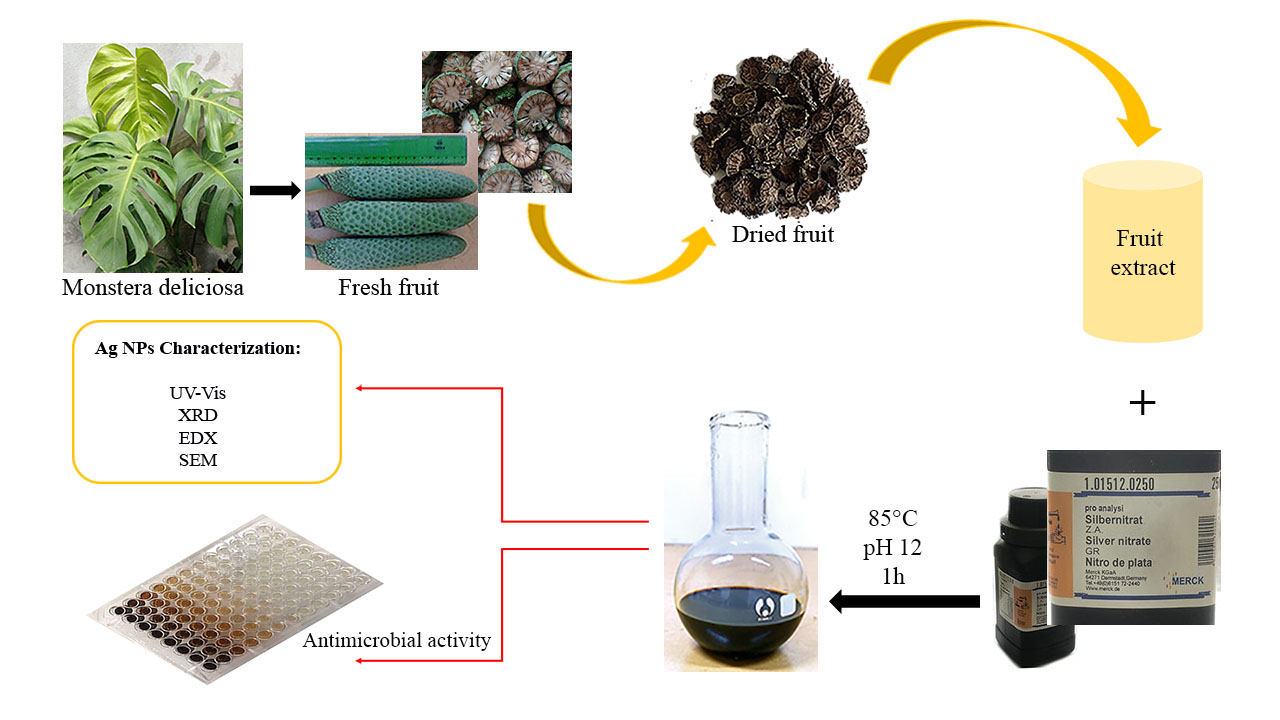
Materials and methods: A hydroalcoholic extract of M. deliciosa fruit was used for the green synthesis of AgNPs. To obtain nanoparticles with a uniform morphology and small particle size, the effects of temperature, pH, initial silver ion concentration and reaction time were investigated and optimized. The formation of AgNPs was initially indicated by a colour change and subsequently confirmed using ultraviolet-visible (UV-Vis) absorption spectroscopy and X-ray diffraction (XRD). Energy-dispersive X-ray spectroscopy (EDX) was used for elemental analysis, while scanning electron microscopy (SEM) was employed to examine nanoparticle morphology. The antibacterial activity of the synthesized nanoparticles was evaluated against Staphylococcus aureus, Enterococcus faecalis, Pseudomonas aeruginosa, Acinetobacter baumannii, Klebsiella pneumoniae, Escherichia coli, Enterobacter aerogenes and Proteus mirabilis. The minimum inhibitory concentration (MIC) and minimum bactericidal concentration (MBC) were determined.
Results: UV-Vis absorption spectroscopy revealed a characteristic absorption peak at 420 nm, indicating the formation of AgNPs. SEM images showed that the synthesized nanoparticles were predominantly spherical, with a mean particle size of 48 ± 8 nm. The AgNPs also exhibited strong antibacterial activity against the bacterial strains tested.
Conclusion: The findings indicate that M. deliciosa fruit extract can be used for the green synthesis of silver nanoparticles. The synthesized nanoparticles also exhibited strong antibacterial activity, particularly against Enterococcus faecalis and Escherichia coli.
Keywords: green synthesis, silver nanoparticles, Monstera deliciosa, antibacterial activity, minimum inhibitory concentration
Type of Study: Research(Original) |
Subject:
Medicinal Chemistry
| Rights and permissions | |
 |
This work is licensed under a Creative Commons Attribution-NonCommercial 4.0 International License. |

Articles Copyright © The Author(s). Owned by Mazandaran University of Medical Sciences.
Contact Us
Address: Journal Office, Building No. 2, Mazandaran University of Medical Sciences, Moallem Square, Sari.Tel: +98 (011)34484874 Postal code: 48175-866 E-Mail: jmums@mazums.ac.ir Telefax: +98 (011)33262679
