

Volume 36, Issue 264 (11-2026)
J Mazandaran Univ Med Sci 2026, 36(264): 91-100 |
Back to browse issues page



Download citation:
BibTeX | RIS | EndNote | Medlars | ProCite | Reference Manager | RefWorks
Send citation to:


BibTeX | RIS | EndNote | Medlars | ProCite | Reference Manager | RefWorks
Send citation to:
Saadati Rad M T, Jorbonyan A, Moosazadeh M, Mokhtary F, Ghaemi A, Soltani S. Comparison of Dietary Energy and Nutrient Intakes Between Older Women and Men in Sari, Iran: Findings from the Baseline Phase of the Tabari Cohort Study. , J Mazandaran Univ Med Sci. 2026; 36 (264) :91-100
URL: http://jmums.mazums.ac.ir/article-1-22286-en.html
URL: http://jmums.mazums.ac.ir/article-1-22286-en.html
Mohammad Taha Saadati Rad 
 , Abdolhakim Jorbonyan , Mahmood Moosazadeh , Farzaneh Mokhtary , Alireza Ghaemi * , Sanaz Soltani
Abstract: (29 Views)
Abstract
Background and purpose: Adequate nutrition is essential for maintaining health in older adults. This study compared dietary energy, macronutrient, vitamin, and mineral intakes between older women and men participating in the Tabari Cohort Study.
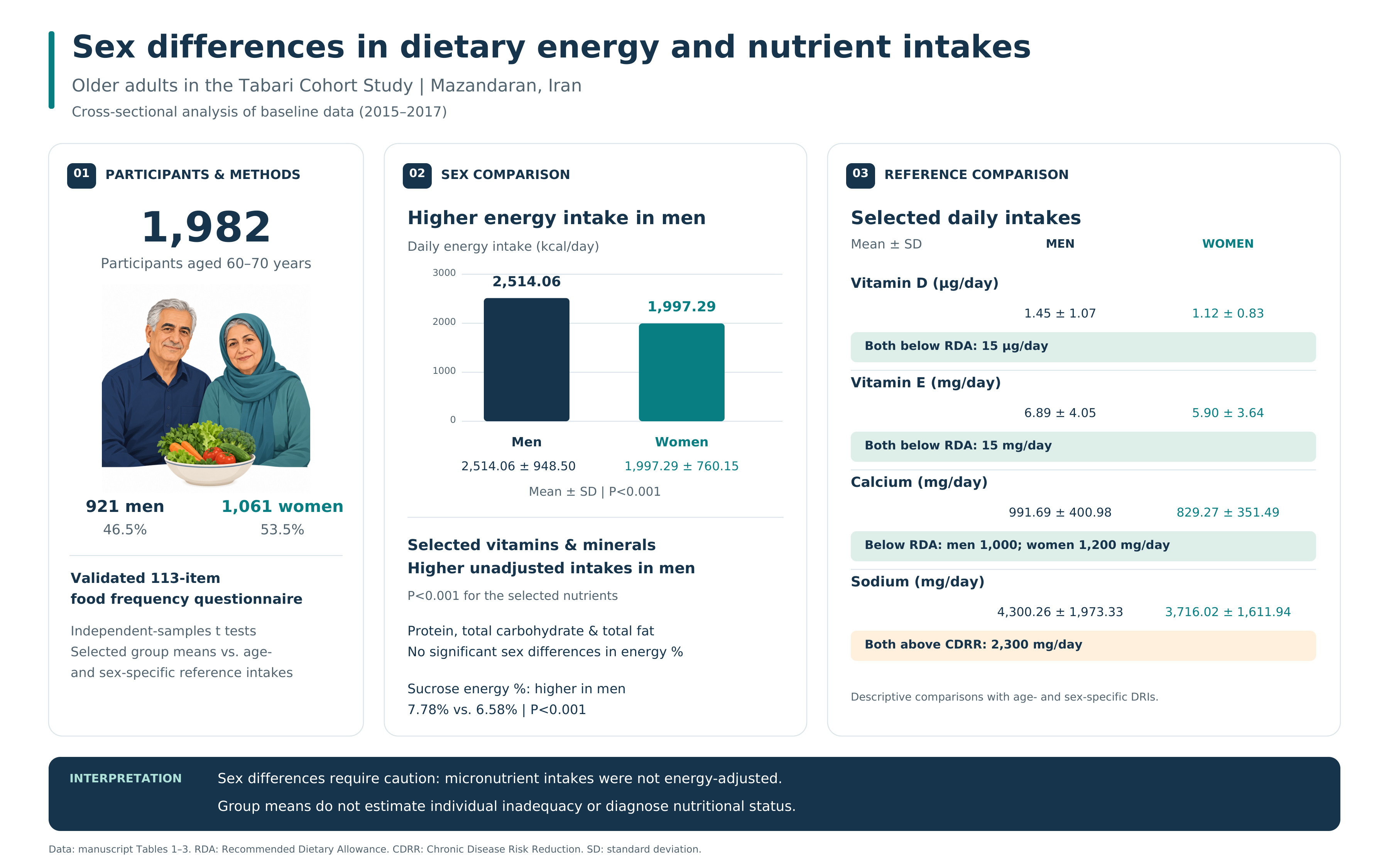
Materials and methods: This cross-sectional analysis used baseline data from 1,982 participants aged 60-70 years enrolled in the Tabari Cohort Study, part of the national PERSIAN Cohort. Habitual dietary intake was estimated using a validated 113-item food frequency questionnaire. Independent-samples t tests were used to compare women and men. Selected mean nutrient intakes were compared descriptively with age- and sex-specific Dietary Reference Intakes (DRIs). Micronutrient comparisons were based on unadjusted intake estimates; therefore, sex differences could not be distinguished from differences related to total energy intake.
Results: Participants included 921 men (46.5%) and 1,061 women (53.5%). Mean energy intake was higher in men than in women (2,514.06 ± 948.50 vs. 1,997.29 ± 760.15 kcal/day; P < 0.001). The percentages of energy derived from protein, total carbohydrate, and total fat did not differ significantly between the sexes, whereas the percentage derived from sucrose was higher in men (P < 0.001). Unadjusted intakes of selected vitamins and minerals were higher in men (P < 0.001). Mean daily intakes in men and women, respectively, were below the corresponding DRIs for vitamin D (1.45 ± 1.07 and 1.12 ± 0.83 µg/day), vitamin E (6.89 ± 4.05 and 5.90 ± 3.64 mg/day), and calcium (991.69 ± 400.98 and 829.27 ± 351.49 mg/day). Mean sodium intake was 4,300.26 ± 1,973.33 mg/day in men and 3,716.02 ± 1,611.94 mg/day in women, exceeding the chronic disease risk reduction level in both groups.
Conclusion: Reported dietary energy and nutrient intakes differed between older men and women. Micronutrient differences should be interpreted cautiously because the analyses were not adjusted for energy intake, which was higher in men. These findings characterise reported dietary intake but do not establish overall nutritional status or the prevalence of individual nutrient inadequacy.
Type of Study: Research(Original) |
Subject:
Nutrition
Send email to the article author
| Rights and permissions | |
 |
This work is licensed under a Creative Commons Attribution-NonCommercial 4.0 International License. |

Articles Copyright © The Author(s). Owned by Mazandaran University of Medical Sciences.
Contact Us
Address: Journal Office, Building No. 2, Mazandaran University of Medical Sciences, Moallem Square, Sari.Tel: +98 (011)34484874 Postal code: 48175-866 E-Mail: jmums@mazums.ac.ir Telefax: +98 (011)33262679
