

Volume 36, Issue 255 (3-2026)
J Mazandaran Univ Med Sci 2026, 36(255): 46-52 |
Back to browse issues page


Download citation:
BibTeX | RIS | EndNote | Medlars | ProCite | Reference Manager | RefWorks
Send citation to:


BibTeX | RIS | EndNote | Medlars | ProCite | Reference Manager | RefWorks
Send citation to:
Entezari Moghaddam N, Saleh A, Rezazadeh M, Aghaali M, Mehdipour A. Comparative Evaluation of Three Commonly Prescribed Pediatric Syrups on Enamel Microhardness, Surface Roughness, and Stainability of Primary Teeth: An In Vitro Study. J Mazandaran Univ Med Sci 2026; 36 (255) :46-52
URL: http://jmums.mazums.ac.ir/article-1-22298-en.html
URL: http://jmums.mazums.ac.ir/article-1-22298-en.html


Abstract: (136 Views)
Background and purpose: Dental caries is the most common oral disease, resulting from acid-induced demineralization of dental enamel by bacterial activity. Certain medications may exacerbate this process. Acidic pediatric syrups may potentially compromise the surface integrity of primary tooth enamel. This in vitro study aimed to evaluate the effects of three commonly prescribed pediatric syrups (multivitamin, iron, and cefixime antibiotic) on the microhardness, surface roughness, and color changes of primary tooth enamel.
Materials and methods: Forty-eight extracted primary teeth with intact crowns were randomly allocated into four groups: control, multivitamin, iron, and antibiotic. Each specimen was immersed in its respective syrup for 2 minutes daily over a period of 28 days. Enamel microhardness was measured using a Vickers microhardness tester, surface roughness was assessed by atomic force microscopy (AFM), and color changes were evaluated using a spectrophotometer.
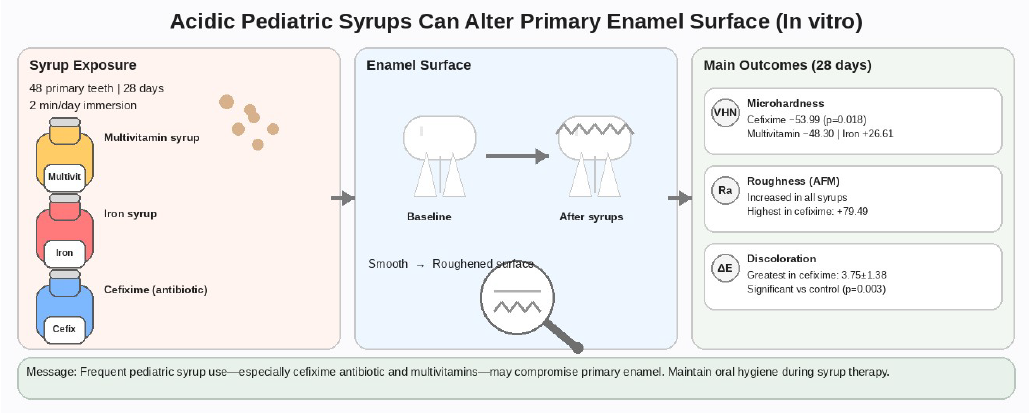
Results: After 28 days, the greatest microhardness reduction occurred in the cefixime group (Δ = -53.99; P = 0.018), followed by the multivitamin group (Δ = -48.30). Interestingly, the iron group showed a slight increase in microhardness (Δ = +26.61). Surface roughness increased significantly in all intervention groups, with the highest increase observed in the antibiotic group (average roughness value increase = +79.49). Color change (ΔE) was also greatest in the antibiotic group (3.75 ± 1.38; P = 0.025), which differed significantly from the control group (P = 0.003).
Conclusion: Frequent consumption of pediatric syrups, particularly antibiotics and multivitamins, may compromise the structural integrity of primary tooth enamel. Liposomal iron syrup demonstrated the least detrimental effect, whereas cefixime exhibited the greatest adverse impact on the crown structure of primary teeth. Therefore, maintaining proper oral hygiene during pharmacological syrup therapy in children is essential.
Materials and methods: Forty-eight extracted primary teeth with intact crowns were randomly allocated into four groups: control, multivitamin, iron, and antibiotic. Each specimen was immersed in its respective syrup for 2 minutes daily over a period of 28 days. Enamel microhardness was measured using a Vickers microhardness tester, surface roughness was assessed by atomic force microscopy (AFM), and color changes were evaluated using a spectrophotometer.
Results: After 28 days, the greatest microhardness reduction occurred in the cefixime group (Δ = -53.99; P = 0.018), followed by the multivitamin group (Δ = -48.30). Interestingly, the iron group showed a slight increase in microhardness (Δ = +26.61). Surface roughness increased significantly in all intervention groups, with the highest increase observed in the antibiotic group (average roughness value increase = +79.49). Color change (ΔE) was also greatest in the antibiotic group (3.75 ± 1.38; P = 0.025), which differed significantly from the control group (P = 0.003).
Conclusion: Frequent consumption of pediatric syrups, particularly antibiotics and multivitamins, may compromise the structural integrity of primary tooth enamel. Liposomal iron syrup demonstrated the least detrimental effect, whereas cefixime exhibited the greatest adverse impact on the crown structure of primary teeth. Therefore, maintaining proper oral hygiene during pharmacological syrup therapy in children is essential.
Keywords: tooth, deciduous, enamel microhardness, surface properties, tooth discoloration, pediatric oral solutions
Type of Study: Brief Report |
Subject:
Dentistry
Send email to the article author
| Rights and permissions | |
 |
This work is licensed under a Creative Commons Attribution-NonCommercial 4.0 International License. |

Articles Copyright © The Author(s). Owned by Mazandaran University of Medical Sciences.
Contact Us
Address: Journal Office, Building No. 2, Mazandaran University of Medical Sciences, Moallem Square, Sari.Tel: +98 (011)34484874 Postal code: 48175-866 E-Mail: jmums@mazums.ac.ir Telefax: +98 (011)33262679
