

Volume 36, Issue 258 (7-2026)
J Mazandaran Univ Med Sci 2026, 36(258): 132-137 |
Back to browse issues page



Download citation:
BibTeX | RIS | EndNote | Medlars | ProCite | Reference Manager | RefWorks
Send citation to:


BibTeX | RIS | EndNote | Medlars | ProCite | Reference Manager | RefWorks
Send citation to:
Enayatfar M, Ghahrani N, Sadeghimahalli F. The Role of Educational Technology in Medical Education from the Perspective of Basic Sciences Medical Students at Mazandaran University of Medical Sciences (2024-2025). J Mazandaran Univ Med Sci 2026; 36 (258) :132-137
URL: http://jmums.mazums.ac.ir/article-1-22387-en.html
URL: http://jmums.mazums.ac.ir/article-1-22387-en.html


Abstract: (18 Views)
Background and purpose: The use of technology in modern educational systems, including medical education, has become increasingly widespread. Investigating students' attitudes towards educational technology can help to optimise its use, improve teaching methods in line with students' needs and learning styles, and enhance learning outcomes. This study examines the role of educational technology in education from the perspective of basic sciences students at Sari Medical School in the 2024-2025 academic year.
Materials and methods: This cross-sectional study was conducted with 280 students using random sampling. The data collection tool was the Persian version of the standard questionnaire “The Role of Educational Technology in Medical Education.” This questionnaire consists of 20 items across four domains assessing the role of educational technology in learning in terms of goals, conditions, resources, and evaluation. Responses were recorded on a five-point Likert scale ranging from “completely ineffective” to “very effective.” The minimum and maximum total scores were 20 and 100, respectively, and the average score for each component ranged from 1 to 5. Data were analysed using IBM SPSS version 26.
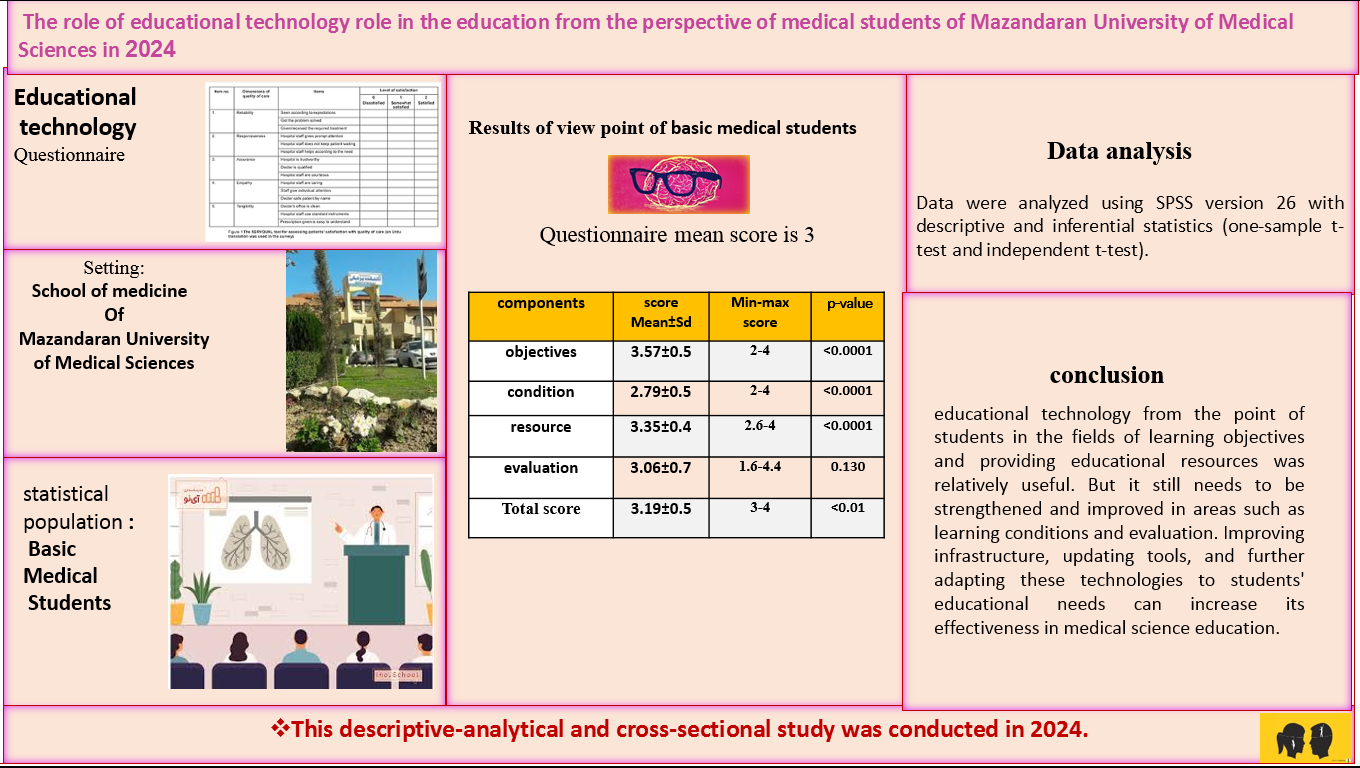
Results: The overall attitude towards the role of educational technology was positive and relatively high, with a mean total score of 89.63 out of 100 (P< 0.01). At the component level, the highest and lowest mean attitude scores were related to “learning objectives” (3.57) and “learning conditions” (2.79), respectively. The attitude towards “learning resources” had a mean score of 3.35, indicating a positive and significant perception (P< 0.01). In contrast, the mean score for the “evaluation” component was 3.06, which was not statistically significant (P = 0.13).
Conclusion: From the students’ perspective, educational technology is relatively effective in supporting learning objectives and providing educational resources; however, it requires further strengthening and improvement in the areas of learning conditions and evaluation.
Materials and methods: This cross-sectional study was conducted with 280 students using random sampling. The data collection tool was the Persian version of the standard questionnaire “The Role of Educational Technology in Medical Education.” This questionnaire consists of 20 items across four domains assessing the role of educational technology in learning in terms of goals, conditions, resources, and evaluation. Responses were recorded on a five-point Likert scale ranging from “completely ineffective” to “very effective.” The minimum and maximum total scores were 20 and 100, respectively, and the average score for each component ranged from 1 to 5. Data were analysed using IBM SPSS version 26.
Results: The overall attitude towards the role of educational technology was positive and relatively high, with a mean total score of 89.63 out of 100 (P< 0.01). At the component level, the highest and lowest mean attitude scores were related to “learning objectives” (3.57) and “learning conditions” (2.79), respectively. The attitude towards “learning resources” had a mean score of 3.35, indicating a positive and significant perception (P< 0.01). In contrast, the mean score for the “evaluation” component was 3.06, which was not statistically significant (P = 0.13).
Conclusion: From the students’ perspective, educational technology is relatively effective in supporting learning objectives and providing educational resources; however, it requires further strengthening and improvement in the areas of learning conditions and evaluation.
Type of Study: Brief Report |
Subject:
medical education
Send email to the article author
| Rights and permissions | |
 |
This work is licensed under a Creative Commons Attribution-NonCommercial 4.0 International License. |

Articles Copyright © The Author(s). Owned by Mazandaran University of Medical Sciences.
Contact Us
Address: Journal Office, Building No. 2, Mazandaran University of Medical Sciences, Moallem Square, Sari.Tel: +98 (011)34484874 Postal code: 48175-866 E-Mail: jmums@mazums.ac.ir Telefax: +98 (011)33262679
