

Volume 35, Issue 254 (3-2026)
J Mazandaran Univ Med Sci 2026, 35(254): 136-151 |
Back to browse issues page


Download citation:
BibTeX | RIS | EndNote | Medlars | ProCite | Reference Manager | RefWorks
Send citation to:


BibTeX | RIS | EndNote | Medlars | ProCite | Reference Manager | RefWorks
Send citation to:
Aghaee M, Mogharabi-Manzari M. A Review of Enzyme Immobilization Methods and Critical Parameters for Evaluating Immobilized Enzymes. J Mazandaran Univ Med Sci 2026; 35 (254) :136-151
URL: http://jmums.mazums.ac.ir/article-1-22524-en.html
URL: http://jmums.mazums.ac.ir/article-1-22524-en.html
A Review of Enzyme Immobilization Methods and Critical Parameters for Evaluating Immobilized Enzymes


Abstract: (970 Views)
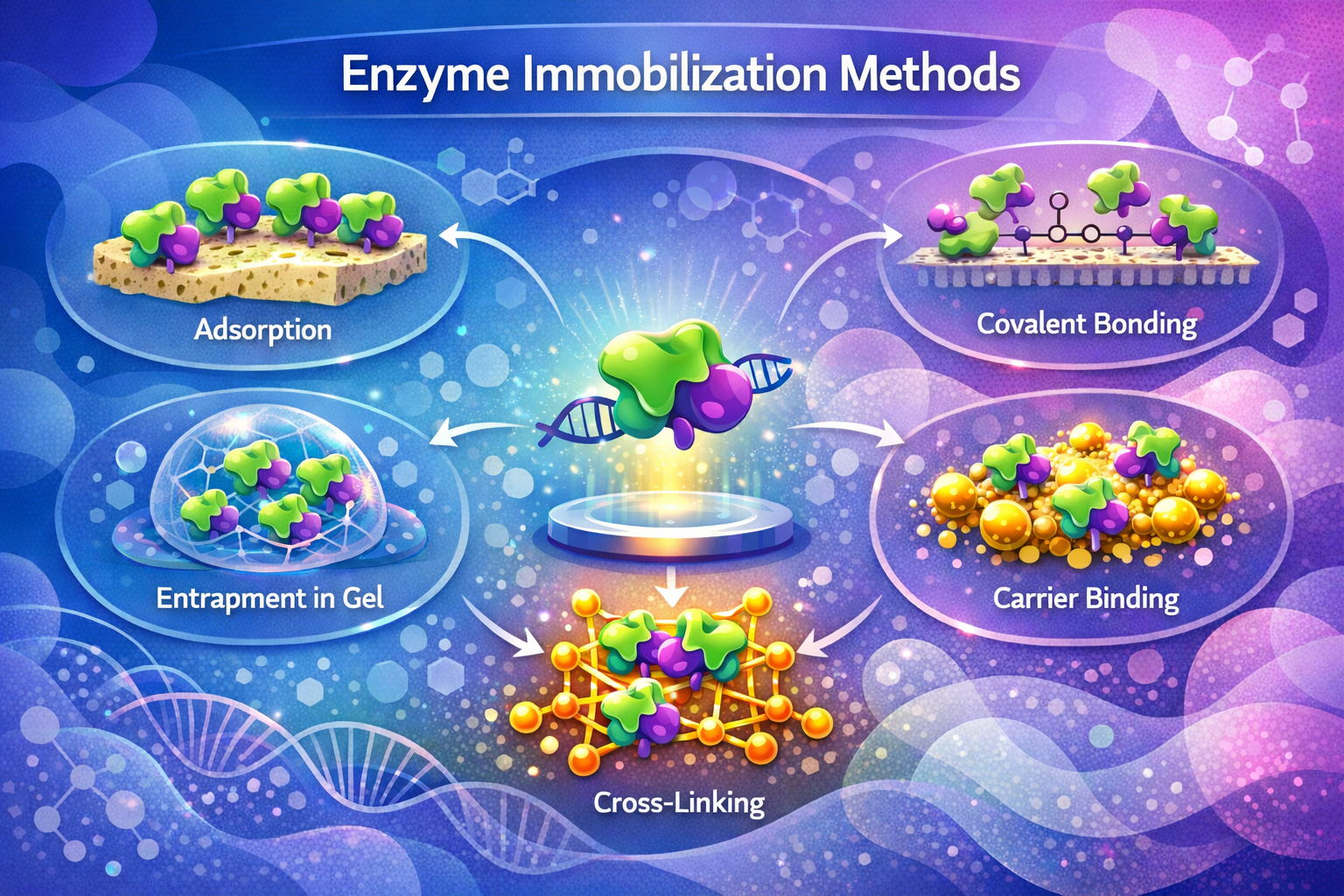
Enzymes, natural biocatalysts with high catalytic efficiency, are essential in numerous biological and industrial processes. However, their inherent instability and sensitivity to environmental conditions often limit their direct application. To overcome these drawbacks, various immobilization techniques have been developed to enhance enzyme stability, reusability, and operational performance. This review discusses the main immobilization strategies, including physical adsorption, covalent bonding, entrapment, and cross-linked enzyme aggregates (CLEAs), highlighting the advantages and limitations of each approach. Physical adsorption is simple and cost-effective but suffers from weak binding, whereas covalent attachment provides strong and stable enzyme support interactions under harsh conditions. Entrapment and encapsulation methods offer a protective microenvironment that helps maintain enzymatic activity, whereas CLEAs present a carrier-free system with improved stability and catalytic efficiency. In addition, several analytical and instrumental techniques are reviewed for the structural and functional characterization of immobilized enzymes, enabling the assessment of conformational changes, surface morphology, and thermal or chemical stability. In evaluating the efficiency of enzyme immobilization, several key parameters are employed to determine how the process affects enzymatic properties and overall catalytic performance. Likewise, thermal and pH stability tests assess the enzyme’s resistance to denaturation under extreme temperature or pH conditions, demonstrating how immobilization enhances structural rigidity and tolerance to environmental stresses. The kinetic parameters, namely the Michaelis–Menten constant (Km) and the maximum reaction velocity (Vmax), provide quantitative insight into changes in substrate affinity and catalytic turnover after immobilization. Overall, this review emphasizes that the rational selection of immobilization methods and support materials can significantly improve enzyme performance and durability, facilitating the development of robust and efficient biocatalysts for industrial and environmental applications.
Type of Study: Review |
Subject:
Biotechnology
Send email to the article author
| Rights and permissions | |
 |
This work is licensed under a Creative Commons Attribution-NonCommercial 4.0 International License. |

Articles Copyright © The Author(s). Owned by Mazandaran University of Medical Sciences.
Contact Us
Address: Journal Office, Building No. 2, Mazandaran University of Medical Sciences, Moallem Square, Sari.Tel: +98 (011)34484874 Postal code: 48175-866 E-Mail: jmums@mazums.ac.ir Telefax: +98 (011)33262679
