

Volume 36, Issue 258 (7-2026)
J Mazandaran Univ Med Sci 2026, 36(258): 98-104 |
Back to browse issues page


Download citation:
BibTeX | RIS | EndNote | Medlars | ProCite | Reference Manager | RefWorks
Send citation to:


BibTeX | RIS | EndNote | Medlars | ProCite | Reference Manager | RefWorks
Send citation to:
Chaleshgar–kordasiabi M, Saemian A, Darbayar M. Knowledge and Professional Practices of Radiology Staff and Students Regarding the Prevention and Management of Tuberculosis. J Mazandaran Univ Med Sci 2026; 36 (258) :98-104
URL: http://jmums.mazums.ac.ir/article-1-22624-en.html
URL: http://jmums.mazums.ac.ir/article-1-22624-en.html


Abstract: (40 Views)
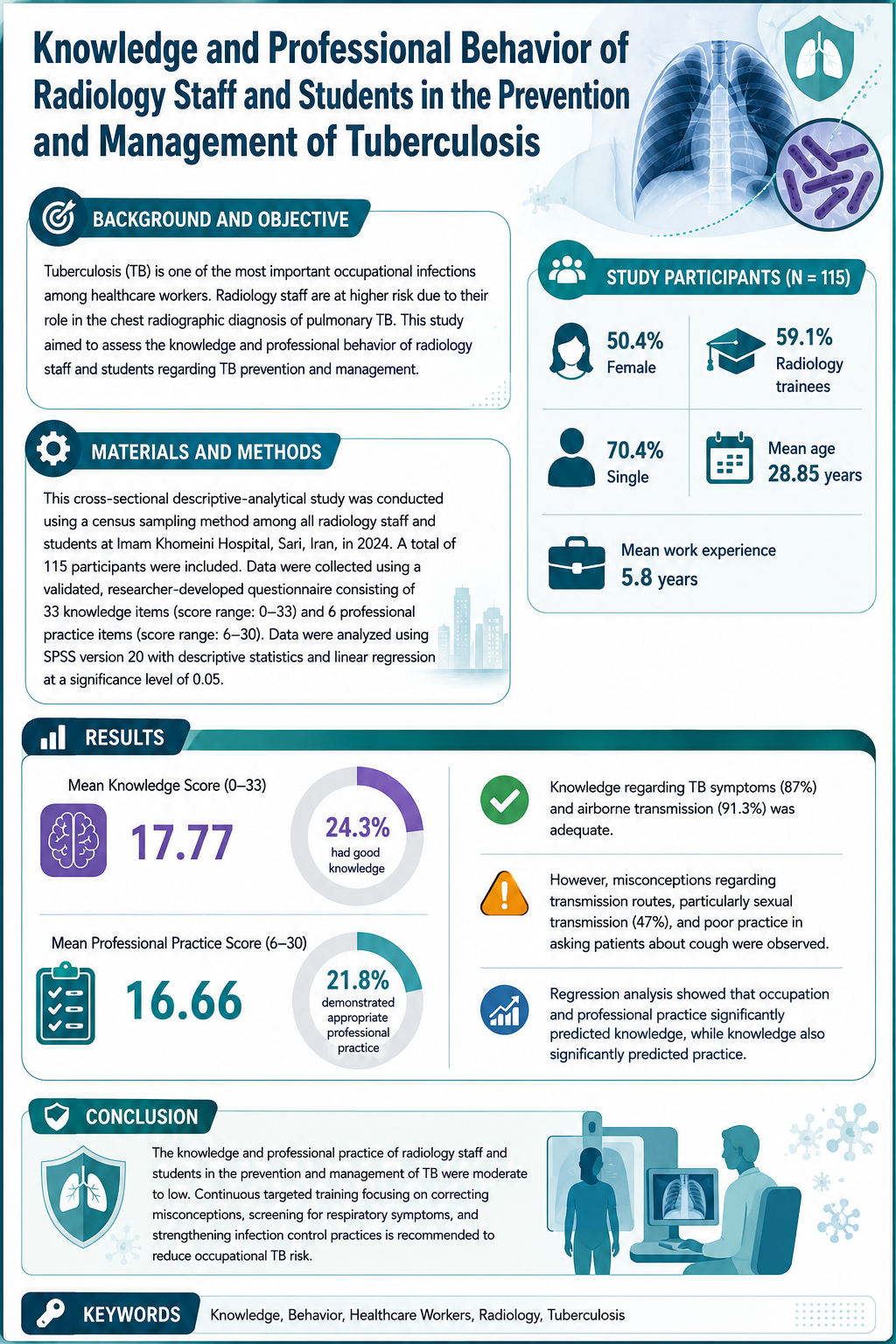
Background and purpose: Tuberculosis (TB) is one of the most important occupational infections among healthcare workers. Radiology staff are at increased risk due to their role in the radiological evaluation and diagnosis of pulmonary TB. This study aimed to assess the knowledge and professional practices of radiology staff and students regarding TB prevention and management.
Materials and methods: This cross-sectional descriptive-analytical study was conducted using a census sampling method among all radiology staff and students at Imam Khomeini Hospital, Sari, Iran, in 2024. A total of 115 participants were included. Data were collected using a validated, researcher-developed questionnaire consisting of 33 knowledge items (score range: 0-33) and 6 professional practice items (score range: 6-30). Data were analyzed using SPSS version 20 through descriptive statistics and linear regression analysis at a significance level of 0.05.
Results: The mean age of participants was 28.85 years, and the mean work experience was 5.8 years. Of the participants, 50.4% were female, 59.1% were radiology trainees, and 70.4% were single. The mean knowledge and professional practice scores were 17.77 and 16.66, respectively. Only 24.3% of participants demonstrated good knowledge, and 21.8% demonstrated appropriate professional practice. Knowledge regarding TB symptoms (87%) and airborne transmission (91.3%) was satisfactory; however, misconceptions regarding transmission routes, particularly sexual transmission (47%), and inadequate practices, such as failure to inquire about patients’ cough symptoms, were observed. Regression analysis showed that occupation and professional practice significantly predicted knowledge, while knowledge also significantly predicted practice.
Conclusion: The knowledge and professional practices of radiology staff and students regarding TB prevention and management were suboptimal. Continuous, targeted training focusing on correcting misconceptions, improving respiratory symptom screening, and strengthening infection control practices is recommended to reduce the occupational risk of TB transmission.
Materials and methods: This cross-sectional descriptive-analytical study was conducted using a census sampling method among all radiology staff and students at Imam Khomeini Hospital, Sari, Iran, in 2024. A total of 115 participants were included. Data were collected using a validated, researcher-developed questionnaire consisting of 33 knowledge items (score range: 0-33) and 6 professional practice items (score range: 6-30). Data were analyzed using SPSS version 20 through descriptive statistics and linear regression analysis at a significance level of 0.05.
Results: The mean age of participants was 28.85 years, and the mean work experience was 5.8 years. Of the participants, 50.4% were female, 59.1% were radiology trainees, and 70.4% were single. The mean knowledge and professional practice scores were 17.77 and 16.66, respectively. Only 24.3% of participants demonstrated good knowledge, and 21.8% demonstrated appropriate professional practice. Knowledge regarding TB symptoms (87%) and airborne transmission (91.3%) was satisfactory; however, misconceptions regarding transmission routes, particularly sexual transmission (47%), and inadequate practices, such as failure to inquire about patients’ cough symptoms, were observed. Regression analysis showed that occupation and professional practice significantly predicted knowledge, while knowledge also significantly predicted practice.
Conclusion: The knowledge and professional practices of radiology staff and students regarding TB prevention and management were suboptimal. Continuous, targeted training focusing on correcting misconceptions, improving respiratory symptom screening, and strengthening infection control practices is recommended to reduce the occupational risk of TB transmission.
Type of Study: Brief Report |
Subject:
Community Health
Send email to the article author
| Rights and permissions | |
 |
This work is licensed under a Creative Commons Attribution-NonCommercial 4.0 International License. |

Articles Copyright © The Author(s). Owned by Mazandaran University of Medical Sciences.
Contact Us
Address: Journal Office, Building No. 2, Mazandaran University of Medical Sciences, Moallem Square, Sari.Tel: +98 (011)34484874 Postal code: 48175-866 E-Mail: jmums@mazums.ac.ir Telefax: +98 (011)33262679
