

Volume 36, Issue 259 (8-2026)
J Mazandaran Univ Med Sci 2026, 36(259): 17-29 |
Back to browse issues page



Download citation:
BibTeX | RIS | EndNote | Medlars | ProCite | Reference Manager | RefWorks
Send citation to:


BibTeX | RIS | EndNote | Medlars | ProCite | Reference Manager | RefWorks
Send citation to:
Mehrabi Khozani N, Naghavi N S, Hoveida L. Antibacterial and Antibiofilm Activities of Imipenem-Loaded Niosomes Against Imipenem-Resistant Acinetobacter baumannii. J Mazandaran Univ Med Sci 2026; 36 (259) :17-29
URL: http://jmums.mazums.ac.ir/article-1-22664-en.html
URL: http://jmums.mazums.ac.ir/article-1-22664-en.html


Abstract: (31 Views)
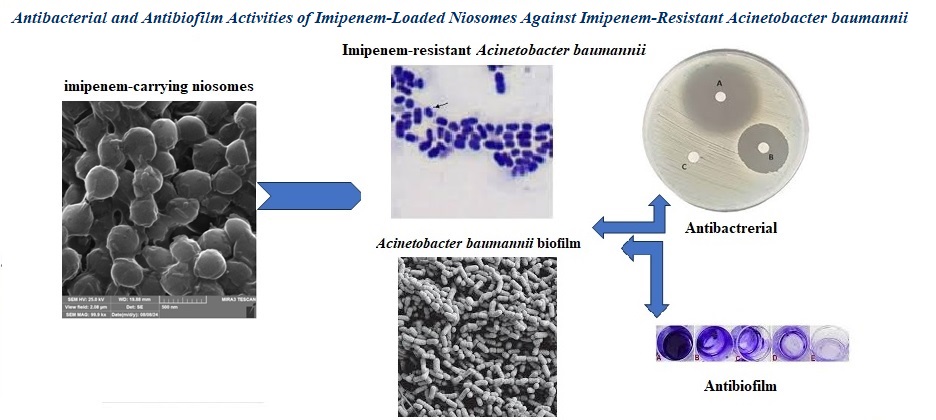
Background and purpose: Niosomes are nonionic surfactant-based vesicular structures that have been investigated for drug delivery due to their biodegradable and non-immunogenic properties. The aim of the present study was to evaluate the antimicrobial and antibiofilm effects of imipenem-loaded niosomes against Acinetobacter baumannii isolates obtained from different hospital wards.
Materials and methods: In this experimental study, 15 Acinetobacter baumannii isolates were collected from different wards of Al-Zahra Hospital in Isfahan. The isolates were identified using biochemical tests. Imipenem resistance and biofilm-forming ability were determined. The physicochemical properties of the imipenem-loaded niosomes, including particle size, zeta potential, entrapment efficiency, and drug release profile, were also evaluated. Antimicrobial activity against imipenem-resistant bacteria was determined using the microdilution method.
Results: Of the 15 Acinetobacter baumannii isolates, 9 were resistant to imipenem. Most isolates formed weak or moderate biofilms. The imipenem-loaded niosomes had a mean particle size of 211.1 nm and a zeta potential of -34.3 mV. Drug release experiments showed that the niosomes provided controlled release and reduced the rapid release of imipenem. The minimum inhibitory concentration (MIC) and minimum bactericidal concentration (MBC) values of the imipenem-loaded niosomes against imipenem-resistant isolates were 2- to 8-fold and 2- to 4-fold lower, respectively, than those of free imipenem. In addition, imipenem-loaded niosomes showed a greater inhibitory effect on biofilm formation than free imipenem, with an improvement of up to threefold.
Conclusion: Imipenem-loaded niosomes may represent a promising approach for addressing imipenem-resistant Acinetobacter baumannii and inhibiting biofilm formation. However, further studies, including clinical validation, are required to determine their therapeutic potential and whether they can reduce the burden of nosocomial infections caused by Acinetobacter baumannii.
Materials and methods: In this experimental study, 15 Acinetobacter baumannii isolates were collected from different wards of Al-Zahra Hospital in Isfahan. The isolates were identified using biochemical tests. Imipenem resistance and biofilm-forming ability were determined. The physicochemical properties of the imipenem-loaded niosomes, including particle size, zeta potential, entrapment efficiency, and drug release profile, were also evaluated. Antimicrobial activity against imipenem-resistant bacteria was determined using the microdilution method.
Results: Of the 15 Acinetobacter baumannii isolates, 9 were resistant to imipenem. Most isolates formed weak or moderate biofilms. The imipenem-loaded niosomes had a mean particle size of 211.1 nm and a zeta potential of -34.3 mV. Drug release experiments showed that the niosomes provided controlled release and reduced the rapid release of imipenem. The minimum inhibitory concentration (MIC) and minimum bactericidal concentration (MBC) values of the imipenem-loaded niosomes against imipenem-resistant isolates were 2- to 8-fold and 2- to 4-fold lower, respectively, than those of free imipenem. In addition, imipenem-loaded niosomes showed a greater inhibitory effect on biofilm formation than free imipenem, with an improvement of up to threefold.
Conclusion: Imipenem-loaded niosomes may represent a promising approach for addressing imipenem-resistant Acinetobacter baumannii and inhibiting biofilm formation. However, further studies, including clinical validation, are required to determine their therapeutic potential and whether they can reduce the burden of nosocomial infections caused by Acinetobacter baumannii.
Type of Study: Research(Original) |
Subject:
Microbiology
Send email to the article author
| Rights and permissions | |
 |
This work is licensed under a Creative Commons Attribution-NonCommercial 4.0 International License. |

Articles Copyright © The Author(s). Owned by Mazandaran University of Medical Sciences.
Contact Us
Address: Journal Office, Building No. 2, Mazandaran University of Medical Sciences, Moallem Square, Sari.Tel: +98 (011)34484874 Postal code: 48175-866 E-Mail: jmums@mazums.ac.ir Telefax: +98 (011)33262679
