

Volume 36, Issue 264 (11-2026)
J Mazandaran Univ Med Sci 2026, 36(264): 204-217 |
Back to browse issues page



Download citation:
BibTeX | RIS | EndNote | Medlars | ProCite | Reference Manager | RefWorks
Send citation to:


BibTeX | RIS | EndNote | Medlars | ProCite | Reference Manager | RefWorks
Send citation to:
Hamzehgardeshi Z, Jahanfar S, Nikbakht R, Farnia S, Shishehgar S, kolbadinezhad Z. Midwives’ Educational Needs and Knowledge Gaps in Providing Maternity Care for Neurodivergent Pregnant Women: A JBI-Based Scoping Review. , J Mazandaran Univ Med Sci. 2026; 36 (264) :204-217
URL: http://jmums.mazums.ac.ir/article-1-22665-en.html
URL: http://jmums.mazums.ac.ir/article-1-22665-en.html
Zeinab Hamzehgardeshi 
 , Shayesteh Jahanfar , Roya Nikbakht , Samaneh Farnia , Sara Shishehgar , Zahra Kolbadinezhad *
Abstract: (21 Views)
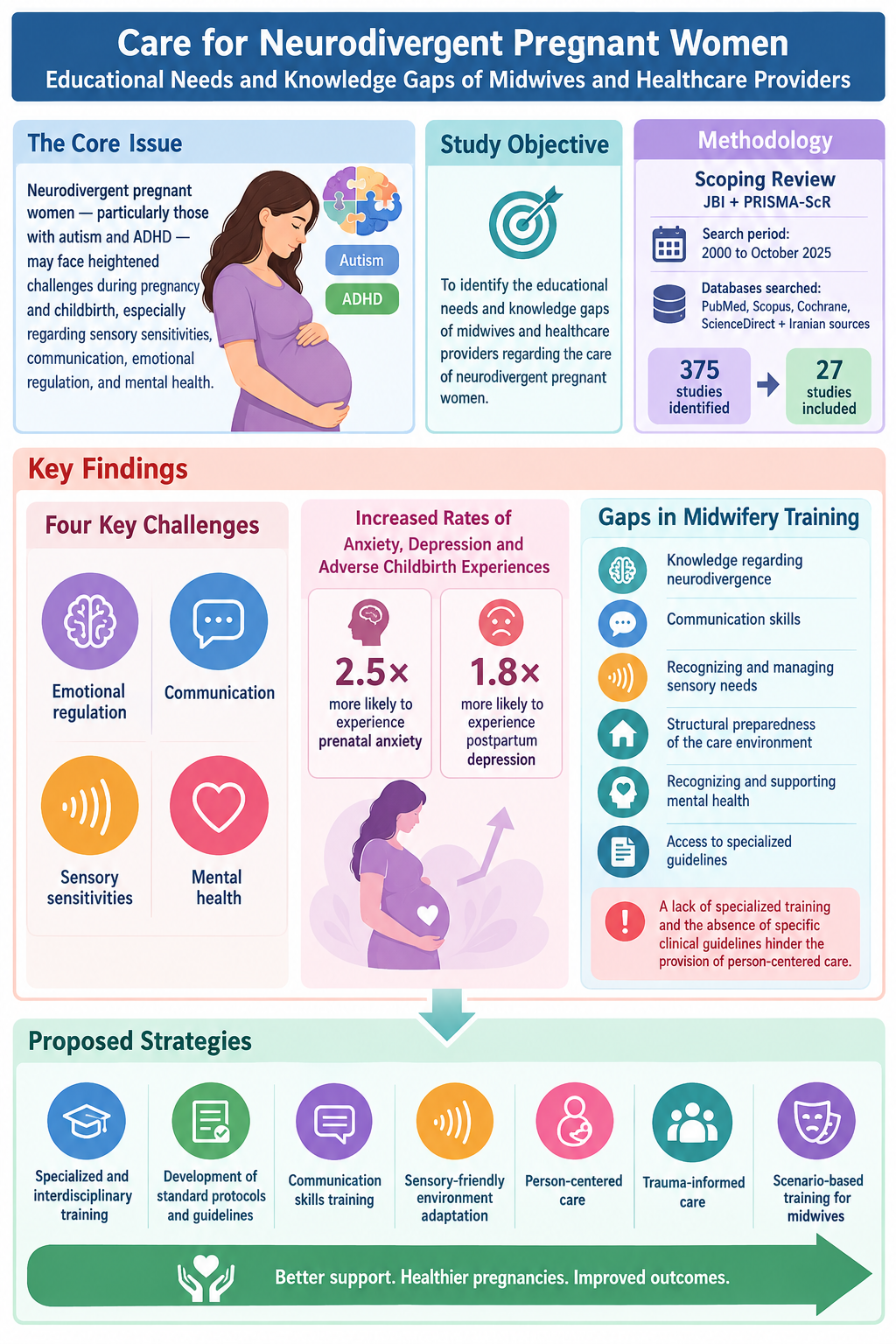
Background and purpose: Neurodivergent women, including women with autism, ADHD, and other neurodevelopmental differences, may face communication, sensory, emotional, and psychological challenges during pregnancy and childbirth. Midwifery providers’ lack of knowledge and specialised skills may affect the quality of care and women’s care experiences. This scoping review aimed to identify educational needs and knowledge gaps among providers delivering midwifery services to neurodivergent pregnant women.
Materials and methods: This scoping review was conducted using the Joanna Briggs Institute (JBI) framework and in accordance with the PRISMA-ScR guidelines. A comprehensive search was conducted from 2000 to October 2025 in PubMed, Scopus, the Cochrane Library, ScienceDirect, SID, MAGIRAN, IRANDOC, and Google Scholar. Eligibility criteria were defined using the PCC (Population, Concept, Context) framework. The population comprised neurodivergent pregnant women, the concept focused on educational needs and knowledge gaps in service delivery, and the context encompassed midwifery services and prenatal care. Studies published in languages other than English or Persian, conference abstracts, personal viewpoints, and studies that did not meet the eligibility criteria were excluded. Data extraction was performed using the standard JBI data extraction form.
Results: Of the 375 records identified, 27 were included in the review. The findings indicated that women with autism and ADHD may experience challenges related to sensory processing, communication, emotional regulation, and mental health. A lack of specialised training and clinical guidelines was identified as a barrier to providing person-centred care tailored to the needs of neurodivergent women. Additionally, the included studies reported increased anxiety, depression, and negative childbirth experiences.
Conclusion: Existing evidence indicates significant gaps in midwifery providers’ knowledge and skills relating to communication and sensory needs, as well as in the organisational preparedness of midwifery services. Strengthening interdisciplinary training, developing specialised clinical guidelines, and integrating person-centred and trauma-informed care into educational programmes may help improve the quality and equity of care for neurodivergent pregnant women.
Keywords: neurodiversity, pregnancy, autism spectrum disorder, attention-deficit/hyperactivity disorder, midwifery services, midwifery education, person-centred care, sensory processing, knowledge gaps
| Rights and permissions | |
 |
This work is licensed under a Creative Commons Attribution-NonCommercial 4.0 International License. |

Articles Copyright © The Author(s). Owned by Mazandaran University of Medical Sciences.
Contact Us
Address: Journal Office, Building No. 2, Mazandaran University of Medical Sciences, Moallem Square, Sari.Tel: +98 (011)34484874 Postal code: 48175-866 E-Mail: jmums@mazums.ac.ir Telefax: +98 (011)33262679
