

Volume 36, Issue 262 (Special Issue 2026)
J Mazandaran Univ Med Sci 2026, 36(262): 77-90 |
Back to browse issues page



Download citation:
BibTeX | RIS | EndNote | Medlars | ProCite | Reference Manager | RefWorks
Send citation to:


BibTeX | RIS | EndNote | Medlars | ProCite | Reference Manager | RefWorks
Send citation to:
Zare Besheli F, Shekarriz foumani R, Alizadeh Navaei R. Trends in Colorectal Cancer Incidence in Mazandaran Province, Iran, 2015 -2022. , J Mazandaran Univ Med Sci. 2026; 36 (262) :77-90
URL: http://jmums.mazums.ac.ir/article-1-22725-en.html
URL: http://jmums.mazums.ac.ir/article-1-22725-en.html


Abstract: (38 Views)
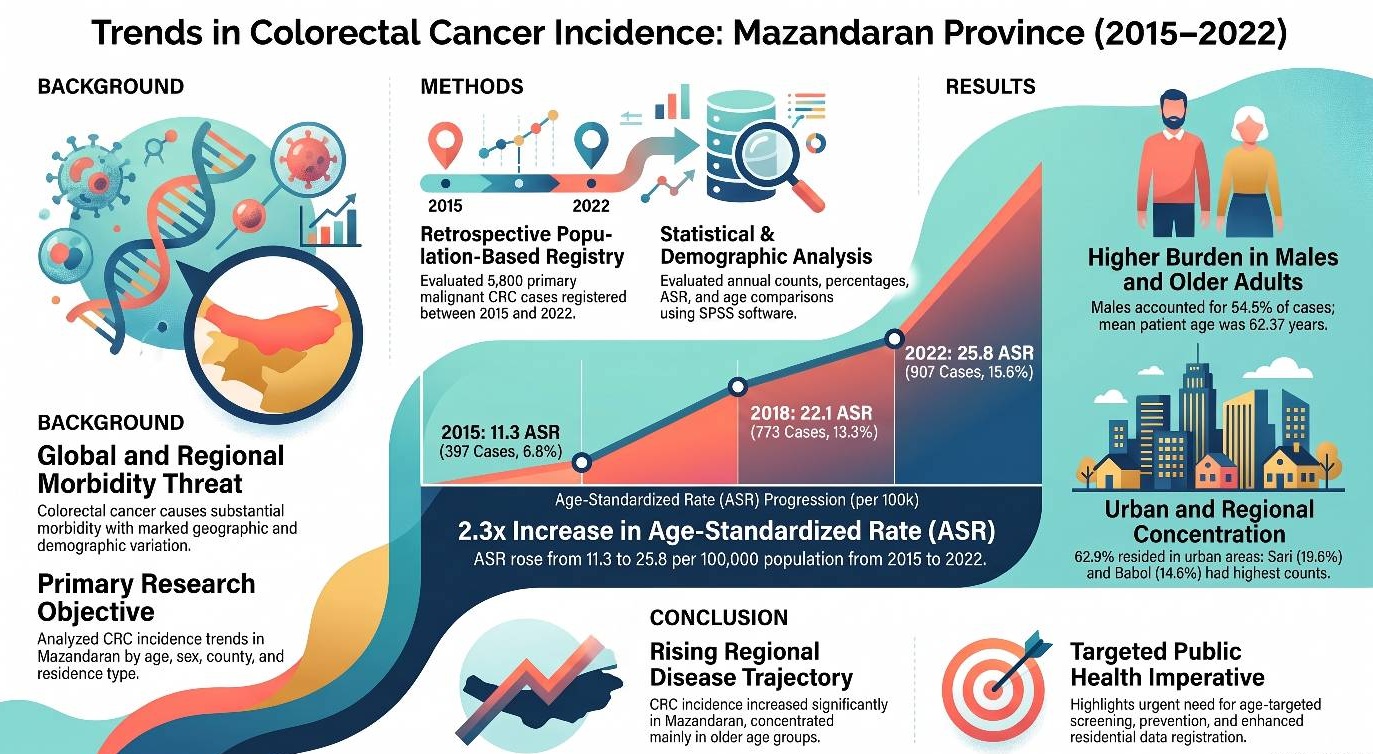
Background and purpose: Colorectal cancer (CRC) is a major cause of cancer-related morbidity and mortality, with substantial geographic and demographic variation in incidence. This study aimed to examine trends in CRC incidence in Mazandaran Province, Iran, from 2015 to 2022, stratified by age, sex, county, and urban or rural residence.
Materials and methods: This retrospective, population-based study (ethics approval code: IR.MAZUMS.IMAMHOSPITAL.REC.1403.010) used data from the population-based cancer registry of Mazandaran University of Medical Sciences. All newly registered primary malignant CRC cases diagnosed between 2015 and 2022 were included. Data on sex, age, county, and type of residence were analysed using SPSS. Annual case counts, percentages, and age-standardised incidence rates (ASRs) were reported. Differences in age were assessed using analysis of variance (ANOVA) and independent-samples t-tests, as appropriate. Statistical significance was set at P < 0.05.
Results: A total of 5,800 cases were included. Annual case counts increased from 397 (6.8% of all cases) in 2015 to 916 (15.8%) in 2021 and 907 (15.6%) in 2022. The ASR increased from 11.3 to 25.8 over the study period. Of the registered cases, 3,162 (54.5%) were male and 2,638 (45.5%) were female. The mean age was 62.37 ± 14.49 years, with no significant difference in mean age across years (P = 0.220). Women were younger than men at diagnosis (61.12 ± 14.53 vs 63.42 ± 14.37 years, P < 0.001). The largest proportion of cases occurred among individuals aged 60-69 years (26.5%), followed by those aged 50-59 years (22.7%) and 70-79 years (19.9%). Residence data were available for 5,343 cases (92.1%); of these, 62.9% were urban residents and 37.1% were rural residents. Rural residents were slightly older than urban residents (P = 0.042). The highest proportions of cases were recorded in Sari (19.6%) and Babol (14.6%), followed by Amol and Qaemshahr (9.3% each).
Conclusion: The ASR of CRC in Mazandaran increased between 2015 and 2022, alongside an increase in annual registered case counts. The distribution of cases varied by age, sex, and county, with a higher proportion of cases among men and older adults. These findings support the need to strengthen CRC prevention and evaluate appropriate age-targeted screening strategies, while improving the completeness of residence data in cancer registration systems.
Keywords: colorectal cancer, age-standardised incidence rate, population-based cancer registry, cancer epidemiology, Mazandaran
Type of Study: Research(Original) |
Subject:
Internal medicine
Send email to the article author
| Rights and permissions | |
 |
This work is licensed under a Creative Commons Attribution-NonCommercial 4.0 International License. |

Articles Copyright © The Author(s). Owned by Mazandaran University of Medical Sciences.
Contact Us
Address: Journal Office, Building No. 2, Mazandaran University of Medical Sciences, Moallem Square, Sari.Tel: +98 (011)34484874 Postal code: 48175-866 E-Mail: jmums@mazums.ac.ir Telefax: +98 (011)33262679
