

Volume 36, Issue 262 (Special Issue 2026)
J Mazandaran Univ Med Sci 2026, 36(262): 169-179 |
Back to browse issues page



Download citation:
BibTeX | RIS | EndNote | Medlars | ProCite | Reference Manager | RefWorks
Send citation to:


BibTeX | RIS | EndNote | Medlars | ProCite | Reference Manager | RefWorks
Send citation to:
Hassannia L, Khavari S A, Hosseini S M, Rezapour M, Barzegar A, Gardkoli H, et al . Barriers, Challenges, and Facilitators to Implementing the Triple Screening Programme for Mental Health, Social Health, and Addiction: A Qualitative Study. , J Mazandaran Univ Med Sci. 2026; 36 (262) :169-179
URL: http://jmums.mazums.ac.ir/article-1-22794-en.html
URL: http://jmums.mazums.ac.ir/article-1-22794-en.html
Leila Hassannia 
 , Seyed Abdullah Khavari , Seyedeh Mohaddeseh Hosseini * , Maysam Rezapour , Aqeel Barzegar , Hadith Gardkoli , Azadeh Fathi Dooky , Kamal-eddin Alaal-edini , Mahmoud Reza Hashemvarzi , Nader Ahangar , Elaheh Fathi Dooky , Seyedeh Roghayeh Mir-Shojaei
Abstract: (30 Views)
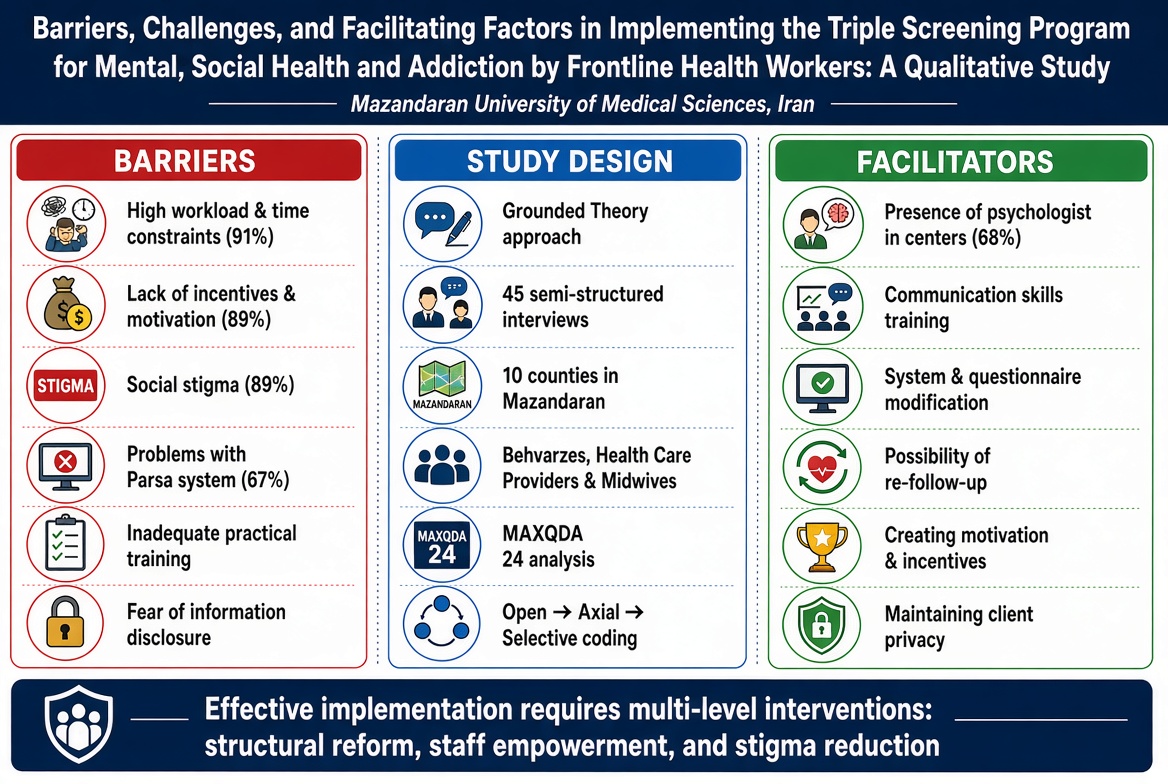
Background and purpose: Primary health care (PHC) is the first point of contact between individuals and the health system and is a cornerstone of health equity and universal health coverage. Integrating mental health, social health, and addiction services into PHC can facilitate early identification of problems and help reduce the treatment gap. Despite the implementation of the triple screening programme in Iran, structural, educational, and cultural challenges remain. This study aimed to explore the barriers, challenges, and facilitators associated with the initial implementation of the triple screening programme for mental health, social health, and addiction, from the perspective of frontline healthcare staff at Mazandaran University of Medical Sciences.
Materials and methods: This qualitative study used a grounded theory approach. Participants included community health workers, healthcare providers, and midwifery care providers in Mazandaran Province, Iran. Purposive maximum-variation and snowball sampling were used to recruit participants from 10 counties until theoretical saturation was achieved. In total, 45 semi-structured interviews were conducted. Data were analysed using open, axial, and selective coding, following the Strauss and Corbin framework, with MAXQDA version 24 used to support data management and analysis.
Results: Structural barriers included high workloads and time constraints, problems with the Parsa system, insufficient incentives and motivation, slow internet connections in rural areas, and lengthy delays in editing screening records. Social and cultural barriers included stigma, concerns about personal information being recorded, and low participation among men and adolescents. Educational barriers included inadequate training and an overly theoretical approach to training. Facilitators included the presence of psychologists at health centres, training in communication skills, opportunities for client follow-up, improvements to the information system and screening questionnaire, staff motivation, and the opportunity to provide further care when new problems arose.
Conclusion: Effective implementation of the triple screening programme requires addressing structural, educational, and cultural barriers, strengthening staff skills and motivation, improving access to psychological support at the primary care level, and raising public awareness to reduce stigma. These findings provide context-specific evidence that may inform improvements to screening policies and implementation strategies in Iran.
Type of Study: Research(Original) |
Subject:
Family Health
Send email to the article author
| Rights and permissions | |
 |
This work is licensed under a Creative Commons Attribution-NonCommercial 4.0 International License. |

Articles Copyright © The Author(s). Owned by Mazandaran University of Medical Sciences.
Contact Us
Address: Journal Office, Building No. 2, Mazandaran University of Medical Sciences, Moallem Square, Sari.Tel: +98 (011)34484874 Postal code: 48175-866 E-Mail: jmums@mazums.ac.ir Telefax: +98 (011)33262679
