

Volume 36, Issue 258 (7-2026)
J Mazandaran Univ Med Sci 2026, 36(258): 138-144 |
Back to browse issues page



Download citation:
BibTeX | RIS | EndNote | Medlars | ProCite | Reference Manager | RefWorks
Send citation to:


BibTeX | RIS | EndNote | Medlars | ProCite | Reference Manager | RefWorks
Send citation to:
Fallah H, Salehi S, Ahmadi N. A Rare Presentation of Leptospirosis with Marked Hyperbilirubinemia: Diagnostic and Therapeutic Challenges. J Mazandaran Univ Med Sci 2026; 36 (258) :138-144
URL: http://jmums.mazums.ac.ir/article-1-22798-en.html
URL: http://jmums.mazums.ac.ir/article-1-22798-en.html


Abstract: (15 Views)
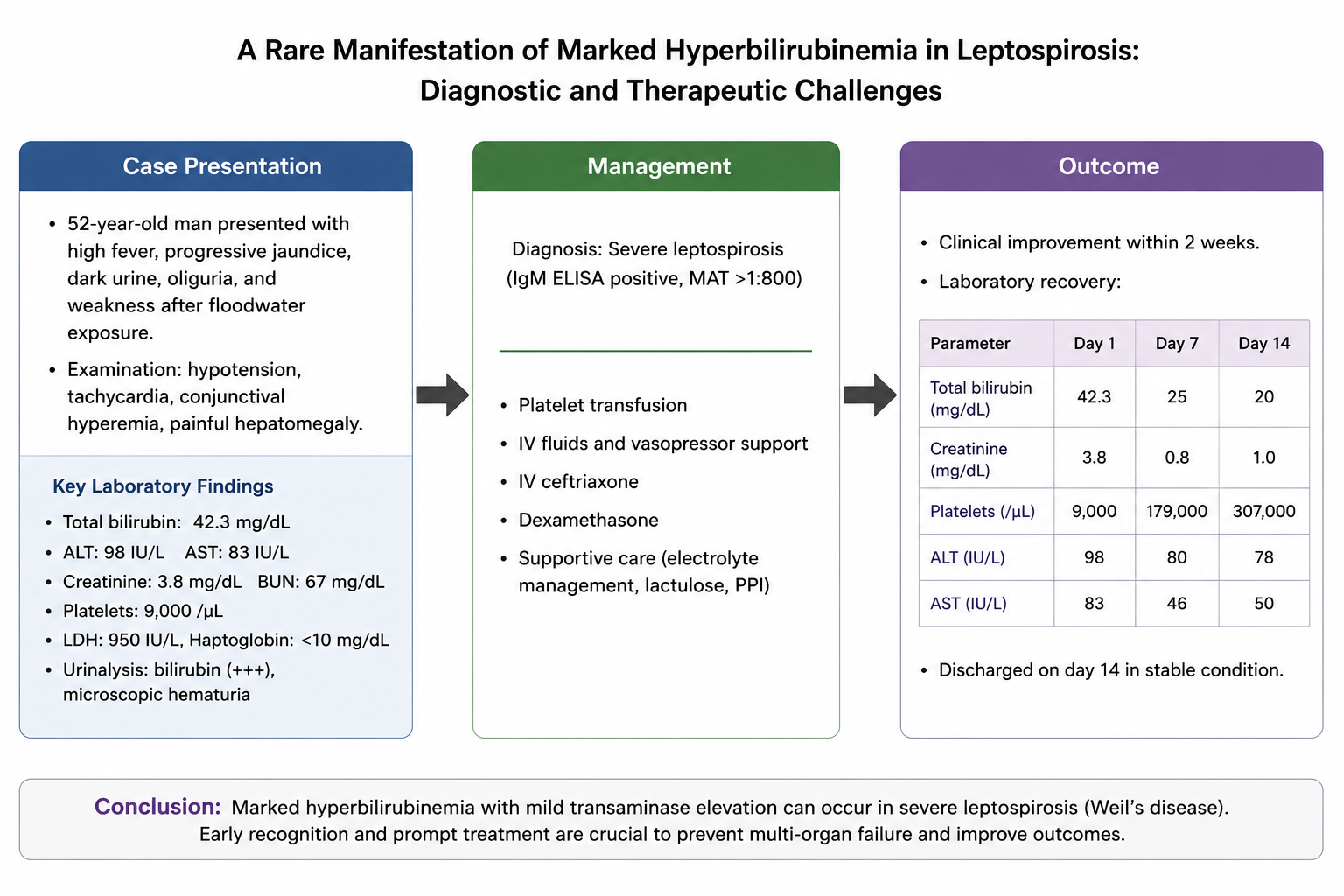
Abstract: Leptospirosis is a widespread zoonotic infection caused by spirochetes of the genus Leptospira, primarily transmitted through contact with water contaminated by the urine of infected animals. The disease ranges in severity from a mild, self-limiting febrile illness to a severe form, known as Weil's disease, which is characterized by hepatic dysfunction, acute kidney injury, and coagulation abnormalities. Jaundice is a common clinical finding; however, severe hyperbilirubinemia is uncommon and may lead to diagnostic confusion with primary hepatobiliary disorders. Hepatic involvement typically follows a cholestatic pattern, with a disproportionate elevation of serum bilirubin relative to transaminase levels. We report the case of a 52-year-old man who presented with high fever, progressive jaundice, and oliguria after exposure to floodwaters. Physical examination revealed hypotension, tachycardia, conjunctival hyperemia, and tender hepatomegaly. Initial laboratory investigations demonstrated severe hyperbilirubinemia, with a total bilirubin level of 42.3 mg/dL, disproportionately elevated relative to serum transaminase levels (aspartate aminotransferase, 83 IU/L; alanine aminotransferase, 98 IU/L). The patient also had acute kidney injury (serum creatinine, 3.8 mg/dL), thrombocytopenia, and evidence suggestive of hemolysis. Serological tests for viral hepatitis, malaria, and dengue were negative. The diagnosis of severe leptospirosis was confirmed by positive Leptospira IgM serology and the microscopic agglutination test (MAT), with a titre of >1:800. Following treatment with targeted antibiotic therapy, intravenous fluids, vasopressors, platelet transfusions, and supportive care, the patient showed marked clinical and laboratory improvement over the subsequent two weeks. This case highlights that severe hyperbilirubinemia with only mild transaminase elevation can be a rare but clinically important presentation of Weil's disease. Leptospirosis should therefore be included in the differential diagnosis of patients presenting with fever, jaundice, acute kidney injury, and a history of exposure to floodwaters or contaminated water. Early recognition, prompt initiation of appropriate antibiotic therapy, and supportive management are essential to prevent multiorgan failure and improve clinical outcomes.
Type of Study: Case Report |
Subject:
Internal medicine
Send email to the article author
| Rights and permissions | |
 |
This work is licensed under a Creative Commons Attribution-NonCommercial 4.0 International License. |

Articles Copyright © The Author(s). Owned by Mazandaran University of Medical Sciences.
Contact Us
Address: Journal Office, Building No. 2, Mazandaran University of Medical Sciences, Moallem Square, Sari.Tel: +98 (011)34484874 Postal code: 48175-866 E-Mail: jmums@mazums.ac.ir Telefax: +98 (011)33262679
