

Volume 36, Issue 259 (8-2026)
J Mazandaran Univ Med Sci 2026, 36(259): 30-40 |
Back to browse issues page



Download citation:
BibTeX | RIS | EndNote | Medlars | ProCite | Reference Manager | RefWorks
Send citation to:


BibTeX | RIS | EndNote | Medlars | ProCite | Reference Manager | RefWorks
Send citation to:
Nazari-Robati M, Naghibi N, Sadeghi A, Qaderipour H. Effects of Ellagic Acid on Sirt1 and AMPK Gene Expression and Oxidative Stress in Aged Rat Hearts. J Mazandaran Univ Med Sci 2026; 36 (259) :30-40
URL: http://jmums.mazums.ac.ir/article-1-22802-en.html
URL: http://jmums.mazums.ac.ir/article-1-22802-en.html


Abstract: (29 Views)
Background and purpose: Impaired energy metabolism and oxidative stress contribute to structural and functional changes in ageing tissues, including the heart. Sirtuin 1 (SIRT1) and adenosine monophosphate-activated protein kinase (AMPK) play important roles in regulating metabolic pathways and antioxidant responses. Ellagic acid is a natural polyphenolic compound with antioxidant properties. This study investigated the effects of ellagic acid on Sirt1 and AMPK-related gene expression, as well as oxidative stress markers, in the hearts of aged rats.
Materials and methods: In this experimental study, 14 male 25-month-old rats were randomly assigned to two groups: a control group and an ellagic acid-treated group. Ellagic acid was dissolved in normal saline containing 0.1% DMSO. The control group received the vehicle solution, whereas the treatment group received ellagic acid (30 mg/kg) by oral gavage for one month. After the treatment period, the animals were deeply anaesthetised, and heart tissues were collected. The expression levels of Sirt1 and AMPK-related genes were evaluated using real-time PCR. Additionally, oxidative stress markers, including malondialdehyde (MDA), superoxide dismutase (SOD), catalase (CAT), and total antioxidant capacity (TAC), were measured in heart tissue.
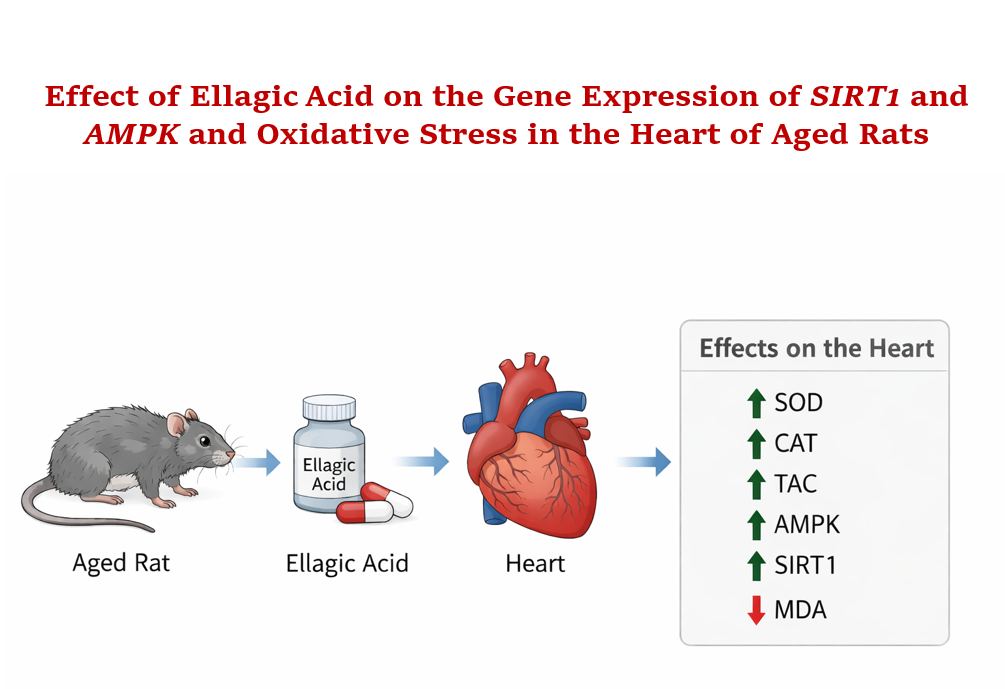
Results: Ellagic acid treatment significantly increased the expression of Sirt1 and AMPK-related genes in the heart tissue of aged rats (P< 0.05). In addition, SOD, CAT, and TAC levels were significantly increased (P< 0.05), whereas MDA levels were significantly decreased (P< 0.001) compared with the control group.
Conclusion: Ellagic acid may exert protective effects on the aged heart by enhancing the expression of genes involved in metabolic regulation, including Sirt1 and AMPK-related pathways, while reducing oxidative stress.
Materials and methods: In this experimental study, 14 male 25-month-old rats were randomly assigned to two groups: a control group and an ellagic acid-treated group. Ellagic acid was dissolved in normal saline containing 0.1% DMSO. The control group received the vehicle solution, whereas the treatment group received ellagic acid (30 mg/kg) by oral gavage for one month. After the treatment period, the animals were deeply anaesthetised, and heart tissues were collected. The expression levels of Sirt1 and AMPK-related genes were evaluated using real-time PCR. Additionally, oxidative stress markers, including malondialdehyde (MDA), superoxide dismutase (SOD), catalase (CAT), and total antioxidant capacity (TAC), were measured in heart tissue.
Results: Ellagic acid treatment significantly increased the expression of Sirt1 and AMPK-related genes in the heart tissue of aged rats (P< 0.05). In addition, SOD, CAT, and TAC levels were significantly increased (P< 0.05), whereas MDA levels were significantly decreased (P< 0.001) compared with the control group.
Conclusion: Ellagic acid may exert protective effects on the aged heart by enhancing the expression of genes involved in metabolic regulation, including Sirt1 and AMPK-related pathways, while reducing oxidative stress.
Type of Study: Research(Original) |
Subject:
Sports biomechanics
Send email to the article author
| Rights and permissions | |
 |
This work is licensed under a Creative Commons Attribution-NonCommercial 4.0 International License. |

Articles Copyright © The Author(s). Owned by Mazandaran University of Medical Sciences.
Contact Us
Address: Journal Office, Building No. 2, Mazandaran University of Medical Sciences, Moallem Square, Sari.Tel: +98 (011)34484874 Postal code: 48175-866 E-Mail: jmums@mazums.ac.ir Telefax: +98 (011)33262679
