

Volume 36, Issue 262 (Special Issue 2026)
J Mazandaran Univ Med Sci 2026, 36(262): 180-186 |
Back to browse issues page



Download citation:
BibTeX | RIS | EndNote | Medlars | ProCite | Reference Manager | RefWorks
Send citation to:


BibTeX | RIS | EndNote | Medlars | ProCite | Reference Manager | RefWorks
Send citation to:
Sargazi Aval O, Nikbakht R, Azarmehr T, Memarbashi E, Poodineh Moghadam M, Bagheri S, et al . Death Anxiety and Hope among Patients with Cancer. , J Mazandaran Univ Med Sci. 2026; 36 (262) :180-186
URL: http://jmums.mazums.ac.ir/article-1-22829-en.html
URL: http://jmums.mazums.ac.ir/article-1-22829-en.html
Omolbanin Sargazi Aval 
 , Razieh Nikbakht , Tayebeh Azarmehr , Ehsan Memarbashi , Mahdieh Poodineh Moghadam * , Somayeh Bagheri , Hossein Shahdadi , Mozghan Rahnama
Abstract: (32 Views)
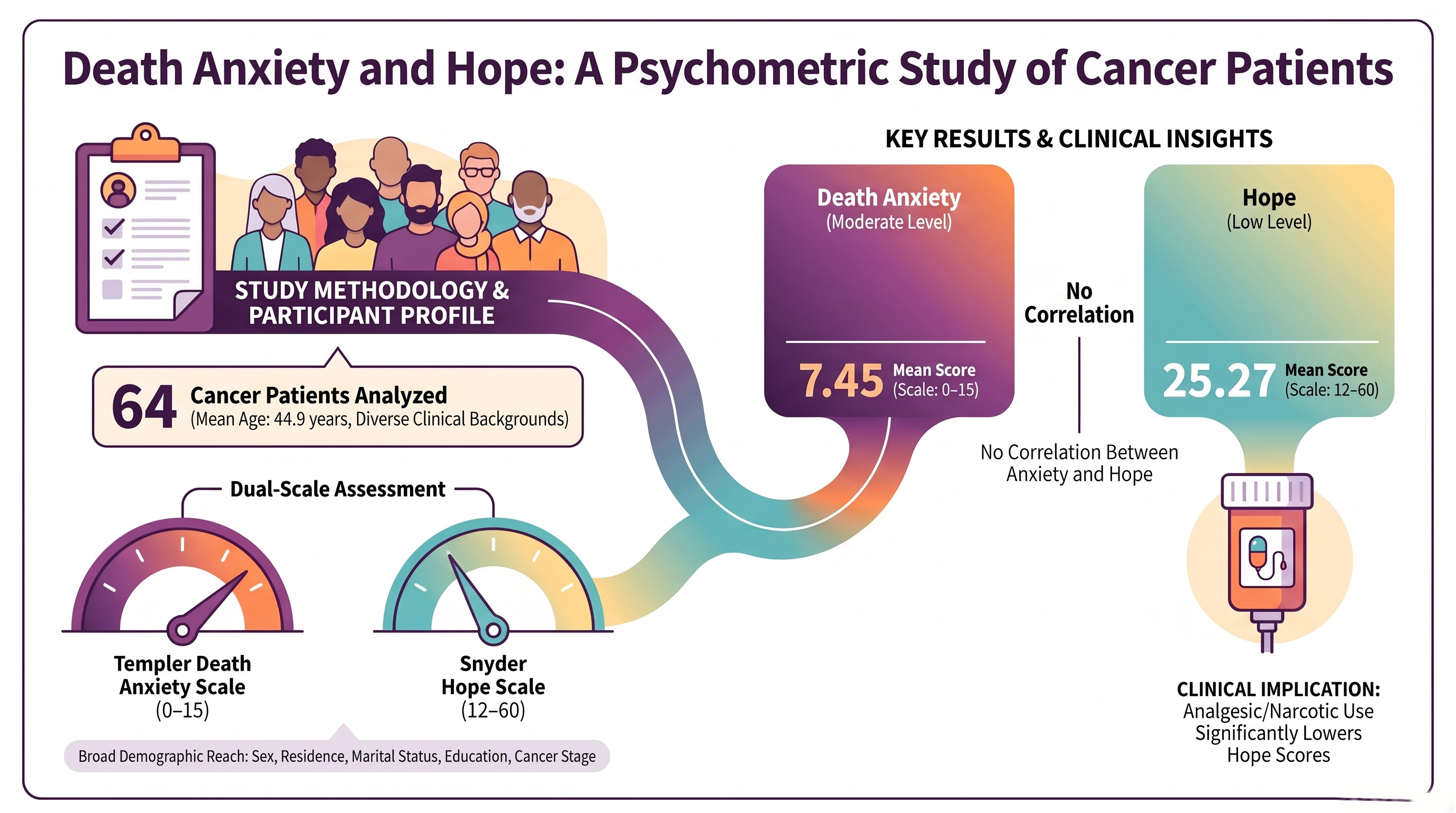
Background and purpose: Cancer can be accompanied by psychological distress, fear of death, and diminished hope, in addition to its physical consequences. Death anxiety refers to fear and apprehension concerning death, whereas, within Snyder’s framework, hope encompasses the motivation to pursue goals and the perceived ability to identify pathways towards achieving them. This study aimed to assess death anxiety and hope and examine their associations with demographic and clinical characteristics in patients with cancer.
Materials and methods: This descriptive-analytical, cross-sectional study involved a secondary analysis of baseline data from a larger study. A total of 64 patients were assessed at IranMehr Oncology Center in Birjand, Iran, between December 2023 and June 2024. Data were collected using a demographic and clinical questionnaire, the 15-item Templer Death Anxiety Scale (score range, 0-15), and the 12-item Snyder Hope Scale (score range, 12-60). Following assessment of normality using the Shapiro-Wilk test, the Mann-Whitney U test, Kruskal-Wallis test, and Spearman’s rank correlation were used, with statistical significance set at P < 0.05.
Results: The mean age of participants was 44.94 ± 11.66 years. Mean death anxiety and hope scores were 7.45 ± 0.85 and 25.27 ± 3.64, respectively; neither variable was normally distributed. Death anxiety was not significantly associated with sex, age, residence, marital status, educational attainment, occupation, economic status, cancer stage, cancer type, or illness duration. Similarly, hope scores were not significantly associated with these characteristics, except for analgesic or narcotic use, which was associated with lower hope scores (U = 392, P = 0.024). Death anxiety and hope were not significantly correlated (ρ = 0.124, P = 0.330).
Conclusion: This study underscores the necessity of enhancing supportive psychological care for cancer patients. Given the psychological challenges inherent in this population, integrating routine psychological screening into clinical practice, particularly for patients with a high symptom burden, is a vital step toward improving their psychological well-being and overall quality of life.
Type of Study: Brief Report |
Subject:
nursing
Send email to the article author
| Rights and permissions | |
 |
This work is licensed under a Creative Commons Attribution-NonCommercial 4.0 International License. |

Articles Copyright © The Author(s). Owned by Mazandaran University of Medical Sciences.
Contact Us
Address: Journal Office, Building No. 2, Mazandaran University of Medical Sciences, Moallem Square, Sari.Tel: +98 (011)34484874 Postal code: 48175-866 E-Mail: jmums@mazums.ac.ir Telefax: +98 (011)33262679
