

Volume 36, Issue 264 (11-2026)
J Mazandaran Univ Med Sci 2026, 36(264): 192-197 |
Back to browse issues page



Download citation:
BibTeX | RIS | EndNote | Medlars | ProCite | Reference Manager | RefWorks
Send citation to:


BibTeX | RIS | EndNote | Medlars | ProCite | Reference Manager | RefWorks
Send citation to:
Rezaei S, Pakdin Parizi A P, Shaban M, Salehipour M, Ebrahimnejad P, Mogharabi-Manzari M. Immobilized Lipase Prepared Using the Cross-Linked Enzyme Aggregates Method for the Transesterification of Soybean Oil. , J Mazandaran Univ Med Sci. 2026; 36 (264) :192-197
URL: http://jmums.mazums.ac.ir/article-1-22834-en.html
URL: http://jmums.mazums.ac.ir/article-1-22834-en.html
Shahla Rezaei 
 , Ali P Pakdin Parizi , Mohammad Shaban , Masoud Salehipour , Pedram Ebrahimnejad , Mehdi Mogharabi-Manzari *
Abstract: (15 Views)
Background and purpose: The use of lipase in biodiesel production, owing to its ability to catalyze reactions under mild conditions and its environmental advantages, is considered a suitable alternative to chemical catalysts. However, the low stability and high cost of free enzymes have limited their industrial use. The aim of this study was to prepare an immobilized lipase using the cross-linked enzyme aggregates (CLEAs) method, evaluate its performance in the transesterification of soybean oil, and determine the optimal process conditions.
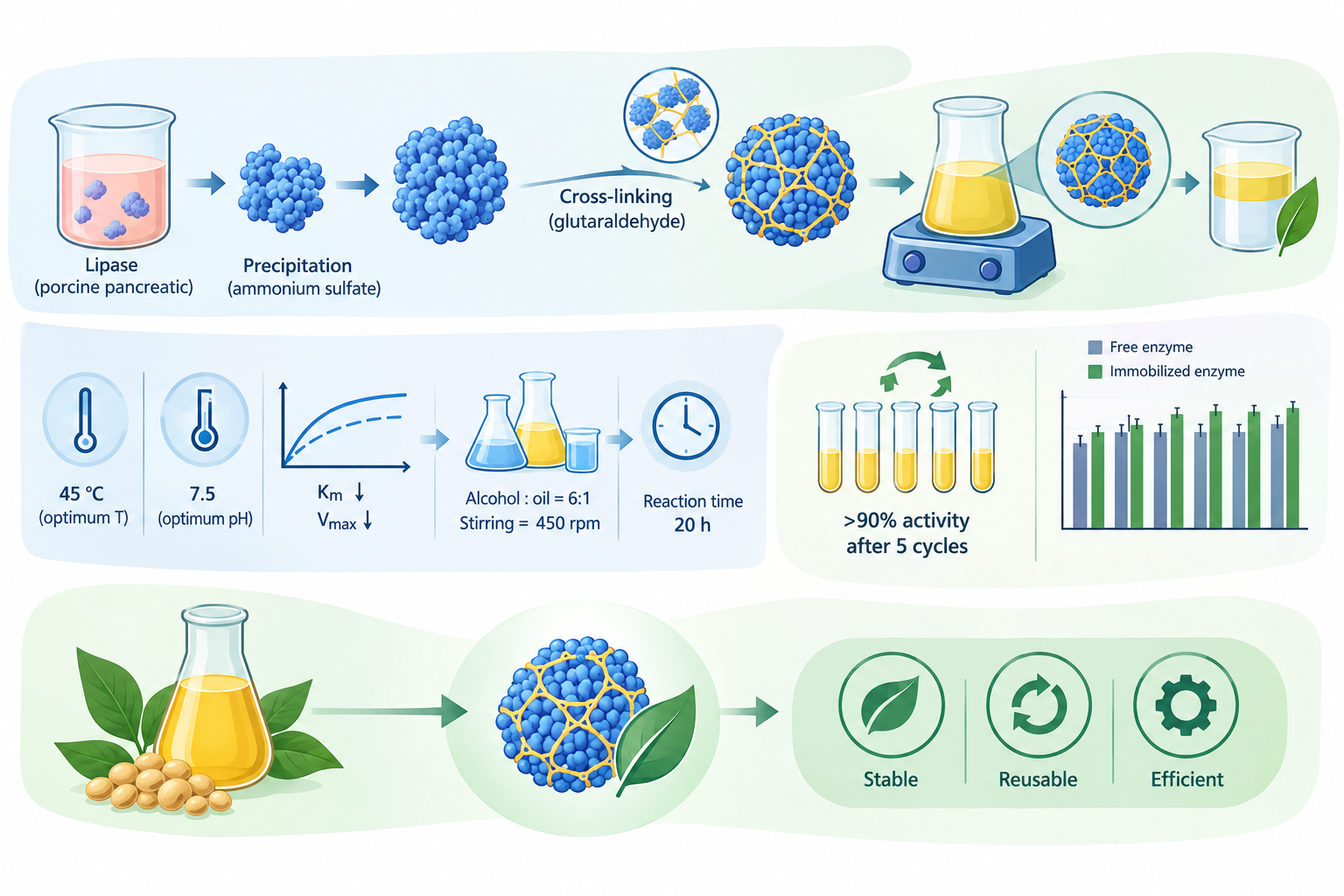
Materials and methods: In this experimental study, porcine pancreatic lipase was precipitated with ammonium sulfate and subsequently immobilized using glutaraldehyde through the cross-linked enzyme aggregates (CLEAs) method. Enzyme activity was determined spectrophotometrically using p-nitrophenyl palmitate as the substrate. The kinetic characteristics of the enzyme and the effects of various factors, including temperature, reaction time, alcohol-to-oil ratio, and stirring speed, on the transesterification yield were also investigated.
Results: The optimum temperature and pH for the activity of the immobilized lipase were 45 °C and 7.5, respectively. After five consecutive reuse cycles, the immobilized enzyme retained more than 90% of its initial activity. The Michaelis–Menten constant (Km) of the immobilized enzyme was lower than that of the free enzyme, whereas the maximum reaction velocity (Vmax) decreased. Furthermore, increasing the alcohol-to-oil ratio to 6 and the stirring speed to 450 rpm enhanced biodiesel yield, with the highest yield achieved after 20 h.
Conclusion: The immobilized lipase prepared by this method exhibited good stability, reusability, and catalytic efficiency in the transesterification of soybean oil. Therefore, it may serve as a promising biocatalyst for enzymatic biodiesel production and could help overcome some limitations of conventional chemical catalysts.
Type of Study: Brief Report |
Subject:
Biotechnology
| Rights and permissions | |
 |
This work is licensed under a Creative Commons Attribution-NonCommercial 4.0 International License. |

Articles Copyright © The Author(s). Owned by Mazandaran University of Medical Sciences.
Contact Us
Address: Journal Office, Building No. 2, Mazandaran University of Medical Sciences, Moallem Square, Sari.Tel: +98 (011)34484874 Postal code: 48175-866 E-Mail: jmums@mazums.ac.ir Telefax: +98 (011)33262679
