

Volume 36, Issue 258 (7-2026)
J Mazandaran Univ Med Sci 2026, 36(258): 153-158 |
Back to browse issues page



Download citation:
BibTeX | RIS | EndNote | Medlars | ProCite | Reference Manager | RefWorks
Send citation to:


BibTeX | RIS | EndNote | Medlars | ProCite | Reference Manager | RefWorks
Send citation to:
Varshoei F, Hajialibeig A, Mehravaran H, Navaeifar M R, Rezai M S. Unusual Initial Presentation of Measles with Subcutaneous Emphysema and Pneumomediastinum: A Case Report. J Mazandaran Univ Med Sci 2026; 36 (258) :153-158
URL: http://jmums.mazums.ac.ir/article-1-22871-en.html
URL: http://jmums.mazums.ac.ir/article-1-22871-en.html
Fatemeh Varshoei 
 , Azin Hajialibeig , Hossein Mehravaran , Mohammad Reza Navaeifar , Mohammad Sadegh Rezai
, Azin Hajialibeig , Hossein Mehravaran , Mohammad Reza Navaeifar , Mohammad Sadegh Rezai
Abstract: (12 Views)
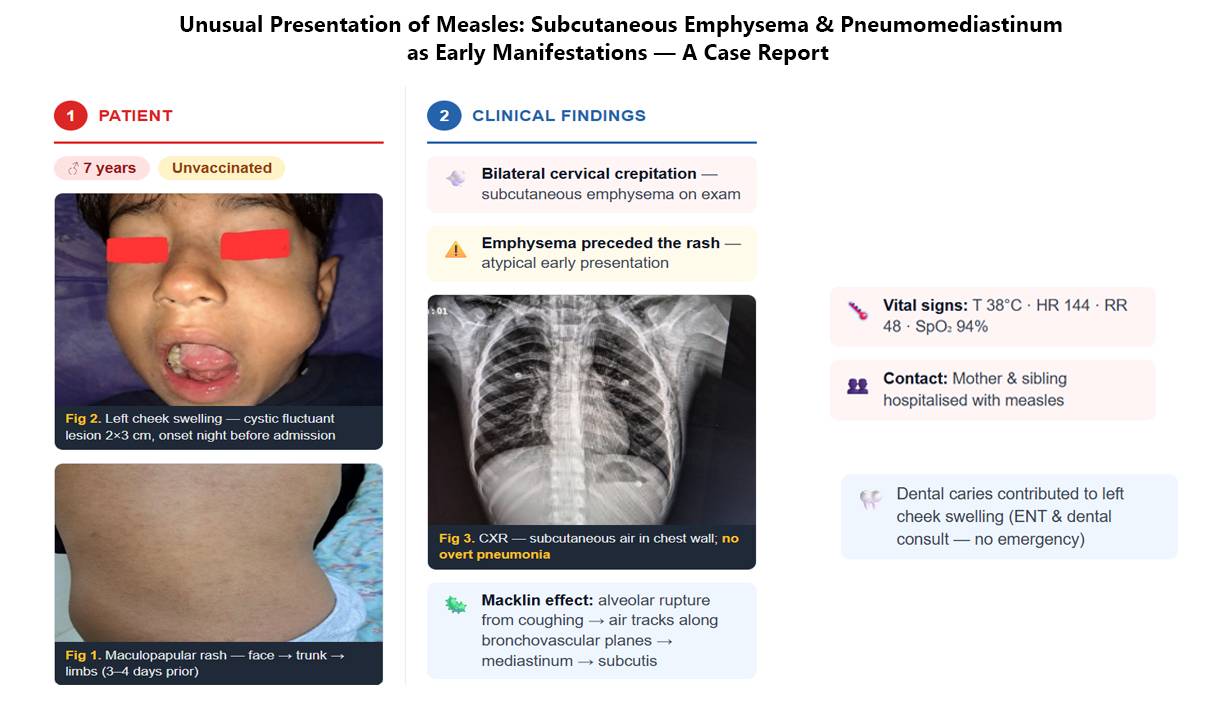
Despite the widespread availability of effective vaccines, measles remains one of the most contagious viral infections and continues to pose a significant public health challenge worldwide. Pneumonia is the most common and severe respiratory complication of measles, whereas pneumomediastinum and subcutaneous emphysema are rare manifestations. Early recognition of these uncommon complications is essential, as timely management may reduce disease-related morbidity and mortality. We report the case of a 7-year-old unvaccinated boy who presented with fever, severe respiratory distress, and cervical subcutaneous emphysema as the initial manifestation of illness. Notably, this unusual presentation preceded the development of the classic clinical features of measles, including the characteristic skin rash and conjunctivitis. Chest radiography and computed tomography revealed extensive subcutaneous emphysema extending into the upper thoracic region, without radiological evidence of pneumonia. Given his history of close contact with confirmed measles cases, supportive care, vitamin A supplementation, and empirical antibiotic therapy were initiated. The patient's clinical condition improved steadily, and no surgical intervention was required. The diagnosis of measles was subsequently confirmed by polymerase chain reaction (PCR) and serological testing. After six days of hospitalization, he was discharged in good general condition with marked clinical improvement and near-complete resolution of the subcutaneous emphysema.
Subcutaneous emphysema may represent a rare but clinically important manifestation of measles, even in the absence of radiologically apparent pneumonia. This case highlights the possibility that such an atypical presentation can occur early in the course of the disease. Clinicians should be aware of this rare complication, particularly in unvaccinated children and during measles outbreaks, as early recognition and appropriate management may help prevent adverse outcomes.
Subcutaneous emphysema may represent a rare but clinically important manifestation of measles, even in the absence of radiologically apparent pneumonia. This case highlights the possibility that such an atypical presentation can occur early in the course of the disease. Clinicians should be aware of this rare complication, particularly in unvaccinated children and during measles outbreaks, as early recognition and appropriate management may help prevent adverse outcomes.
Type of Study: Case Report |
Subject:
Pediatric Infectious Disease
Send email to the article author
| Rights and permissions | |
 |
This work is licensed under a Creative Commons Attribution-NonCommercial 4.0 International License. |

Articles Copyright © The Author(s). Owned by Mazandaran University of Medical Sciences.
Contact Us
Address: Journal Office, Building No. 2, Mazandaran University of Medical Sciences, Moallem Square, Sari.Tel: +98 (011)34484874 Postal code: 48175-866 E-Mail: jmums@mazums.ac.ir Telefax: +98 (011)33262679
