

Volume 36, Issue 259 (8-2026)
J Mazandaran Univ Med Sci 2026, 36(259): 158-164 |
Back to browse issues page



Download citation:
BibTeX | RIS | EndNote | Medlars | ProCite | Reference Manager | RefWorks
Send citation to:


BibTeX | RIS | EndNote | Medlars | ProCite | Reference Manager | RefWorks
Send citation to:
Nasiri Formi E, Tabatabaei Aghda S A, Siahposht-Khachaki A, Azizi S, Darayee M, Ebrahimnejad P. Comparative Effects of Mupirocin, Silver Nanoparticle, and Arnebia euchroma (Abukhalsa) Ointments on IL-1β and IL-10 Expression during Wound Healing in Rats. J Mazandaran Univ Med Sci 2026; 36 (259) :158-164
URL: http://jmums.mazums.ac.ir/article-1-22874-en.html
URL: http://jmums.mazums.ac.ir/article-1-22874-en.html
Ebrahim Nasiri Formi 
 , Seyyed Abolfazl Tabatabaei Aghda , Ali Siahposht-Khachaki , Soheil Azizi , Masood Darayee , Pedram Ebrahimnejad
, Seyyed Abolfazl Tabatabaei Aghda , Ali Siahposht-Khachaki , Soheil Azizi , Masood Darayee , Pedram Ebrahimnejad
Abstract: (47 Views)
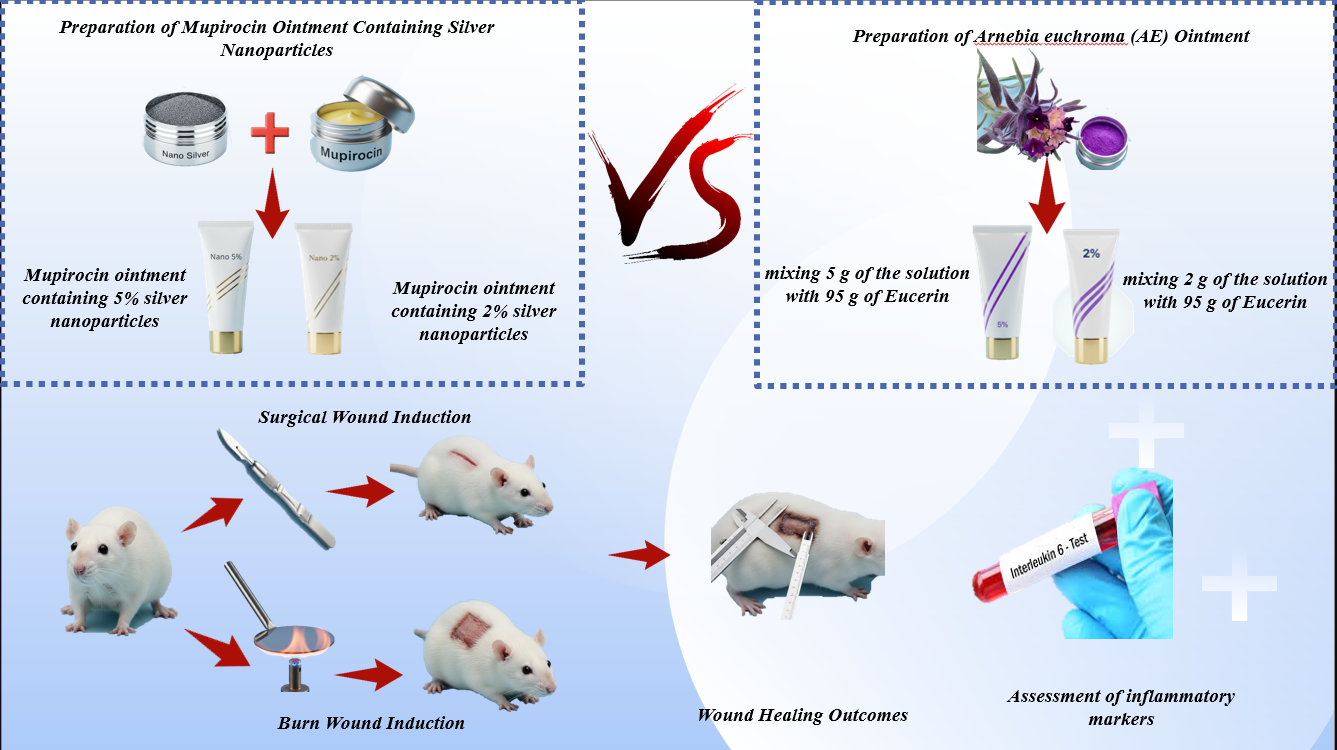
Background and purpose: Burn and surgical wounds are associated with distinct inflammatory responses, and conventional treatments such as mupirocin alone may be insufficient. This study aimed to compare the effects of mupirocin and silver nanoparticle (Nano)-based ointment with Arnebia euchroma (AE; Abukhalsa) ointment on inflammatory markers IL-1β and IL-10 in rat burn and full-thickness longitudinal incisional wound models, and to evaluate reductions in wound-related outcomes, including infection, discharge, inflammation, and scab formation.
Materials and methods: A controlled in vivo experimental study was conducted using 72 male Wistar rats (weighing 160-210 g) with two wound models: deep second-degree burn (7 groups of 6 rats) and full-thickness longitudinal incision wounds (5 groups of 6 rats). Treatment groups received ointments containing 2% mupirocin, 1% silver sulfadiazine (SSD), 2% and 5% AE, and 2% and 5% Nano formulations. Dressings were changed daily, and clinical signs were assessed on days 3, 7, 14, and 21 using a 0-2 scoring system. Serum levels of IL-1β and IL-10 were measured on days 7 and 21 using ELISA. Data were analysed using one-way analysis of variance (ANOVA) and Tukey’s post hoc test in SPSS version 24.
Results: Nano 5% ointment in burn wounds demonstrated the lowest discharge (mean score = 0.001) and infection score (mean score = 0.001), while Nano 2% ointment in surgical wounds showed greater reductions in discharge, infection, inflammation, and scab formation compared with AE 5% (p < 0.05). IL-1β levels in the Nano 2% and AE 5% groups were significantly decreased (p < 0.01), while IL-10 levels were increased, indicating potential modulation of the inflammatory response.
Conclusion: Silver nanoparticle formulations demonstrated promising wound-healing effects in this experimental model compared with mupirocin and AE. Nano 5% for burn wounds and Nano 2% for full-thickness longitudinal incision wounds showed greater potential for improving wound outcomes through reduced discharge, infection, and modulation of inflammatory cytokines. Further clinical studies are required to determine their effectiveness in human wound management.
Materials and methods: A controlled in vivo experimental study was conducted using 72 male Wistar rats (weighing 160-210 g) with two wound models: deep second-degree burn (7 groups of 6 rats) and full-thickness longitudinal incision wounds (5 groups of 6 rats). Treatment groups received ointments containing 2% mupirocin, 1% silver sulfadiazine (SSD), 2% and 5% AE, and 2% and 5% Nano formulations. Dressings were changed daily, and clinical signs were assessed on days 3, 7, 14, and 21 using a 0-2 scoring system. Serum levels of IL-1β and IL-10 were measured on days 7 and 21 using ELISA. Data were analysed using one-way analysis of variance (ANOVA) and Tukey’s post hoc test in SPSS version 24.
Results: Nano 5% ointment in burn wounds demonstrated the lowest discharge (mean score = 0.001) and infection score (mean score = 0.001), while Nano 2% ointment in surgical wounds showed greater reductions in discharge, infection, inflammation, and scab formation compared with AE 5% (p < 0.05). IL-1β levels in the Nano 2% and AE 5% groups were significantly decreased (p < 0.01), while IL-10 levels were increased, indicating potential modulation of the inflammatory response.
Conclusion: Silver nanoparticle formulations demonstrated promising wound-healing effects in this experimental model compared with mupirocin and AE. Nano 5% for burn wounds and Nano 2% for full-thickness longitudinal incision wounds showed greater potential for improving wound outcomes through reduced discharge, infection, and modulation of inflammatory cytokines. Further clinical studies are required to determine their effectiveness in human wound management.
Keywords: Mupirocin, silver nanoparticles, ointments, Arnebia euchroma, interleukin-1β (IL-1β), interleukin-10 (IL-10), wound healing, surgical wounds, burns, full-thickness incisional wounds
Type of Study: Brief Report |
Subject:
Reconstructive and Burn, Plastic surgery
Send email to the article author
| Rights and permissions | |
 |
This work is licensed under a Creative Commons Attribution-NonCommercial 4.0 International License. |

Articles Copyright © The Author(s). Owned by Mazandaran University of Medical Sciences.
Contact Us
Address: Journal Office, Building No. 2, Mazandaran University of Medical Sciences, Moallem Square, Sari.Tel: +98 (011)34484874 Postal code: 48175-866 E-Mail: jmums@mazums.ac.ir Telefax: +98 (011)33262679
