

Volume 36, Issue 264 (11-2026)
J Mazandaran Univ Med Sci 2026, 36(264): 39-51 |
Back to browse issues page



Download citation:
BibTeX | RIS | EndNote | Medlars | ProCite | Reference Manager | RefWorks
Send citation to:


BibTeX | RIS | EndNote | Medlars | ProCite | Reference Manager | RefWorks
Send citation to:
Torabi Goodarzi S, Layali I, Ghanbari S, RanjbarQorveh H, Torabi Goodarzi A H. Design and Construction of an Expression Vector for the Expression of a Human VEGF-COP-GFP Fusion Protein in Escherichia coli. , J Mazandaran Univ Med Sci. 2026; 36 (264) :39-51
URL: http://jmums.mazums.ac.ir/article-1-22875-en.html
URL: http://jmums.mazums.ac.ir/article-1-22875-en.html
Sam Torabi Goodarzi 
 , Issa Layali * , Shakila Ghanbari , Hadis RanjbarQorveh , Amir Hossien Torabi Goodarzi
Abstract: (23 Views)
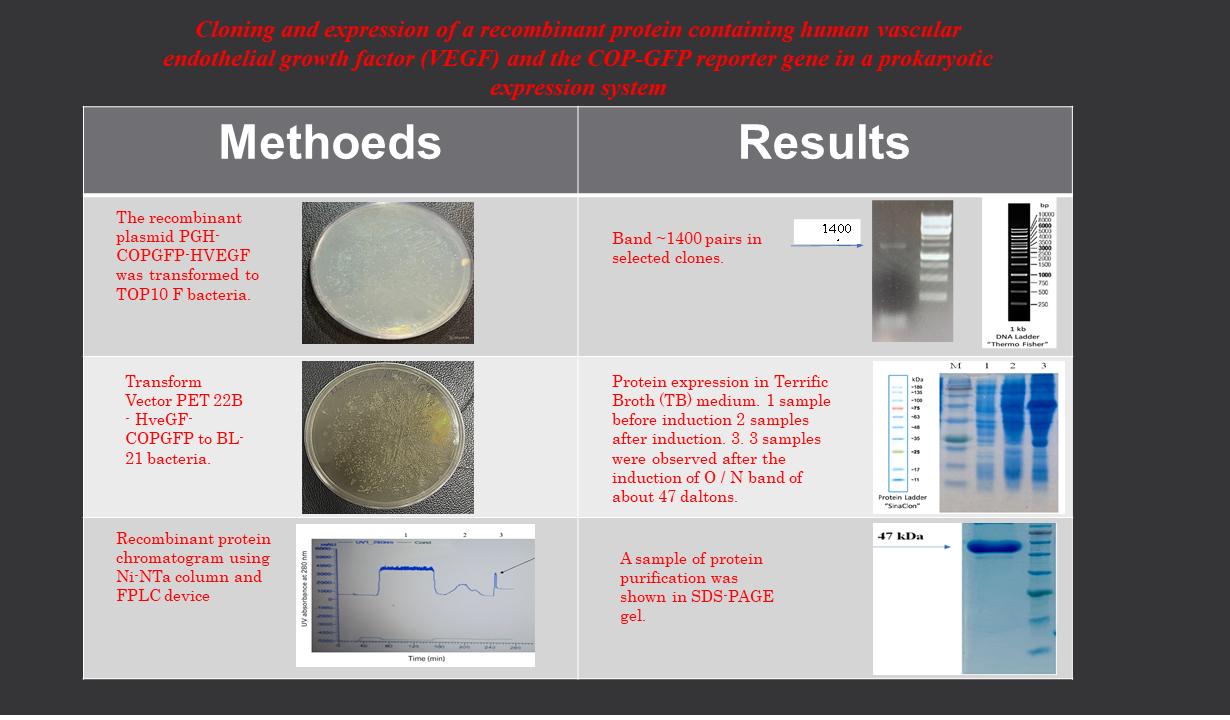
Background and purpose: Vascular endothelial growth factor (VEGF) plays a vital role in physiological processes such as angiogenesis and tissue repair. Given its involvement in the pathophysiology of various diseases, including cardiovascular disease, ocular disorders, and cancer, the production of adequate quantities of recombinant VEGF is of great importance. In this study, the COP-GFP fluorescent reporter gene was used to facilitate the monitoring of cloning success and recombinant protein expression through fluorescence.
Materials and methods: The gene construct was designed by fusing the human VEGF gene with the COP-GFP gene. This construct was cloned into the pET22b expression vector and subsequently introduced into E. coli strains for cloning and into BL21 cells for protein expression. Expression of the VEGF-COP-GFP fusion protein was induced by adding IPTG to the culture medium. Successful protein expression and the expected molecular weight were assessed by SDS-PAGE and Western blotting. The recombinant VEGF-COP-GFP protein was then purified from the cell lysate using Ni-NTA chromatography.
Results: The VEGF-COP-GFP fusion construct was successfully expressed in the E. coli prokaryotic expression system. SDS-PAGE and Western blotting confirmed protein expression and a molecular weight consistent with the expected size. Purification by Ni-NTA chromatography provided a straightforward and cost-effective approach to obtaining the recombinant protein. The COP-GFP reporter enabled direct monitoring of the fusion protein through fluorescence.
Conclusion: The results demonstrate the successful expression of the VEGF-COP-GFP fusion protein in the E. coli prokaryotic expression system. The incorporation of COP-GFP enables fluorescence-based tracking of the fusion protein, providing a useful tool for future functional studies. This approach may also support the development of production methods for VEGF and other recombinant proteins for research and potential therapeutic applications.
Keywords: Vascular Endothelial Growth Factor (VEGF), COP‑GFP: COP‑GFP, Recombinant Protein, Prokaryotic Expression System, Cloning
Type of Study: Research(Original) |
Subject:
Sports biomechanics
Send email to the article author
| Rights and permissions | |
 |
This work is licensed under a Creative Commons Attribution-NonCommercial 4.0 International License. |

Articles Copyright © The Author(s). Owned by Mazandaran University of Medical Sciences.
Contact Us
Address: Journal Office, Building No. 2, Mazandaran University of Medical Sciences, Moallem Square, Sari.Tel: +98 (011)34484874 Postal code: 48175-866 E-Mail: jmums@mazums.ac.ir Telefax: +98 (011)33262679
