

Volume 36, Issue 264 (11-2026)
J Mazandaran Univ Med Sci 2026, 36(264): 185-191 |
Back to browse issues page



Download citation:
BibTeX | RIS | EndNote | Medlars | ProCite | Reference Manager | RefWorks
Send citation to:


BibTeX | RIS | EndNote | Medlars | ProCite | Reference Manager | RefWorks
Send citation to:
Latifi S A, Moradi Farahani A, Farahani H, Ramezani M. Cytotoxic Effects of a Hydroalcoholic Leaf Extract of Elderberry (Sambucus ebulus L.) and Associated Changes in Redox Markers in A431 Skin Cancer Cells. , J Mazandaran Univ Med Sci. 2026; 36 (264) :185-191
URL: http://jmums.mazums.ac.ir/article-1-22888-en.html
URL: http://jmums.mazums.ac.ir/article-1-22888-en.html


Abstract: (9 Views)
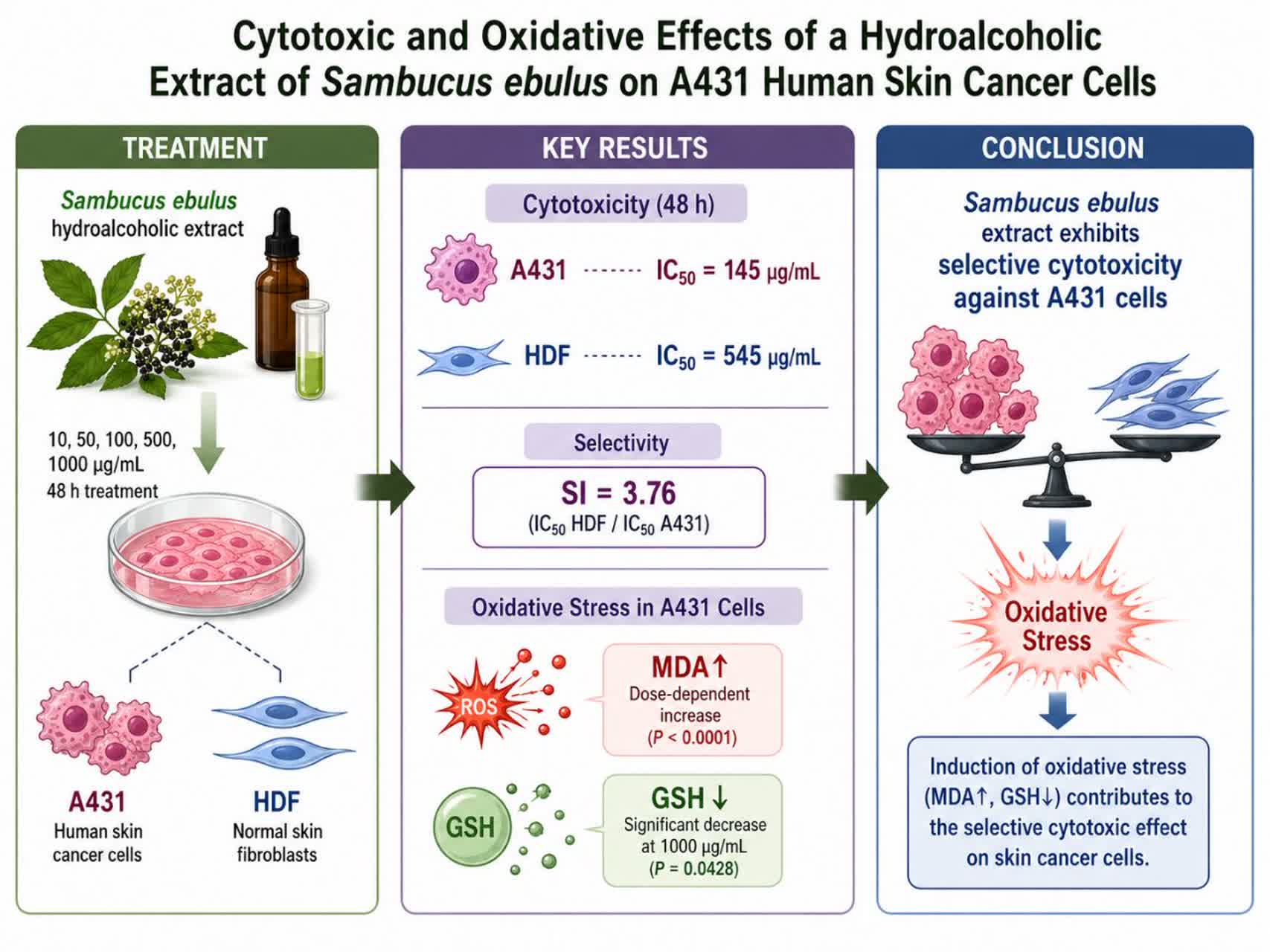
Background and purpose: Elderberry (Sambucus ebulus L.) is a medicinal plant traditionally used for various purposes and contains a range of phenolic and flavonoid compounds. Its antioxidant and cytotoxic properties have been reported in previous studies. The present study aimed to evaluate the cytotoxic effects of a hydroalcoholic extract of elderberry leaves on the A431 human skin cancer cell line, compare its effects with those observed in normal human dermal fibroblast (HDF) cells, and assess selected markers of cellular redox status.
Materials and methods: Elderberry leaves were extracted using 50% ethanol. A431 and HDF cells were treated with the extract at concentrations of 10, 50, 100, 500, and 1000 μg/mL for 48 hours. Cell viability was assessed using the MTT assay, and the half-maximal inhibitory concentration (IC₅₀) and selectivity index (SI) were determined. Malondialdehyde (MDA) and reduced glutathione (GSH) levels were also measured in A431 cells.
Results: The total phenolic content of the extract was 69.6 ± 13.6 mg gallic acid equivalents per gram of dried extract. Treatment with the extract resulted in a concentration-dependent decrease in A431 cell viability, with an IC₅₀ of 145 μg/mL. In HDF cells, the IC₅₀ was 545 μg/mL, yielding a selectivity index of 3.76. MDA levels increased significantly at all concentrations tested (P < 0.0001), whereas GSH levels decreased significantly only at the highest concentration tested (1000 μg/mL) (P = 0.0428).
Conclusion: The hydroalcoholic leaf extract of elderberry exhibited greater cytotoxic activity against A431 cells than against normal HDF cells, suggesting a degree of selectivity toward cancer cells. Exposure to the extract was also associated with alterations in cellular redox status, as reflected by changes in MDA and GSH levels. However, these findings alone are insufficient to establish a causal role for oxidative stress in extract-induced cell death.
Type of Study: Brief Report |
Subject:
toxicology
Send email to the article author
| Rights and permissions | |
 |
This work is licensed under a Creative Commons Attribution-NonCommercial 4.0 International License. |

Articles Copyright © The Author(s). Owned by Mazandaran University of Medical Sciences.
Contact Us
Address: Journal Office, Building No. 2, Mazandaran University of Medical Sciences, Moallem Square, Sari.Tel: +98 (011)34484874 Postal code: 48175-866 E-Mail: jmums@mazums.ac.ir Telefax: +98 (011)33262679
