

Volume 36, Issue 259 (8-2026)
J Mazandaran Univ Med Sci 2026, 36(259): 218-235 |
Back to browse issues page



Download citation:
BibTeX | RIS | EndNote | Medlars | ProCite | Reference Manager | RefWorks
Send citation to:


BibTeX | RIS | EndNote | Medlars | ProCite | Reference Manager | RefWorks
Send citation to:
Rahimzadeh G, Rezai M S. Phage Cocktails for Biological Decontamination: A Narrative Review of Applications, Formulation Challenges, and Translational Barriers. J Mazandaran Univ Med Sci 2026; 36 (259) :218-235
URL: http://jmums.mazums.ac.ir/article-1-22896-en.html
URL: http://jmums.mazums.ac.ir/article-1-22896-en.html


Abstract: (26 Views)
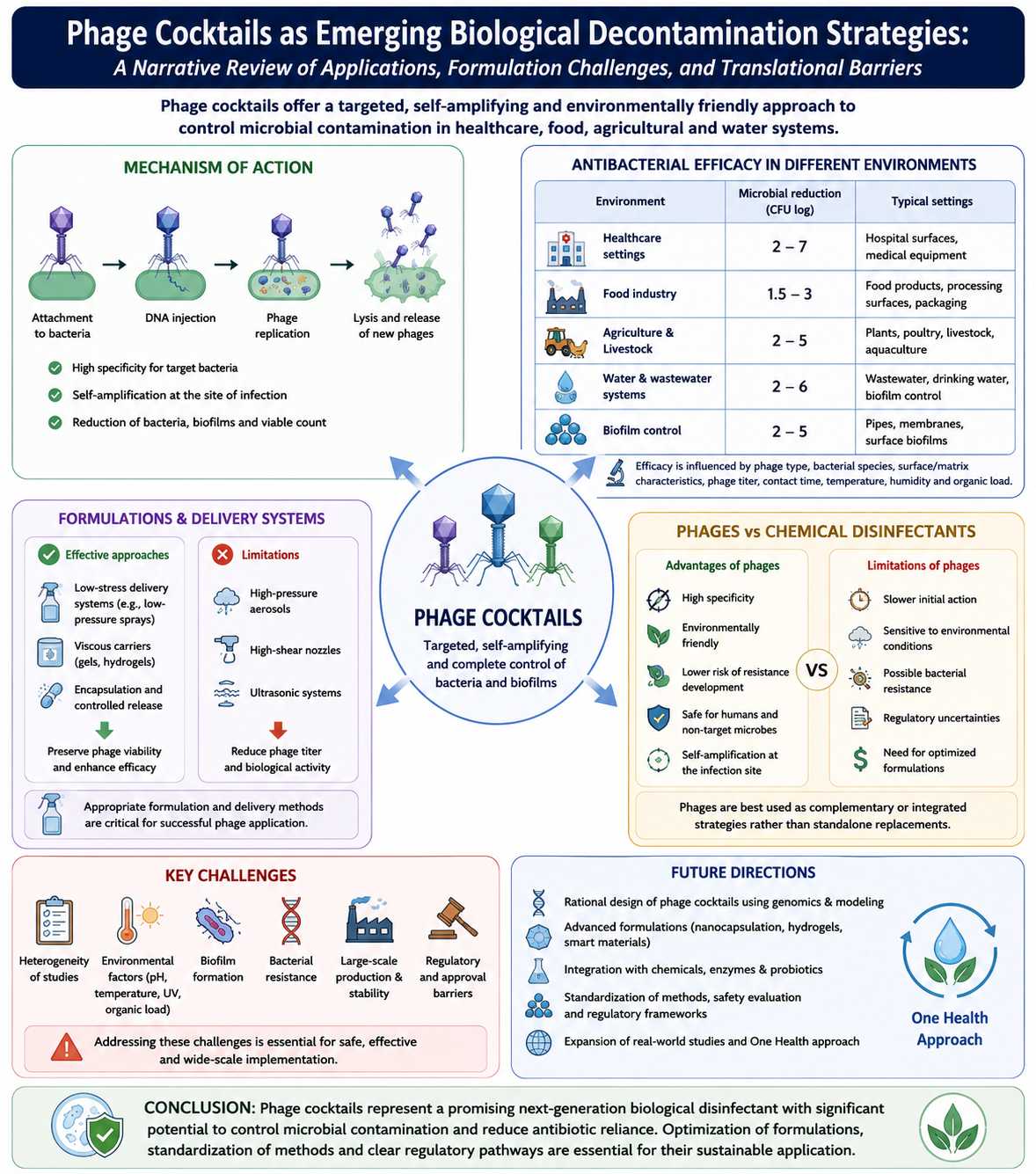
Background and purpose: Healthcare-associated infections and the increasing prevalence of antimicrobial resistance are among the most critical global public health challenges. In this context, bacteriophage cocktails have emerged as promising alternatives to conventional antimicrobial approaches owing to their high specificity, ability to replicate at the site of contamination, reduced likelihood of resistance development, and environmental compatibility. Despite numerous studies, a comprehensive synthesis of their applications across different fields is still lacking. Therefore, this narrative review aimed to summarize the available evidence on the application of phage cocktails for microbial contamination control in medical, food, livestock and poultry, and environmental settings.
Materials and methods: This narrative review evaluated studies published between 2000 and 2025 that were retrieved from PubMed, Scopus, Web of Science, Google Scholar, and patent databases. The selected studies were categorized and analyzed according to their application field, target pathogens, matrix characteristics, phage formulation, and delivery or application methods.
Results: The reported reduction in microbial load achieved by phage cocktails ranged from approximately 1.5 to more than 7 log, depending on the target pathogen, matrix characteristics, phage titre, contact time, environmental conditions, and organic load. Phage cocktails demonstrated superior efficacy owing to their broader host range and lower probability of resistance development. Furthermore, protective or encapsulated formulations improved phage stability and performance. The strongest evidence was found in food safety applications, whereas clinical and wastewater treatment applications remain largely at the laboratory or pilot stage. Biofilm formation, UV exposure, surface desiccation, and regulatory challenges were identified as the main barriers to broader implementation.
Conclusion: Phage cocktails offer considerable promise as biological disinfectants for controlling microbial contamination and reducing dependence on antibiotics. However, their widespread application will require optimized formulations, standardized evaluation methods, and well-defined regulatory frameworks, allowing this technology to become a key component of sustainable microbial contamination control strategies within the One Health framework.
Materials and methods: This narrative review evaluated studies published between 2000 and 2025 that were retrieved from PubMed, Scopus, Web of Science, Google Scholar, and patent databases. The selected studies were categorized and analyzed according to their application field, target pathogens, matrix characteristics, phage formulation, and delivery or application methods.
Results: The reported reduction in microbial load achieved by phage cocktails ranged from approximately 1.5 to more than 7 log, depending on the target pathogen, matrix characteristics, phage titre, contact time, environmental conditions, and organic load. Phage cocktails demonstrated superior efficacy owing to their broader host range and lower probability of resistance development. Furthermore, protective or encapsulated formulations improved phage stability and performance. The strongest evidence was found in food safety applications, whereas clinical and wastewater treatment applications remain largely at the laboratory or pilot stage. Biofilm formation, UV exposure, surface desiccation, and regulatory challenges were identified as the main barriers to broader implementation.
Conclusion: Phage cocktails offer considerable promise as biological disinfectants for controlling microbial contamination and reducing dependence on antibiotics. However, their widespread application will require optimized formulations, standardized evaluation methods, and well-defined regulatory frameworks, allowing this technology to become a key component of sustainable microbial contamination control strategies within the One Health framework.
Keywords: phage cocktails, biological disinfection, antimicrobial resistance, biofilm control, surface decontamination, One Health, food safety
Type of Study: Review |
Subject:
Microbiology
Send email to the article author
| Rights and permissions | |
 |
This work is licensed under a Creative Commons Attribution-NonCommercial 4.0 International License. |

Articles Copyright © The Author(s). Owned by Mazandaran University of Medical Sciences.
Contact Us
Address: Journal Office, Building No. 2, Mazandaran University of Medical Sciences, Moallem Square, Sari.Tel: +98 (011)34484874 Postal code: 48175-866 E-Mail: jmums@mazums.ac.ir Telefax: +98 (011)33262679
