

Volume 36, Issue 258 (7-2026)
J Mazandaran Univ Med Sci 2026, 36(258): 3-13 |
Back to browse issues page



Download citation:
BibTeX | RIS | EndNote | Medlars | ProCite | Reference Manager | RefWorks
Send citation to:


BibTeX | RIS | EndNote | Medlars | ProCite | Reference Manager | RefWorks
Send citation to:
Joudaki M, Mozafari M H, Baazm M, Asadi-Fard Y, Khorsandi L. The Hepatoprotective Effect of Alpha-Lipoic Acid against Bisphenol A-Induced Liver Injury in Mice: Modulation of the Nrf2 Pathway and Oxidative Stress. J Mazandaran Univ Med Sci 2026; 36 (258) :3-13
URL: http://jmums.mazums.ac.ir/article-1-22943-en.html
URL: http://jmums.mazums.ac.ir/article-1-22943-en.html
Mohammad Joudaki 
 , Mohammad Hossein Mozafari , Maryam Baazm , Yousef Asadi-Fard , Layasadat Khorsandi
, Mohammad Hossein Mozafari , Maryam Baazm , Yousef Asadi-Fard , Layasadat Khorsandi
Abstract: (19 Views)
Background and purpose: Bisphenol A (BPA), an endocrine-disrupting compound, causes hepatotoxicity through oxidative stress and inflammation. Alpha-lipoic acid (α-LA) is a potent antioxidant shown to protect against liver injury induced by various toxic agents. This study aimed to evaluate the protective effect of α-LA against BPA-induced liver damage in mice.
Materials and methods: In this experimental study, 28 NMRI mice were randomly assigned to four groups: control, α-LA (100 mg/kg), BPA (300 mg/kg), and BPA + α-LA co-treatment. After 35 days, blood and liver tissue samples were collected. Serum activities of AST and ALT, oxidative stress markers (MDA, SOD, and CAT), and the expression of the Nrf2 and NF-κB genes were evaluated using RT-PCR. Histopathological changes were evaluated by H&E staining. Data were analyzed using SPSS software by one-way ANOVA followed by Tukey's post hoc test.
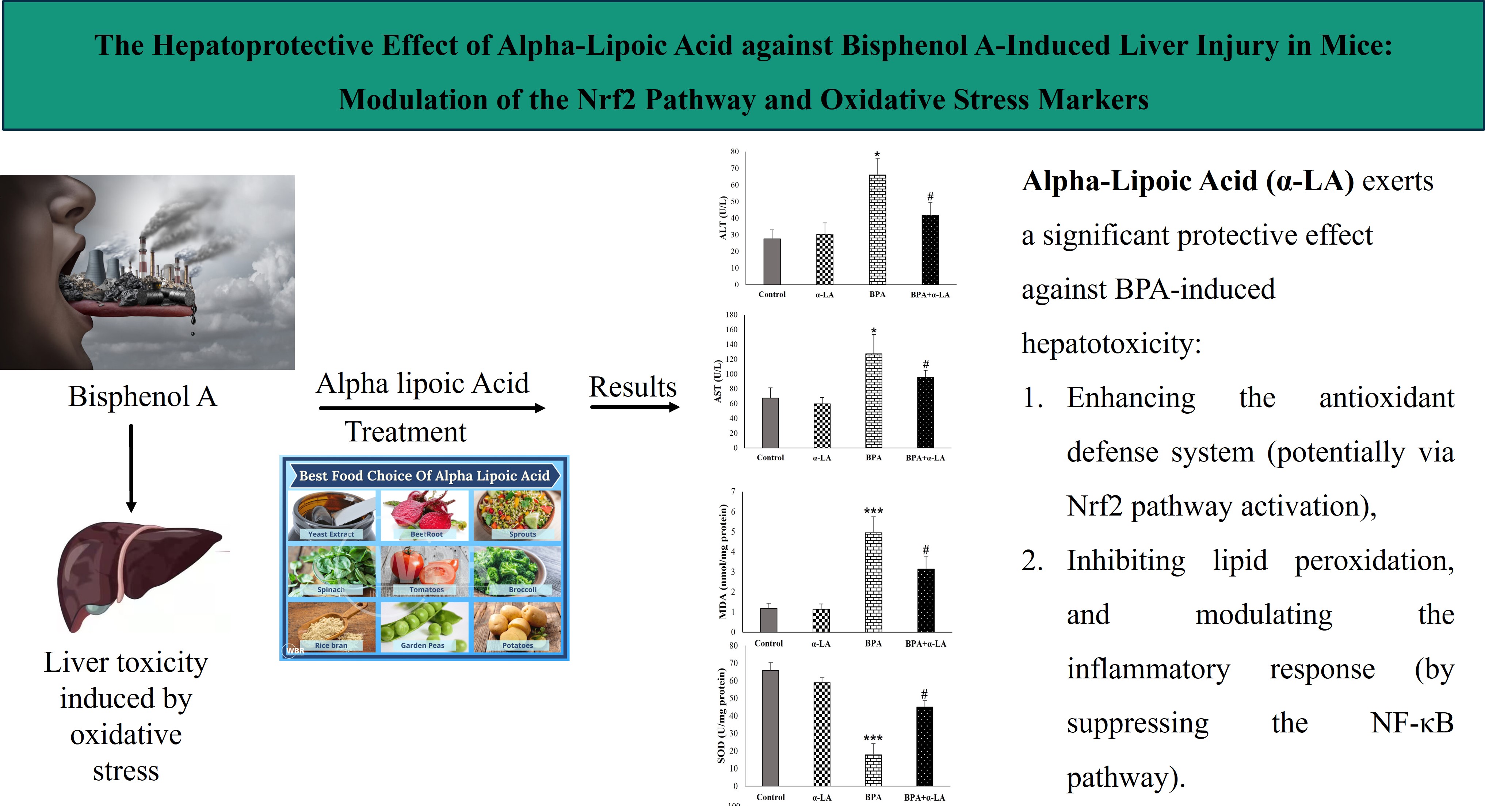
Results: BPA administration significantly increased liver enzyme activities, MDA levels, and NF-κB expression, while decreasing antioxidant enzyme activities and Nrf2 expression. In addition, marked histopathological alterations, including inflammatory cell infiltration and vascular congestion, were observed. Co-treatment with α-LA significantly attenuated these disturbances by reducing hepatic injury markers, improving oxidative stress parameters, upregulating Nrf2 expression, and downregulating NF-κB expression.
Conclusion: The findings indicate that α-LA exerts a significant protective effect against BPA-induced hepatotoxicity, possibly by enhancing the antioxidant defence system through activation of the Nrf2 pathway, inhibiting lipid peroxidation, and suppressing the inflammatory response via downregulation of the NF-κB pathway. These findings support the potential of α-LA as a promising therapeutic strategy for preventing chemically induced liver injury. Therefore, α-LA may represent a potential therapeutic agent for protecting against liver injury induced by endocrine-disrupting chemicals.
Materials and methods: In this experimental study, 28 NMRI mice were randomly assigned to four groups: control, α-LA (100 mg/kg), BPA (300 mg/kg), and BPA + α-LA co-treatment. After 35 days, blood and liver tissue samples were collected. Serum activities of AST and ALT, oxidative stress markers (MDA, SOD, and CAT), and the expression of the Nrf2 and NF-κB genes were evaluated using RT-PCR. Histopathological changes were evaluated by H&E staining. Data were analyzed using SPSS software by one-way ANOVA followed by Tukey's post hoc test.
Results: BPA administration significantly increased liver enzyme activities, MDA levels, and NF-κB expression, while decreasing antioxidant enzyme activities and Nrf2 expression. In addition, marked histopathological alterations, including inflammatory cell infiltration and vascular congestion, were observed. Co-treatment with α-LA significantly attenuated these disturbances by reducing hepatic injury markers, improving oxidative stress parameters, upregulating Nrf2 expression, and downregulating NF-κB expression.
Conclusion: The findings indicate that α-LA exerts a significant protective effect against BPA-induced hepatotoxicity, possibly by enhancing the antioxidant defence system through activation of the Nrf2 pathway, inhibiting lipid peroxidation, and suppressing the inflammatory response via downregulation of the NF-κB pathway. These findings support the potential of α-LA as a promising therapeutic strategy for preventing chemically induced liver injury. Therefore, α-LA may represent a potential therapeutic agent for protecting against liver injury induced by endocrine-disrupting chemicals.
Type of Study: Research(Original) |
Subject:
toxicology
Send email to the article author
| Rights and permissions | |
 |
This work is licensed under a Creative Commons Attribution-NonCommercial 4.0 International License. |

Articles Copyright © The Author(s). Owned by Mazandaran University of Medical Sciences.
Contact Us
Address: Journal Office, Building No. 2, Mazandaran University of Medical Sciences, Moallem Square, Sari.Tel: +98 (011)34484874 Postal code: 48175-866 E-Mail: jmums@mazums.ac.ir Telefax: +98 (011)33262679
