

Volume 36, Issue 264 (11-2026)
J Mazandaran Univ Med Sci 2026, 36(264): 132-140 |
Back to browse issues page



Download citation:
BibTeX | RIS | EndNote | Medlars | ProCite | Reference Manager | RefWorks
Send citation to:


BibTeX | RIS | EndNote | Medlars | ProCite | Reference Manager | RefWorks
Send citation to:
Cheraghmakani H, Moradian M J, Baghbanian S M, Hosseini S H, Abedini M, Ghasemihamedani et al . Distribution of ABO and Rh Blood Groups Among Patients With Multiple Sclerosis in Mazandaran Province, Iran. , J Mazandaran Univ Med Sci. 2026; 36 (264) :132-140
URL: http://jmums.mazums.ac.ir/article-1-23041-en.html
URL: http://jmums.mazums.ac.ir/article-1-23041-en.html
Hamed Cheraghmakani 
 , Mohammad Javad Moradian , Seyed Mohammad Baghbanian , Seyed Hossein Hosseini , Mahmoud Abedini , Ghasemihamedani , Reza Habibisaravi *
Abstract: (17 Views)
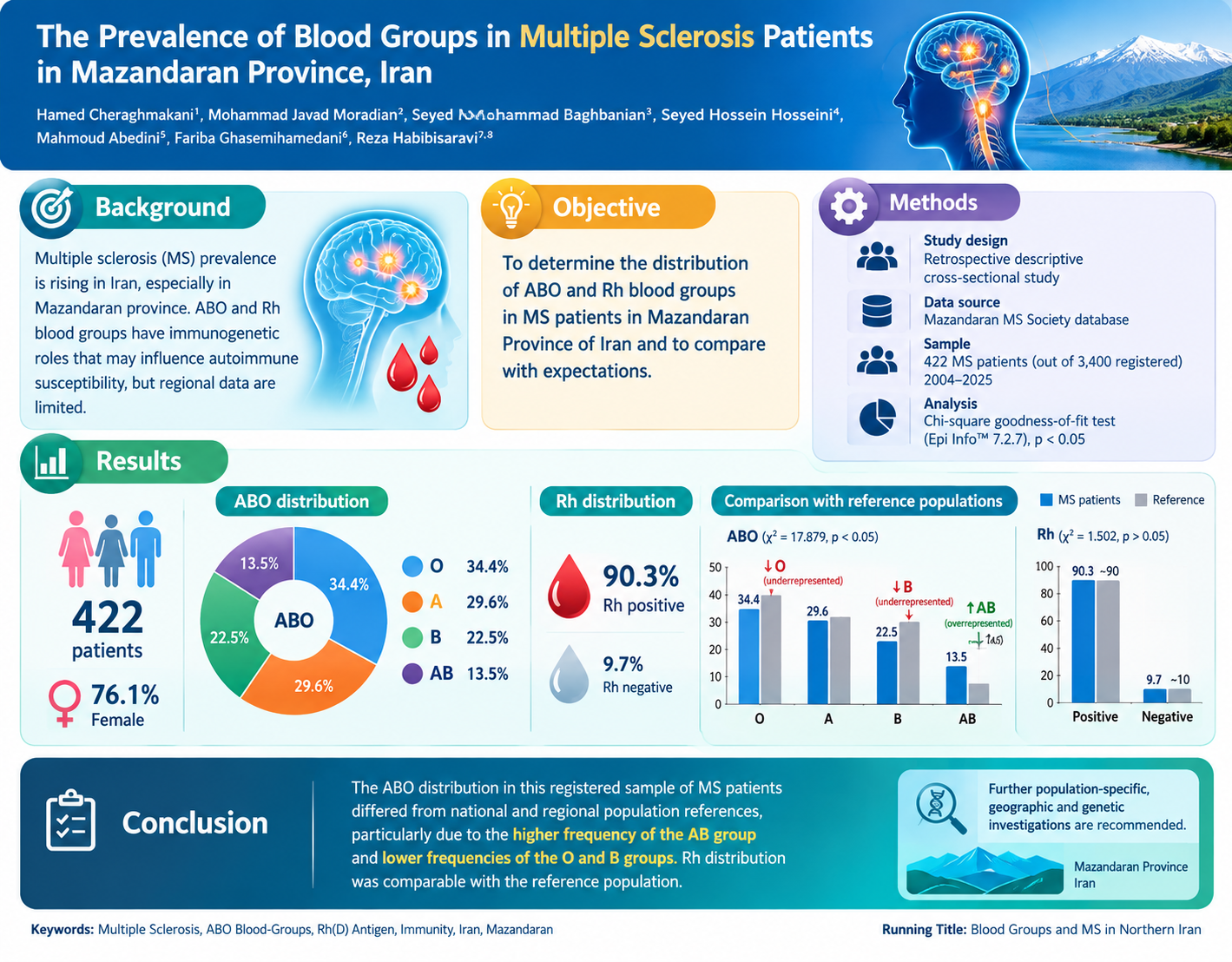
Background and purpose: Multiple sclerosis prevalence is rising in Iran, particularly in Mazandaran Province. ABO and Rh blood groups have immunogenetic roles that may influence autoimmune susceptibility, but region-specific data are limited. This study aimed to characterize the distribution of ABO and Rh blood groups among patients with MS in Mazandaran Province, Iran, and compare the observed distribution with expected frequencies.
Materials and methods: This retrospective descriptive cross-sectional study used registered data from the database of the Multiple Sclerosis Society of Mazandaran Province. Of 3,400 registered patients between 2004 and the end of 2025, records of 422 patients with documented ABO and Rh blood groups were analyzed. A stratified random sampling approach ensured representation by geographic region and sex. Frequencies were compared with published population estimates using chi-square goodness-of-fit tests; analyses were performed with Epi Info™ 7.2.7. A two-sided P value < 0.05 was considered significant.
Results: The cohort comprised 422 patients (76.1% female). ABO distribution was O 34.4%, A 29.6%, B 22.5%, and AB 13.5%; Rh-positive prevalence was 90.3%. Observed ABO frequencies differed from national expectations (χ²=17.879, df=3, P<0.05) and from Mazandaran population estimates (χ²=24.899, df=1, P<0.05). The AB phenotype was markedly overrepresented, while O and B were underrepresented. Rh distribution did not differ from expectations (P>0.05)
Conclusion: The ABO distribution in this registered sample of patients with MS differed from published national and regional population references, particularly with a higher frequency of the AB group and lower frequencies of the O and B groups. Rh distribution was comparable with the reference population. These findings support further population-specific, geographic, and genetic investigations.
Type of Study: Research(Original) |
Subject:
Neurology
Send email to the article author
| Rights and permissions | |
 |
This work is licensed under a Creative Commons Attribution-NonCommercial 4.0 International License. |

Articles Copyright © The Author(s). Owned by Mazandaran University of Medical Sciences.
Contact Us
Address: Journal Office, Building No. 2, Mazandaran University of Medical Sciences, Moallem Square, Sari.Tel: +98 (011)34484874 Postal code: 48175-866 E-Mail: jmums@mazums.ac.ir Telefax: +98 (011)33262679
