

Volume 36, Issue 264 (11-2026)
J Mazandaran Univ Med Sci 2026, 36(264): 121-131 |
Back to browse issues page



Download citation:
BibTeX | RIS | EndNote | Medlars | ProCite | Reference Manager | RefWorks
Send citation to:


BibTeX | RIS | EndNote | Medlars | ProCite | Reference Manager | RefWorks
Send citation to:
Ebrahimi H, Babazadeh A, Ebrahimpour S, Sabbagh P, Ramezaninejad S, Faghanzadeh Ganji G. Frequency of Staphylococcus aureus Nasal Colonisation and Proportion of Methicillin-Resistant Isolates Among Patients Undergoing Coronary Artery Bypass Grafting: A Cross-Sectional Study. , J Mazandaran Univ Med Sci. 2026; 36 (264) :121-131
URL: http://jmums.mazums.ac.ir/article-1-23093-en.html
URL: http://jmums.mazums.ac.ir/article-1-23093-en.html
Hoda Ebrahimi 
 , Arefeh Babazadeh , Soheil Ebrahimpour , Parisa Sabbagh , Sima Ramezaninejad , Ghasem Faghanzadeh Ganji *
Abstract: (22 Views)
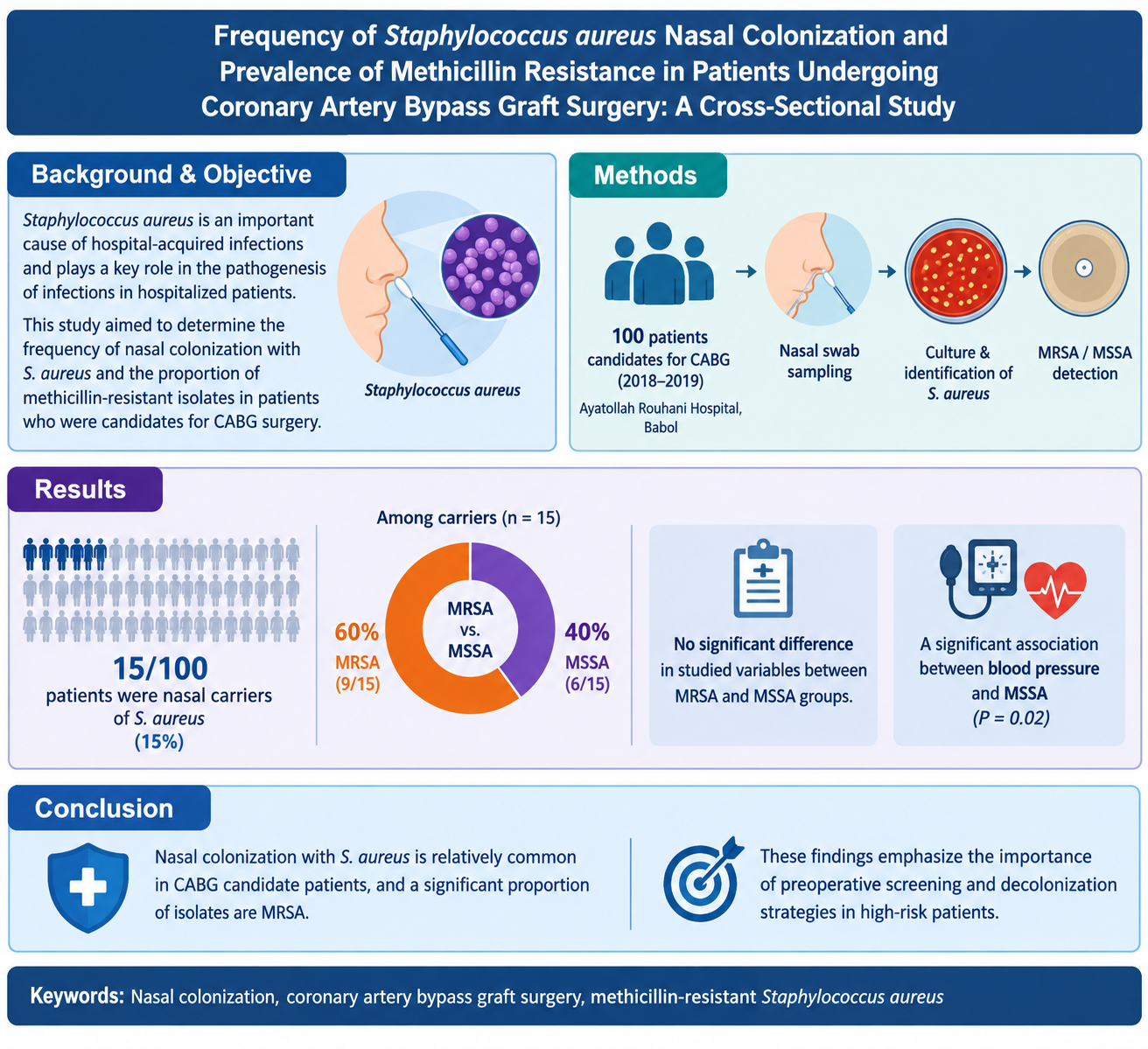
Background and purpose: Staphylococcus aureus is an important cause of hospital-acquired infections. Nasal colonisation with this organism can contribute to the spread of antimicrobial-resistant strains in healthcare settings. Identifying nasal carriers is therefore important for infection prevention. This study aimed to determine the prevalence of nasal colonisation with S. aureus and the proportion of methicillin-resistant isolates among patients scheduled to undergo coronary artery bypass grafting (CABG).
Materials and methods: Patients scheduled to undergo CABG at the cardiac surgery department of Ayatollah Rouhani Hospital in Babol, Iran, in 2019 were enrolled. Nasal swabs were collected to assess colonisation with S. aureus and identify methicillin-resistant S. aureus (MRSA).
Results: Of the 100 patients assessed for cardiac surgery, 15 were identified as nasal carriers of S. aureus. Of these 15 isolates, 60% were methicillin-resistant and 40% were methicillin-susceptible. No significant differences were found in the variables examined between patients carrying methicillin-resistant and methicillin-susceptible S. aureus. However, blood pressure was significantly associated with methicillin-susceptible S. aureus (P = 0.02).
Conclusion: The results of this study showed that nasal colonization of Staphylococcus aureus is relatively common in CABG candidate patients and a significant proportion of isolates are MRSA. These findings highlight the potential importance of preoperative screening and appropriate decolonisation strategies for reducing the risk of healthcare-associated infection in high-risk patients.
Keywords: nasal colonisation, coronary artery bypass grafting, methicillin-resistant Staphylococcus aureus
Type of Study: Research(Original) |
Subject:
infection
Send email to the article author
| Rights and permissions | |
 |
This work is licensed under a Creative Commons Attribution-NonCommercial 4.0 International License. |

Articles Copyright © The Author(s). Owned by Mazandaran University of Medical Sciences.
Contact Us
Address: Journal Office, Building No. 2, Mazandaran University of Medical Sciences, Moallem Square, Sari.Tel: +98 (011)34484874 Postal code: 48175-866 E-Mail: jmums@mazums.ac.ir Telefax: +98 (011)33262679
