

Volume 36, Issue 262 (Special Issue 2026)
J Mazandaran Univ Med Sci 2026, 36(262): 65-76 |
Back to browse issues page



Download citation:
BibTeX | RIS | EndNote | Medlars | ProCite | Reference Manager | RefWorks
Send citation to:


BibTeX | RIS | EndNote | Medlars | ProCite | Reference Manager | RefWorks
Send citation to:
Mohammadi F, Emamjomeh M M, Alizadeh A, Janati Esfahani A. Assessment of Electric and Magnetic Fields Generated by High-Voltage Power Lines Near a Residential Area in Qazvin, Iran. , J Mazandaran Univ Med Sci. 2026; 36 (262) :65-76
URL: http://jmums.mazums.ac.ir/article-1-23131-en.html
URL: http://jmums.mazums.ac.ir/article-1-23131-en.html


Abstract: (51 Views)
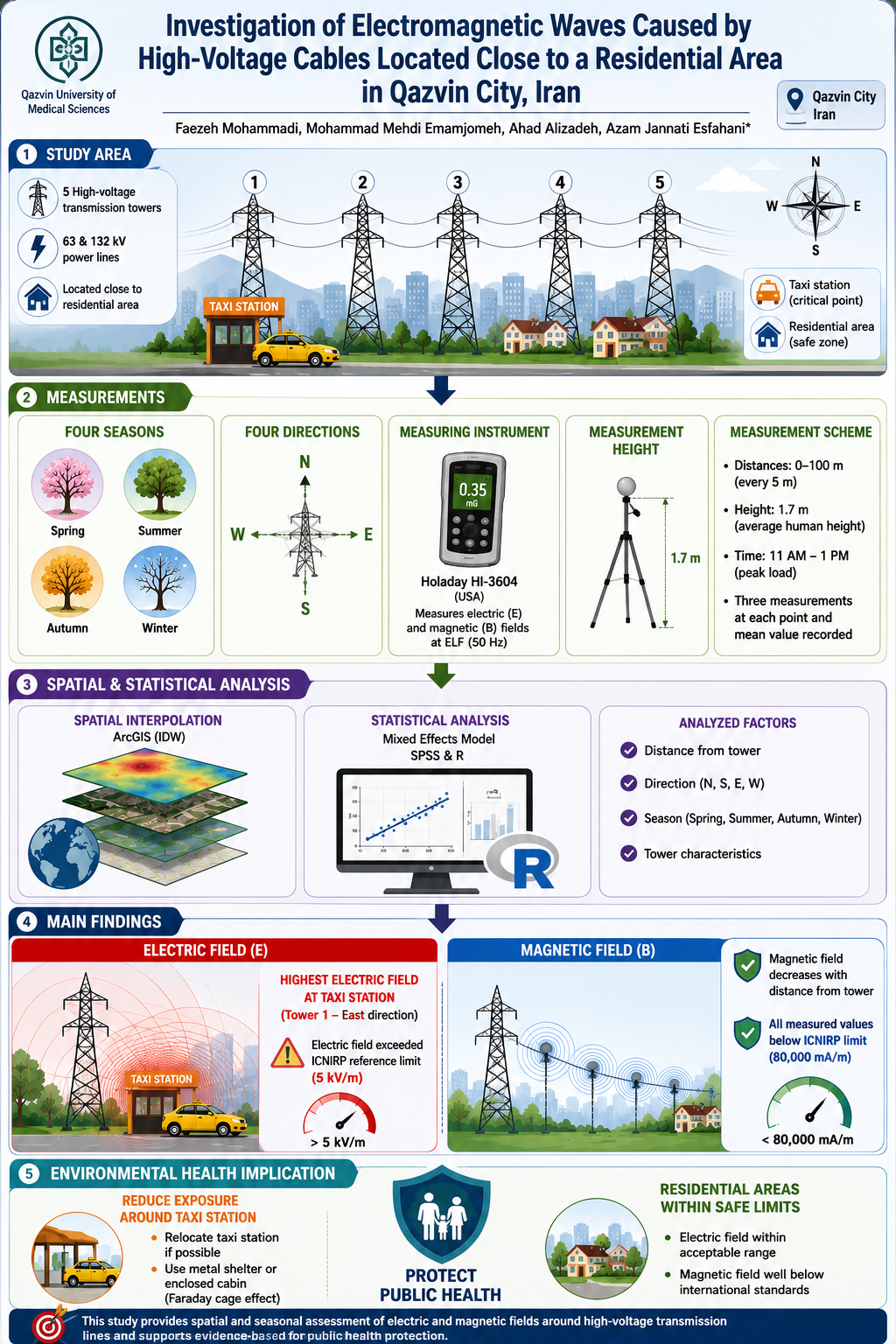
Background and purpose: Given the close proximity of high-voltage power transmission lines to residential areas, it is essential to assess their potential health and environmental impacts. The presence of these lines near residential areas raises concerns about human exposure to extremely low-frequency (ELF) electromagnetic fields. This study aimed to measure the intensities of electric and magnetic fields generated by high-voltage transmission lines near a residential area in Qazvin, Iran.
Materials and methods: This descriptive-analytical study measured electric and magnetic field intensities around five transmission towers carrying 63-kV and 132-kV power lines. Measurements were taken in the four cardinal directions during each of the four seasons of 2025, at a height of 170 cm above ground level. Data were collected using a Holaday HI-3604 field meter and analysed using SPSS, R, and spatial analysis techniques. Distribution maps were generated using ArcGIS. The measured field intensities were compared with the exposure limits recommended by the Iranian National Standards Organization and the International Commission on Non-Ionizing Radiation Protection (ICNIRP).
Results: The highest electric field intensity was observed to the east of Tower 1, at a taxi station, where it exceeded the reference levels recommended by both the Iranian national standard and ICNIRP guidelines. By contrast, all measured magnetic field intensities remained within the recommended limits.
Conclusion: The findings characterise the spatial distribution of electric and magnetic fields around high-voltage transmission lines and indicate that exposure levels vary according to tower location and geographical orientation. The taxi station was identified as the location with the highest measured electric field intensity, highlighting the need for appropriate preventive measures. The other surveyed areas, including residential zones, were within the applicable exposure limits.
Keywords: extremely low-frequency (ELF), electric fields, magnetic fields, ArcGIS, power transmission lines
Type of Study: Research(Original) |
Subject:
health
Send email to the article author
| Rights and permissions | |
 |
This work is licensed under a Creative Commons Attribution-NonCommercial 4.0 International License. |

Articles Copyright © The Author(s). Owned by Mazandaran University of Medical Sciences.
Contact Us
Address: Journal Office, Building No. 2, Mazandaran University of Medical Sciences, Moallem Square, Sari.Tel: +98 (011)34484874 Postal code: 48175-866 E-Mail: jmums@mazums.ac.ir Telefax: +98 (011)33262679
