

Volume 36, Issue 264 (11-2026)
J Mazandaran Univ Med Sci 2026, 36(264): 234-248 |
Back to browse issues page



Download citation:
BibTeX | RIS | EndNote | Medlars | ProCite | Reference Manager | RefWorks
Send citation to:


BibTeX | RIS | EndNote | Medlars | ProCite | Reference Manager | RefWorks
Send citation to:
bahramisamani S, Shahveisi M, shahhosseini Z. Medicalisation of Labour Induction in Low-Risk Pregnancies: A Scoping Review. , J Mazandaran Univ Med Sci. 2026; 36 (264) :234-248
URL: http://jmums.mazums.ac.ir/article-1-23152-en.html
URL: http://jmums.mazums.ac.ir/article-1-23152-en.html


Abstract: (18 Views)
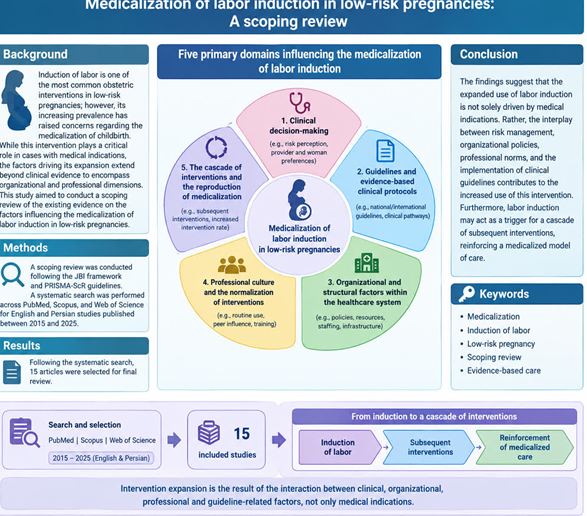
Background and purpose: Induction of labour is a common obstetric intervention, including in low-risk pregnancies. However, its increasing use has raised concerns about the medicalisation of childbirth. Although induction of labour is important when clinically indicated, its growing use may also reflect factors beyond clinical indications, including organisational practices and professional norms. This study aimed to map the existing evidence on factors contributing to the medicalisation of labour induction in low-risk pregnancies through a scoping review.
Materials and methods: This scoping review was conducted in accordance with the Joanna Briggs Institute (JBI) methodology and the Preferred Reporting Items for Systematic Reviews and Meta-Analyses Extension for Scoping Reviews (PRISMA-ScR) guidelines. PubMed, Scopus and Web of Science were searched for English- and Persian-language studies published between 2015 and 2025. Studies examining induction of labour in low-risk or uncomplicated pregnancies were eligible for inclusion, whereas studies focusing on high-risk pregnancies, including those complicated by pre-eclampsia or gestational diabetes, were excluded.
Results: Fifteen articles met the inclusion criteria and were included in the review. The findings were grouped into five main domains influencing the medicalisation of labour induction: (1) clinical decision-making; (2) guidelines and evidence-based clinical protocols; (3) organisational and structural factors within healthcare systems; (4) professional culture and the normalisation of interventions; and (5) cascades of intervention and the perpetuation of medicalisation.
Conclusion: The findings suggest that the increasing use of labour induction in low-risk pregnancies cannot be explained by medical indications alone. Rather, it appears to reflect the interplay of risk management practices, organisational policies, professional norms and the implementation of clinical guidelines. Labour induction may also initiate a cascade of subsequent interventions, potentially reinforcing a medicalised model of childbirth care.
Keywords: medicalisation, induction of labour, low-risk pregnancy, scoping review, evidence-based care.
| Rights and permissions | |
 |
This work is licensed under a Creative Commons Attribution-NonCommercial 4.0 International License. |

Articles Copyright © The Author(s). Owned by Mazandaran University of Medical Sciences.
Contact Us
Address: Journal Office, Building No. 2, Mazandaran University of Medical Sciences, Moallem Square, Sari.Tel: +98 (011)34484874 Postal code: 48175-866 E-Mail: jmums@mazums.ac.ir Telefax: +98 (011)33262679
