

Volume 36, Issue 262 (Special Issue 2026)
J Mazandaran Univ Med Sci 2026, 36(262): 220-234 |
Back to browse issues page



Download citation:
BibTeX | RIS | EndNote | Medlars | ProCite | Reference Manager | RefWorks
Send citation to:


BibTeX | RIS | EndNote | Medlars | ProCite | Reference Manager | RefWorks
Send citation to:
Raeisvand S, Gholami-Borujeni F. Health Risk Assessment of Oral Exposure to Phthalate Esters in Bottled Water: A Systematic Review, Meta-Analysis, and Monte Carlo Simulation. , J Mazandaran Univ Med Sci. 2026; 36 (262) :220-234
URL: http://jmums.mazums.ac.ir/article-1-23160-en.html
URL: http://jmums.mazums.ac.ir/article-1-23160-en.html


Abstract: (51 Views)
Background and purpose: Phthalates are plasticisers that are not covalently bound to the polymer matrix and can migrate from polyethylene terephthalate (PET) packaging into water. Their endocrine-disrupting properties and potential carcinogenicity make their presence in bottled water a public health concern. This study aimed to synthesise global data on phthalate concentrations in bottled water and probabilistically assess the associated health risks across different age and sex groups.
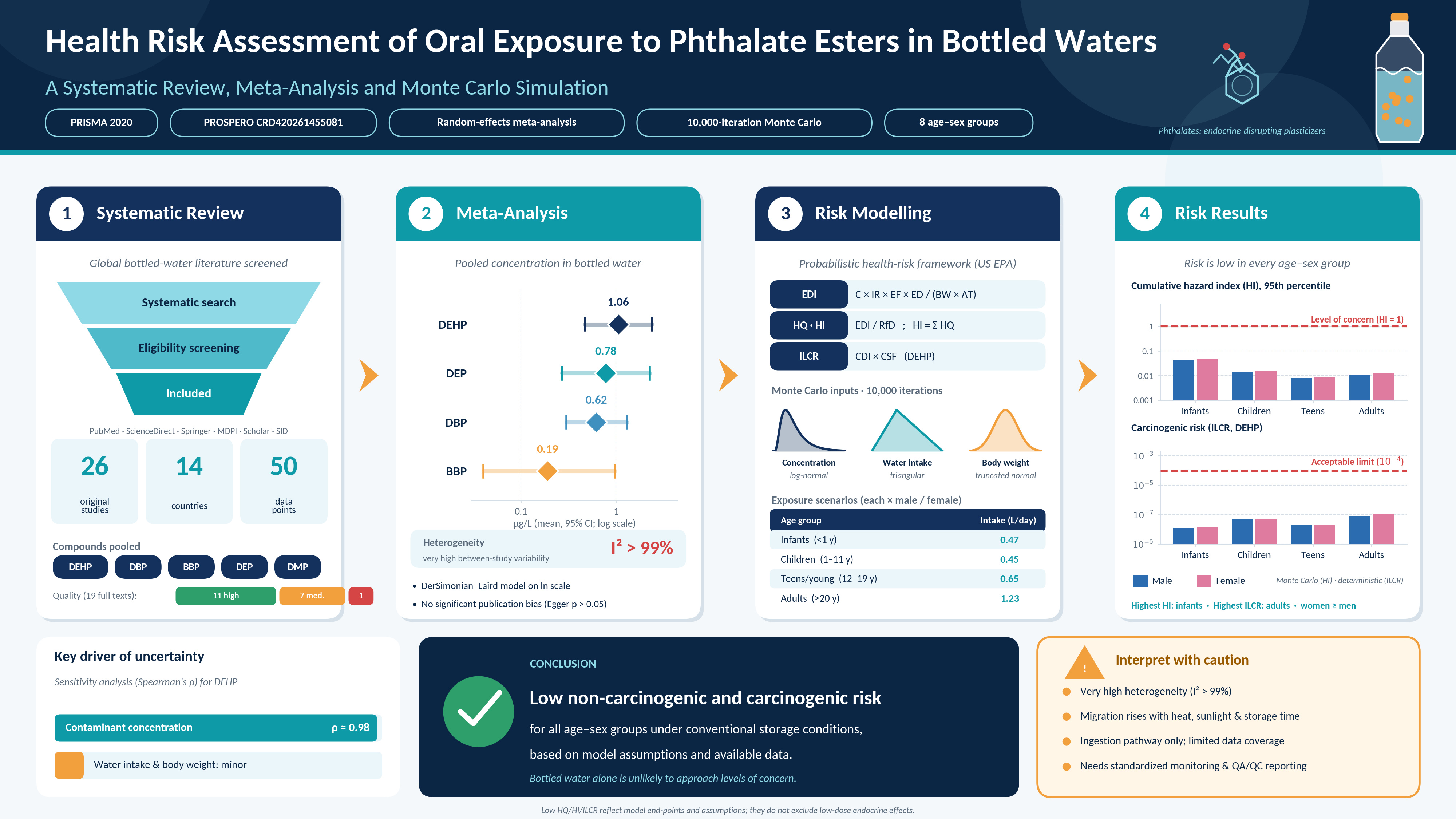
Materials and methods: A systematic search was conducted in accordance with the PRISMA 2020 guidelines, yielding 26 studies from 14 countries, comprising 50 data points. Pooled concentrations of individual phthalates were estimated using a random-effects model on the logarithmic scale. Using exposure factors from the US Environmental Protection Agency (EPA), reference doses from the Integrated Risk Information System (IRIS), and carcinogenic slope factors, the estimated daily intake (EDI), hazard quotient (HQ), cumulative hazard index (HI), and incremental lifetime cancer risk (ILCR) were calculated probabilistically for eight age-sex groups using Monte Carlo simulation (10,000 iterations). Phthalate concentrations were modelled using an empirical log-normal distribution, water consumption rates using triangular distributions, and body weight using a normal distribution.
Results: The pooled mean concentrations of di(2-ethylhexyl) phthalate (DEHP), diethyl phthalate (DEP), dibutyl phthalate (DBP), and butyl benzyl phthalate (BBP) were 1.06, 0.78, 0.62, and 0.19 µg/L, respectively, with substantial between-study heterogeneity (I² > 99%). Across all groups, HQ and HI values were several orders of magnitude below 1, with the highest HI observed in infants. The estimated carcinogenic risk associated with DEHP ranged from 10⁻⁸ to 10⁻⁷, below the commonly applied benchmark of 10⁻⁴. Adults accounted for the largest proportion of the cumulative carcinogenic risk, with slightly higher estimates in women than in men. Phthalate concentration was the dominant contributor to risk uncertainty (Spearman's ρ ≈ 0.98).
Conclusion: Under the assumptions of this assessment and based on the available data, the estimated non-carcinogenic and carcinogenic risks associated with phthalate exposure through bottled water consumption were low across all age and sex groups. However, the substantial between-study heterogeneity, the potential for increased phthalate migration under unfavourable storage conditions, and limitations in the available data warrant cautious interpretation of these findings and highlight the need for standardised monitoring.
Keywords: phthalate esters, bottled water, endocrine disruptors, meta-analysis, health risk assessment, Monte Carlo simulation, carcinogenic risk
Type of Study: Review |
Subject:
Environmental Health
Send email to the article author
| Rights and permissions | |
 |
This work is licensed under a Creative Commons Attribution-NonCommercial 4.0 International License. |

Articles Copyright © The Author(s). Owned by Mazandaran University of Medical Sciences.
Contact Us
Address: Journal Office, Building No. 2, Mazandaran University of Medical Sciences, Moallem Square, Sari.Tel: +98 (011)34484874 Postal code: 48175-866 E-Mail: jmums@mazums.ac.ir Telefax: +98 (011)33262679
