

Volume 36, Issue 263 (11-2026)
J Mazandaran Univ Med Sci 2026, 36(263): 269-284 |
Back to browse issues page



Download citation:
BibTeX | RIS | EndNote | Medlars | ProCite | Reference Manager | RefWorks
Send citation to:


BibTeX | RIS | EndNote | Medlars | ProCite | Reference Manager | RefWorks
Send citation to:
Mottaghi-Dastjerdi N, Sharafi-Badr P, Safaeinejad F. Artificial Intelligence in Oxidative Stress Research: Algorithm Selection, Biomarker Discovery, and Drug Development: Narrative Review. , J Mazandaran Univ Med Sci. 2026; 36 (263) :269-284
URL: http://jmums.mazums.ac.ir/article-1-23167-en.html
URL: http://jmums.mazums.ac.ir/article-1-23167-en.html


Abstract: (25 Views)
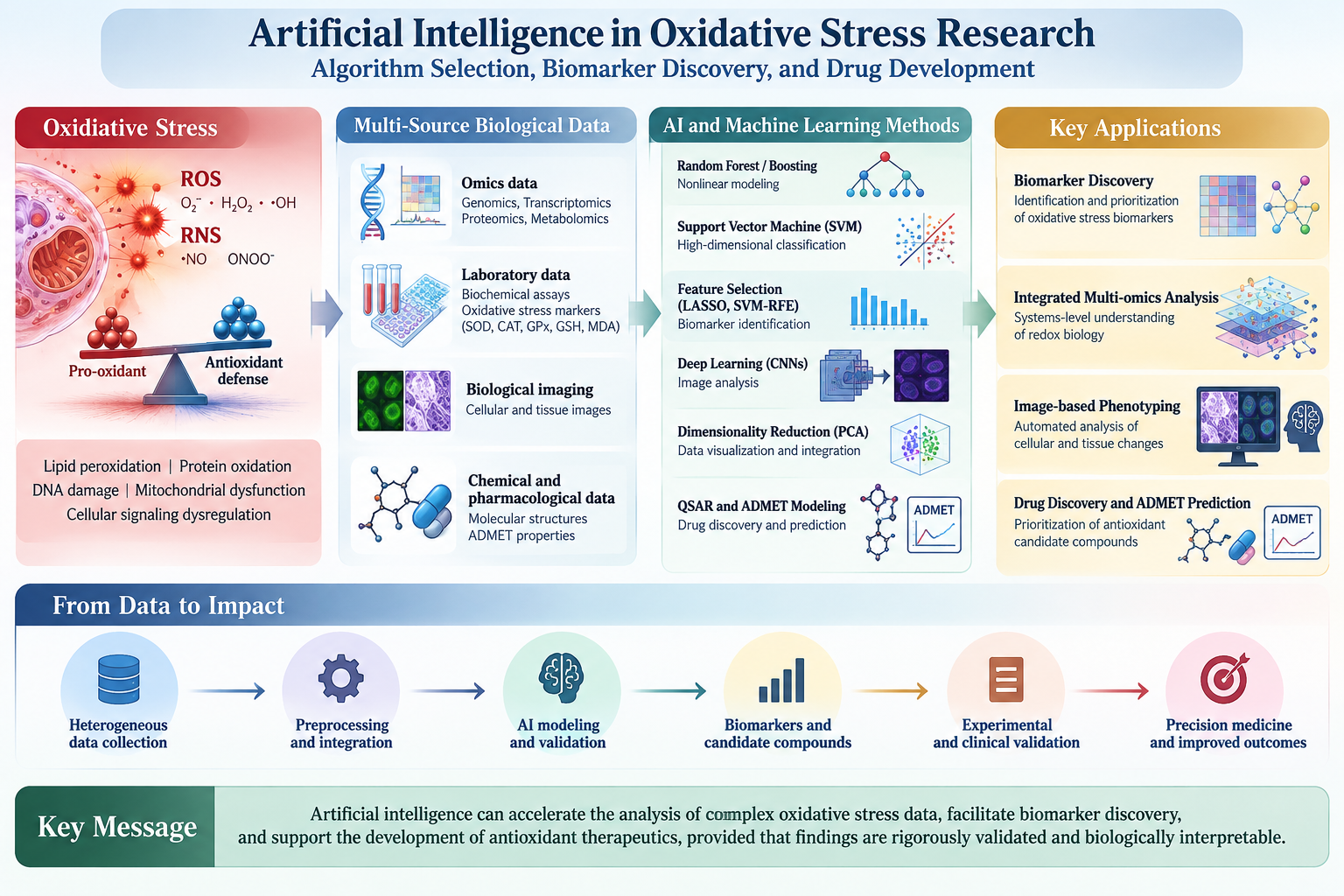
Background and purpose: Oxidative stress arises from disruption of cellular redox homeostasis and an imbalance between the production of reactive oxygen and nitrogen species and antioxidant defences. Its contribution to inflammatory, metabolic, cardiovascular, neurological, and malignant disorders varies across biological contexts. Variability in measurement methods and sampling times, together with the complexity of high-dimensional molecular data, complicates the interpretation of oxidative stress. This narrative review critically evaluates the opportunities and limitations of artificial intelligence in oxidative stress research, biomarker discovery, and drug-candidate prioritisation.
Materials and methods: The literature on redox biology, machine learning, multi-omics integration, cellular imaging, and computational pharmacology was reviewed thematically. Common algorithms were compared according to their underlying principles, suitability for specific biological questions and data types, and reported applications. Particular attention was paid to sample size, data quality, feature selection, information leakage, validation strategies, and the distinction between statistical associations and biological mechanisms.
Results: Random Forest and boosting approaches are suitable for identifying nonlinear patterns in tabular data. Support vector machines can classify high-dimensional observations, while LASSO and recursive feature elimination using support vector machines support feature selection. Deep neural networks, particularly convolutional architectures, enable the analysis of cellular images and mitochondrial phenotypes. Integration of transcriptomic, proteomic, and metabolomic data may improve the prioritisation of candidate biomarkers related to antioxidant defences. Quantitative structure-activity relationship modelling and predictions of absorption, distribution, metabolism, excretion, and toxicity (ADMET) can assist in the early screening of candidate compounds. However, high predictive performance alone does not establish causality, confirm mechanistic validity, or demonstrate clinical benefit.
Conclusion: Artificial intelligence can support hypothesis generation, biomarker prioritisation, and the design of more focused studies by integrating molecular, imaging, and clinical data in oxidative stress research. Algorithm selection should be guided by the biological question and data structure rather than predictive accuracy alone. Independent biological experiments, transparent reporting, standardised measurements, external validation, and prospective evaluation of clinical utility remain essential before computational findings can be used to inform diagnosis or treatment. Computational findings should be independently validated using external datasets and biological experiments.
Materials and methods: The literature on redox biology, machine learning, multi-omics integration, cellular imaging, and computational pharmacology was reviewed thematically. Common algorithms were compared according to their underlying principles, suitability for specific biological questions and data types, and reported applications. Particular attention was paid to sample size, data quality, feature selection, information leakage, validation strategies, and the distinction between statistical associations and biological mechanisms.
Results: Random Forest and boosting approaches are suitable for identifying nonlinear patterns in tabular data. Support vector machines can classify high-dimensional observations, while LASSO and recursive feature elimination using support vector machines support feature selection. Deep neural networks, particularly convolutional architectures, enable the analysis of cellular images and mitochondrial phenotypes. Integration of transcriptomic, proteomic, and metabolomic data may improve the prioritisation of candidate biomarkers related to antioxidant defences. Quantitative structure-activity relationship modelling and predictions of absorption, distribution, metabolism, excretion, and toxicity (ADMET) can assist in the early screening of candidate compounds. However, high predictive performance alone does not establish causality, confirm mechanistic validity, or demonstrate clinical benefit.
Conclusion: Artificial intelligence can support hypothesis generation, biomarker prioritisation, and the design of more focused studies by integrating molecular, imaging, and clinical data in oxidative stress research. Algorithm selection should be guided by the biological question and data structure rather than predictive accuracy alone. Independent biological experiments, transparent reporting, standardised measurements, external validation, and prospective evaluation of clinical utility remain essential before computational findings can be used to inform diagnosis or treatment. Computational findings should be independently validated using external datasets and biological experiments.
Keywords: oxidative stress, artificial intelligence, machine learning, biomarkers, reactive oxygen species, precision medicine, drug discovery
Type of Study: Review |
Subject:
Artificial Intelligence
Send email to the article author
| Rights and permissions | |
 |
This work is licensed under a Creative Commons Attribution-NonCommercial 4.0 International License. |

Articles Copyright © The Author(s). Owned by Mazandaran University of Medical Sciences.
Contact Us
Address: Journal Office, Building No. 2, Mazandaran University of Medical Sciences, Moallem Square, Sari.Tel: +98 (011)34484874 Postal code: 48175-866 E-Mail: jmums@mazums.ac.ir Telefax: +98 (011)33262679
