

Volume 36, Issue 264 (11-2026)
J Mazandaran Univ Med Sci 2026, 36(264): 111-120 |
Back to browse issues page



Download citation:
BibTeX | RIS | EndNote | Medlars | ProCite | Reference Manager | RefWorks
Send citation to:


BibTeX | RIS | EndNote | Medlars | ProCite | Reference Manager | RefWorks
Send citation to:
Akrami Z, Malek Bagali F, Iranpour S, Sadeghnejad M, Khademi F. Epidemiological Characteristics of Tuberculosis in Ardabil Province, Iran, from 2017 to 2024. , J Mazandaran Univ Med Sci. 2026; 36 (264) :111-120
URL: http://jmums.mazums.ac.ir/article-1-23178-en.html
URL: http://jmums.mazums.ac.ir/article-1-23178-en.html


Abstract: (32 Views)
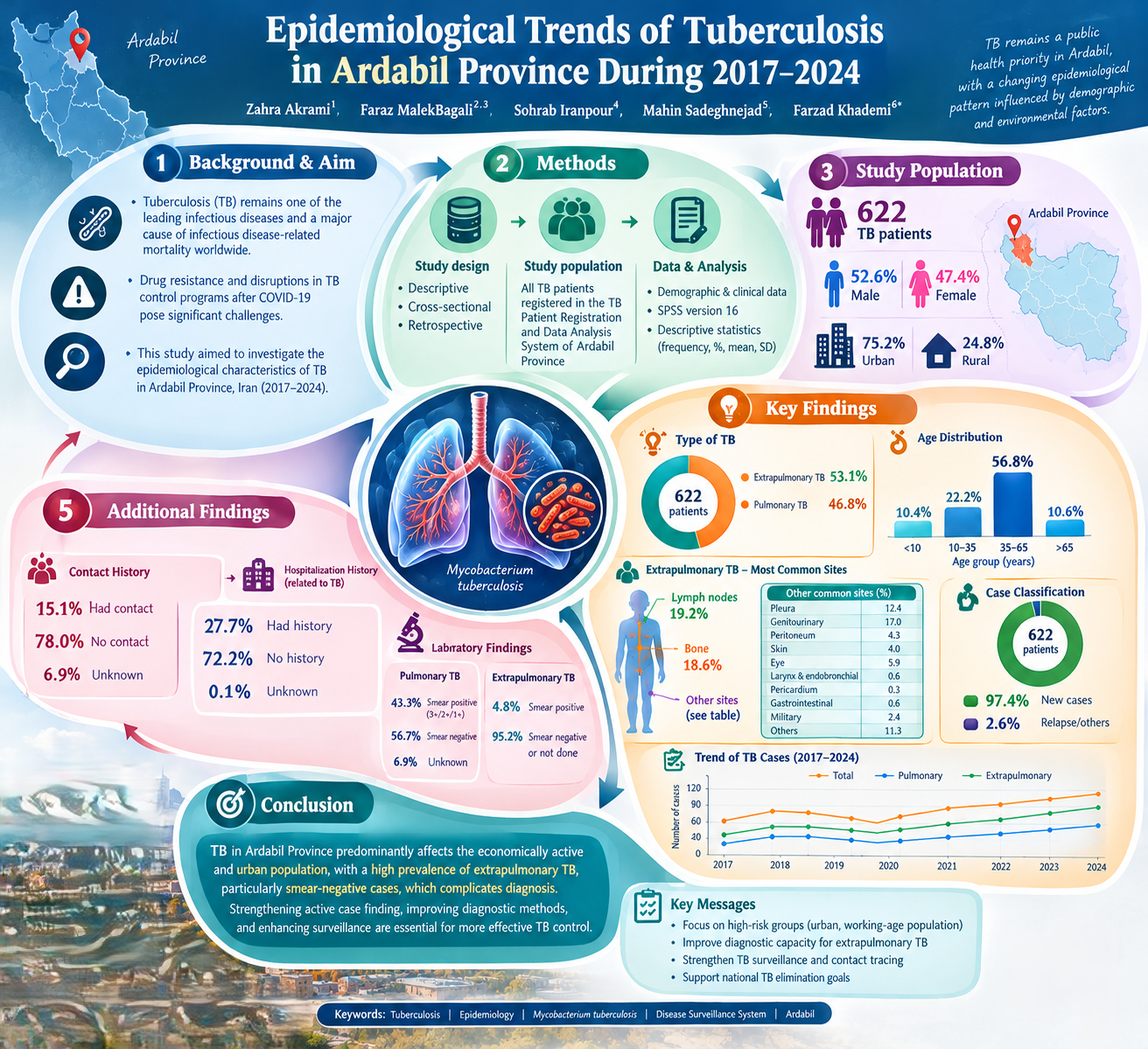
Background and purpose: Tuberculosis (TB), caused by Mycobacterium tuberculosis, is one of the most important infectious diseases and remains a leading cause of infection-related mortality worldwide. Despite advances in diagnostic and therapeutic approaches, the increasing emergence of drug-resistant TB and disruptions to TB control programs following the COVID-19 pandemic have continued to challenge disease control efforts. This study aimed to investigate the epidemiological characteristics of tuberculosis in Ardabil Province, Iran, from 2017 to 2024.
Materials and methods: This descriptive, cross-sectional, retrospective study included all tuberculosis patients registered in the Tuberculosis Patient Registration and Data Analysis System. We extracted and analyzed demographic and clinical data, including age, sex, place of residence, type of TB, contact history, hospitalization history, and laboratory findings, using SPSS version 16.
Results: The study included 622 patients with tuberculosis, of whom 52.6% were male and 47.4% were female. Most patients lived in urban areas (75.2%), and the highest frequency of TB was observed among individuals aged 35–65 years (56.8%). Extrapulmonary tuberculosis was the most common form of the disease (53.1%), while 46.8% of patients had pulmonary tuberculosis. Among extrapulmonary cases, lymph node and bone involvement were the most frequent sites of infection. In addition, 97.4% of the patients were classified as new cases. Laboratory findings showed that sputum smear results before treatment were negative in the majority of extrapulmonary TB cases.
Conclusion: According to the results of the present study, Tuberculosis in Ardabil Province mainly affects the economically active urban population. The high proportion of smear-negative extrapulmonary cases complicates diagnosis, and the predominance of new cases indicates ongoing community transmission. Strengthening active case finding and improving diagnostic methods, especially for extrapulmonary TB, is essential for better disease control.
Keywords: tuberculosis, epidemiology, Mycobacterium tuberculosis, disease surveillance system, Ardabil
Type of Study: Research(Original) |
Subject:
Epidemiology
Send email to the article author
| Rights and permissions | |
 |
This work is licensed under a Creative Commons Attribution-NonCommercial 4.0 International License. |

Articles Copyright © The Author(s). Owned by Mazandaran University of Medical Sciences.
Contact Us
Address: Journal Office, Building No. 2, Mazandaran University of Medical Sciences, Moallem Square, Sari.Tel: +98 (011)34484874 Postal code: 48175-866 E-Mail: jmums@mazums.ac.ir Telefax: +98 (011)33262679
