

Volume 36, Issue 263 (11-2026)
J Mazandaran Univ Med Sci 2026, 36(263): 90-99 |
Back to browse issues page



Download citation:
BibTeX | RIS | EndNote | Medlars | ProCite | Reference Manager | RefWorks
Send citation to:


BibTeX | RIS | EndNote | Medlars | ProCite | Reference Manager | RefWorks
Send citation to:
Moghimi A, Yazdani J, Etemadinezhad S, Khosravi K, Mohammadpour R A. Geographical Distribution of Hepatitis B in Kurdistan Province, Iran: A Poisson and Negative Binomial Regression Analysis. , J Mazandaran Univ Med Sci. 2026; 36 (263) :90-99
URL: http://jmums.mazums.ac.ir/article-1-23211-en.html
URL: http://jmums.mazums.ac.ir/article-1-23211-en.html


Abstract: (29 Views)
Background and purpose: This study aimed to map the geographical distribution of hepatitis B incidence across Kurdistan Province, Iran, using Poisson and negative binomial regression models.
Materials and methods: In this cross-sectional study, data on all recorded hepatitis B cases in Kurdistan Province between 2008 and 2017 were collected and analysed. The chi-square test, independent-samples t-test and one-way analysis of variance (ANOVA) were used to examine associations between the study variables. Poisson and negative binomial regression models were fitted using R, and geographical distribution maps were generated using ArcGIS version 10.4.1.
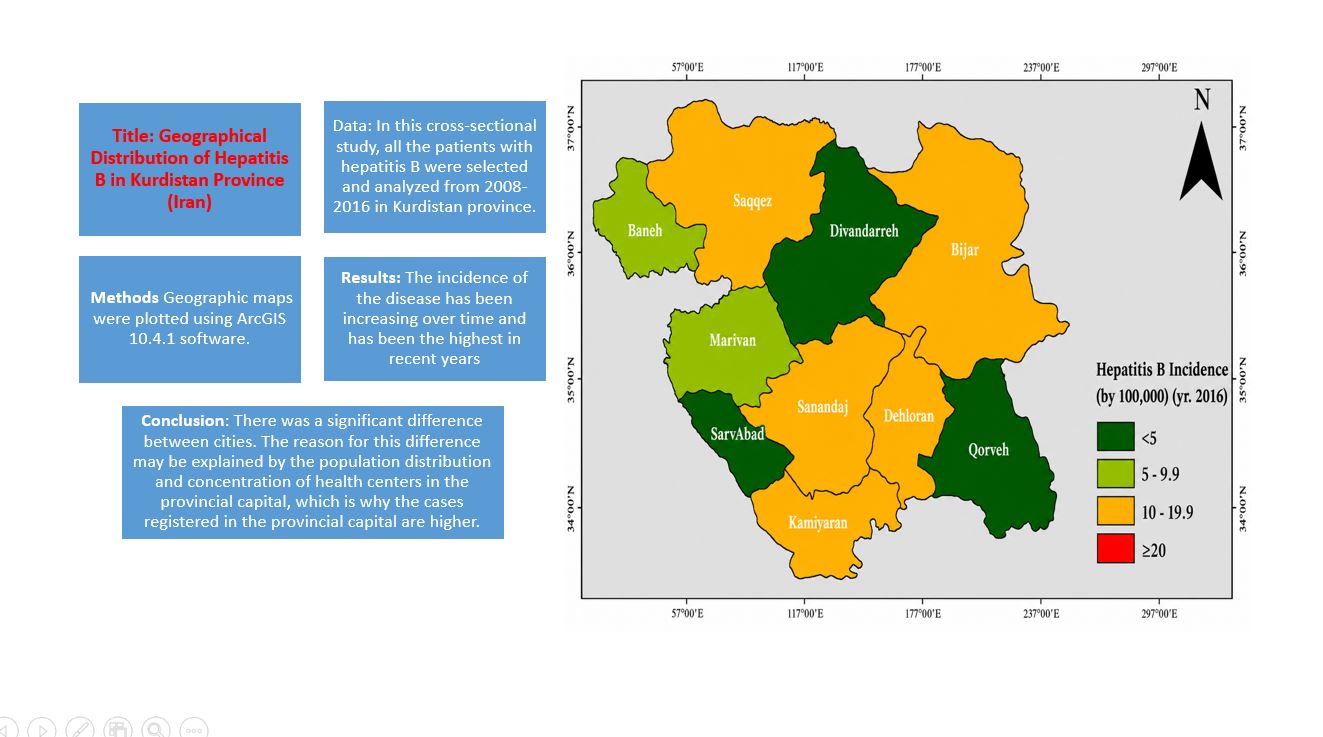
Results: The annual incidence of hepatitis B showed an increasing trend over the study period, reaching its highest level in 2016 and its lowest level in 2009. Among the cities, Sanandaj accounted for the highest proportion of reported cases, with 413 cases (36.9%), followed by Saqqez (19.7%), Qorveh (9.4%), Bijar (9.0%) and Kamyaran (8.8%). The lowest proportions were reported in Sarvabad (4 cases; 0.4%) and Dehgolan (2.4%).
Conclusion: Vaccination plays an important role in the prevention and control of hepatitis B. The geographical distribution of reported cases varied significantly across cities. This variation may partly reflect differences in population size and the concentration of healthcare facilities in the provincial capital, which may contribute to the higher number of cases recorded in Sanandaj.
Type of Study: Research(Original) |
Subject:
general practitioner
Send email to the article author
| Rights and permissions | |
 |
This work is licensed under a Creative Commons Attribution-NonCommercial 4.0 International License. |

Articles Copyright © The Author(s). Owned by Mazandaran University of Medical Sciences.
Contact Us
Address: Journal Office, Building No. 2, Mazandaran University of Medical Sciences, Moallem Square, Sari.Tel: +98 (011)34484874 Postal code: 48175-866 E-Mail: jmums@mazums.ac.ir Telefax: +98 (011)33262679
