

Volume 36, Issue 263 (11-2026)
J Mazandaran Univ Med Sci 2026, 36(263): 344-356 |
Back to browse issues page



Download citation:
BibTeX | RIS | EndNote | Medlars | ProCite | Reference Manager | RefWorks
Send citation to:


BibTeX | RIS | EndNote | Medlars | ProCite | Reference Manager | RefWorks
Send citation to:
Asghari Ozma M, Tabibi M, Moaddab S R, Fallahi Alileh N. Postbiotics and the Gut-Lung Axis in Respiratory Infections: The Role of Microbial Metabolites and Their Regulation of Mucosal Immunity. , J Mazandaran Univ Med Sci. 2026; 36 (263) :344-356
URL: http://jmums.mazums.ac.ir/article-1-23302-en.html
URL: http://jmums.mazums.ac.ir/article-1-23302-en.html


Abstract: (32 Views)
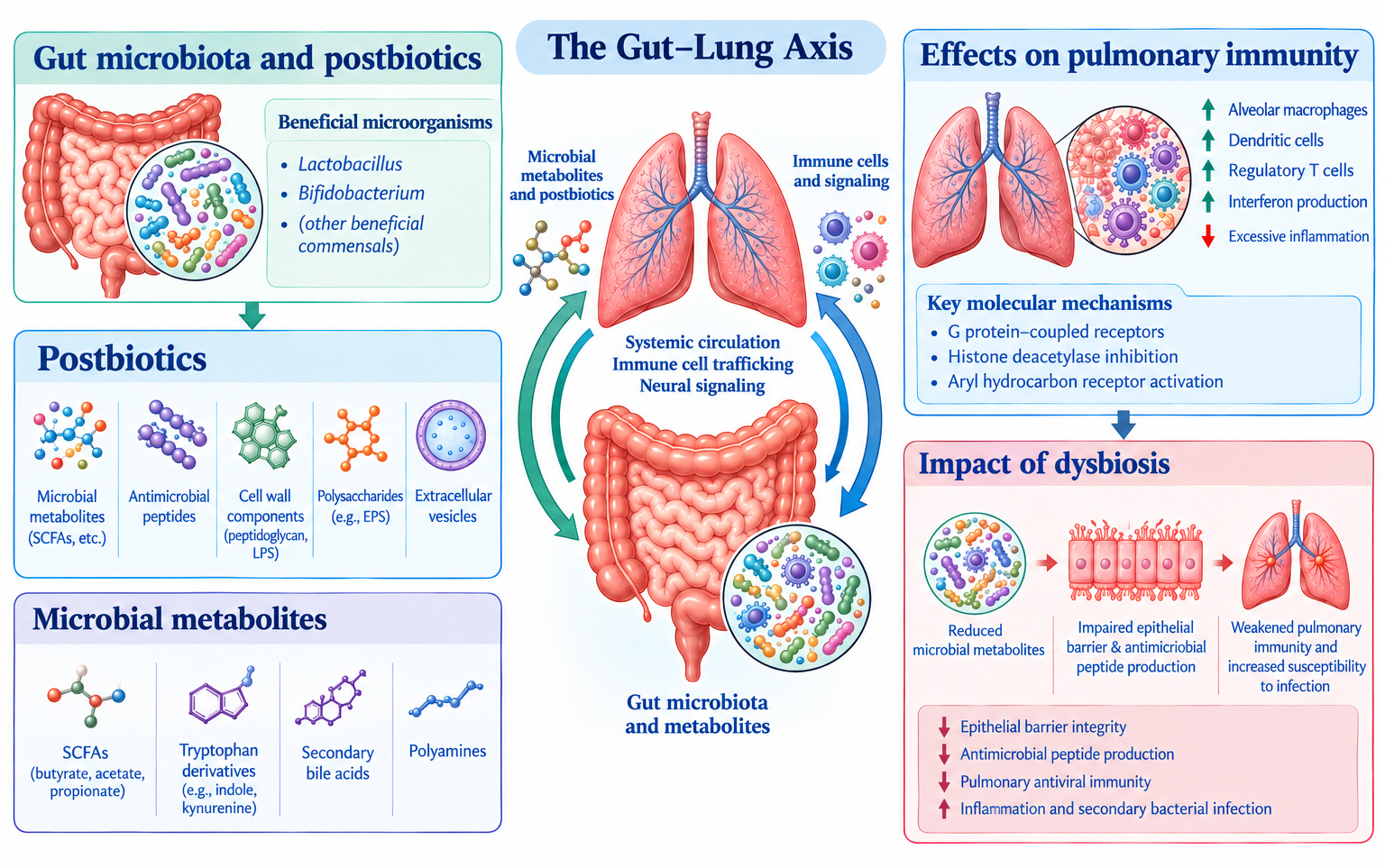
Respiratory infections, ranging from influenza and respiratory syncytial virus (RSV) infection to bacterial pneumonia, tuberculosis, and secondary infections following viral disease, are shaped by complex interactions among the gut microbiota, respiratory microbiota, and mucosal immune system. Increasing evidence suggests that the gut–lung axis is not merely an immunological communication pathway but also an active metabolic network through which microbial products regulate pulmonary epithelial and immune responses via systemic circulation, immune cell trafficking, and neural signalling. Among these products, short-chain fatty acids, particularly butyrate, acetate, and propionate, together with tryptophan-derived metabolites, secondary bile acids, and certain polyamines, modulate the functions of alveolar macrophages, dendritic cells, neutrophils, and regulatory T cells, as well as interferon production, through G protein-coupled receptor signalling, histone deacetylase inhibition, and activation of the aryl hydrocarbon receptor pathway. Infection-, antibiotic-, and diet-associated dysbiosis may reduce the production of these microbial metabolites, disrupt epithelial barrier integrity and antimicrobial peptide production, and impair pulmonary antiviral immunity, thereby increasing susceptibility to excessive inflammation and secondary bacterial infections. Against this background, postbiotics, including microbial metabolites, antimicrobial peptides, cell-wall components, polysaccharides, and extracellular vesicles derived from beneficial microorganisms, have emerged as potentially more controllable alternatives to interventions involving live microorganisms. Preclinical evidence suggests that these bioactive components may influence mucosal barrier integrity, inflammatory signalling, and host defence against respiratory pathogens. This review examines the interplay between postbiotics, microbial metabolism, and mucosal immunity. It discusses the molecular mechanisms underlying the gut–lung axis in respiratory infections and critically compares evidence from studies of influenza, RSV, SARS-CoV-2, bacterial pneumonia, and secondary infections. Particular emphasis is placed on strain- and metabolite-specific effects, the differences between live and non-living microbial interventions, translational challenges, and the need to develop targeted postbiotic strategies for precision respiratory therapeutics.
Keywords: postbiotics, gut–lung axis, respiratory infections, microbial metabolites, mucosal immunity
Type of Study: Review |
Subject:
Microbiology
| Rights and permissions | |
 |
This work is licensed under a Creative Commons Attribution-NonCommercial 4.0 International License. |

Articles Copyright © The Author(s). Owned by Mazandaran University of Medical Sciences.
Contact Us
Address: Journal Office, Building No. 2, Mazandaran University of Medical Sciences, Moallem Square, Sari.Tel: +98 (011)34484874 Postal code: 48175-866 E-Mail: jmums@mazums.ac.ir Telefax: +98 (011)33262679
