

Volume 35, Issue 253 (1-2026)
J Mazandaran Univ Med Sci 2026, 35(253): 78-87 |
Back to browse issues page



Download citation:
BibTeX | RIS | EndNote | Medlars | ProCite | Reference Manager | RefWorks
Send citation to:


BibTeX | RIS | EndNote | Medlars | ProCite | Reference Manager | RefWorks
Send citation to:
Peivandi S, Saneifar Z, Ataroud Z, Khademloo M, Elyasi F, Habibi A. The relationship between the quality of life and the seveity and type of incontinence of women with urinary incontinence. J Mazandaran Univ Med Sci 2026; 35 (253) :78-87
URL: http://jmums.mazums.ac.ir/article-1-21497-en.html
URL: http://jmums.mazums.ac.ir/article-1-21497-en.html
Salome Peivandi 
 , Zahra Saneifar , Zoleikha Ataroud , Mohammad Khademloo , Forozan Elyasi , Ali Habibi
, Zahra Saneifar , Zoleikha Ataroud , Mohammad Khademloo , Forozan Elyasi , Ali Habibi
Abstract: (38 Views)
Background and purpose: Urinary incontinence is a common health problem in women that affects their quality of life. The aim of the present study was to compare the quality of life in different types of urinary incontinence in women.
Materials and methods: This descriptive cross-sectional study was conducted in 2023 AH on women with urinary incontinence presenting to the Sari Women's Clinic. Women with urinary incontinence, diagnosed by a certified gynecologist, were included in the study and divided into three groups based on the type of incontinence: stress, urgency, and mixed. 30 people from each group were randomly included in the study. The severity of urinary incontinence was determined using the International Consultation on Incontinence Questionnaire–Urinary Incontinence Short Form (ICIQ-UI SF), and quality of life was determined using the Incontinence Impact Questionnaire (IIQ-7). SPSS version 22 software and Chi-square test and Fisher's exact test were used for analysis.
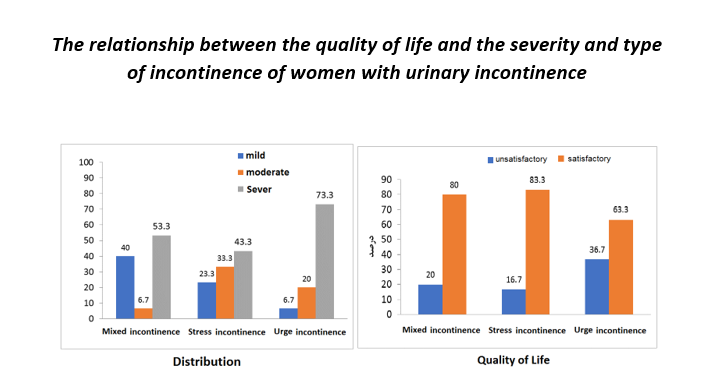
Results: The results showed that the frequency of women with severe incontinence in the stress, urgency, and mixed groups was 43.3%, 83.3%, and 53.0%, respectively. In the study of quality of life, 83.3% of women with stress incontinence, 80% of those with mixed incontinence, and 86.7% of women with urgency had an unsatisfactory quality of life (P=0.787). There was no relationship between the decrease in quality of life and the increase in the severity of urinary incontinence in women with mixed and stress urinary incontinence (P<0.050). However, in women with urgency urinary incontinence, quality of life decreased significantly, increasing severity of incontinence (P-0.034).
Conclusion: In women with urgency urinary incontinence, quality of life decreases significantly as the severity of incontinence increases, compared to mixed and stress urinary incontinence. The significant impact of urinary incontinence on women's quality of life makes it imperative to recognize and treat it.
Materials and methods: This descriptive cross-sectional study was conducted in 2023 AH on women with urinary incontinence presenting to the Sari Women's Clinic. Women with urinary incontinence, diagnosed by a certified gynecologist, were included in the study and divided into three groups based on the type of incontinence: stress, urgency, and mixed. 30 people from each group were randomly included in the study. The severity of urinary incontinence was determined using the International Consultation on Incontinence Questionnaire–Urinary Incontinence Short Form (ICIQ-UI SF), and quality of life was determined using the Incontinence Impact Questionnaire (IIQ-7). SPSS version 22 software and Chi-square test and Fisher's exact test were used for analysis.
Results: The results showed that the frequency of women with severe incontinence in the stress, urgency, and mixed groups was 43.3%, 83.3%, and 53.0%, respectively. In the study of quality of life, 83.3% of women with stress incontinence, 80% of those with mixed incontinence, and 86.7% of women with urgency had an unsatisfactory quality of life (P=0.787). There was no relationship between the decrease in quality of life and the increase in the severity of urinary incontinence in women with mixed and stress urinary incontinence (P<0.050). However, in women with urgency urinary incontinence, quality of life decreased significantly, increasing severity of incontinence (P-0.034).
Conclusion: In women with urgency urinary incontinence, quality of life decreases significantly as the severity of incontinence increases, compared to mixed and stress urinary incontinence. The significant impact of urinary incontinence on women's quality of life makes it imperative to recognize and treat it.
Type of Study: Research(Original) |
Subject:
Gynecology and Infertility
Send email to the article author
| Rights and permissions | |
 |
This work is licensed under a Creative Commons Attribution-NonCommercial 4.0 International License. |

Articles Copyright © The Author(s). Owned by Mazandaran University of Medical Sciences.
Contact Us
Address: Journal Office, Building No. 2, Mazandaran University of Medical Sciences, Moallem Square, Sari.Tel: +98 (011)34484874 Postal code: 48175-866 E-Mail: jmums@mazums.ac.ir Telefax: +98 (011)33262679
