

Volume 35, Issue 252 (12-2025)
J Mazandaran Univ Med Sci 2025, 35(252): 59-67 |
Back to browse issues page


Download citation:
BibTeX | RIS | EndNote | Medlars | ProCite | Reference Manager | RefWorks
Send citation to:


BibTeX | RIS | EndNote | Medlars | ProCite | Reference Manager | RefWorks
Send citation to:
Khalatbary A R, Barzegari S, Nasiry D. The Effect of the Flipped Classroom Approach on Enhancing Problem-Solving and Self-Directed Learning Skills Among Medical Sciences Students in Anatomy Education. J Mazandaran Univ Med Sci 2025; 35 (252) :59-67
URL: http://jmums.mazums.ac.ir/article-1-21597-en.html
URL: http://jmums.mazums.ac.ir/article-1-21597-en.html


Abstract: (76 Views)
Background and purpose: Given the numerous challenges encountered in clinical settings, it is essential to enhance students’ problem-solving abilities and self-directed learning skills. The flipped classroom model has emerged as a promising approach to improve these competencies. This study aimed to investigate the effect of the flipped classroom on the development of problem-solving skills and self-directed learning among undergraduate students.
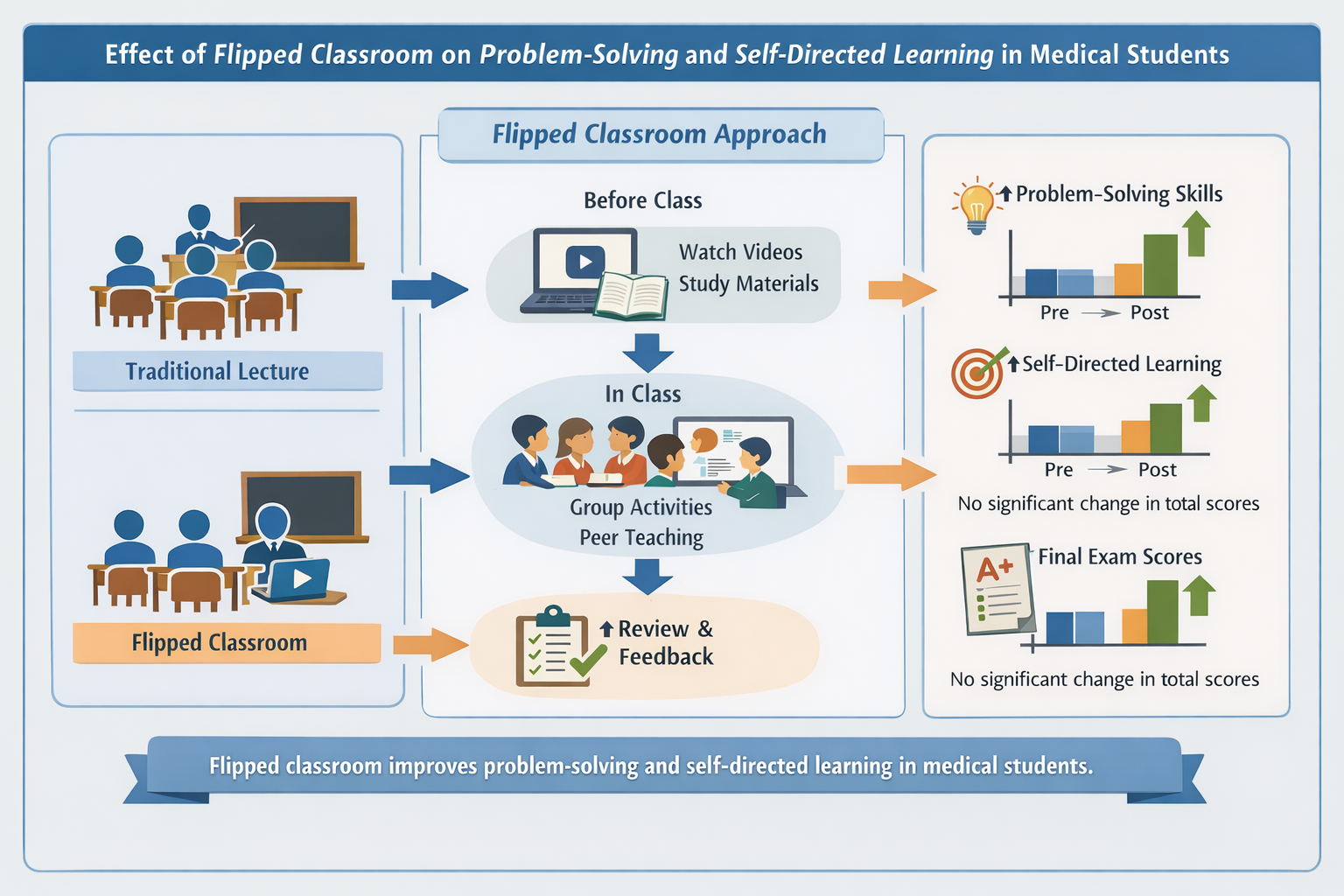
Materials and methods: This semi-experimental educational study was conducted on 50 undergraduate students, with participants randomly assigned to control and intervention groups. The control group received traditional lecture-based instruction, while the intervention group was taught using the flipped classroom approach. At the beginning of the semester, standardized questionnaires assessing problem-solving and self-directed learning were administered as a pre-test, and the same questionnaires were repeated at the end of the intervention. Data were collected and analyzed using these standardized instruments, and appropriate statistical tests were applied to evaluate differences between groups and pre- and post-intervention scores.
Results: The mean total problem-solving score in the flipped classroom group increased from 106.4 ± 7.4 at the beginning of the semester to 169.8 ± 4 at the end (P< 0.001), whereas no significant change was observed in the control group (P= 0.12). Similarly, the mean total self-directed learning score in the flipped classroom group increased from 114.8 ± 13.9 to 169.8 ± 4 (P< 0.001), while no significant difference was found in the control group (P= 0.45). Also, final exam scores were significantly higher in the flipped classroom group compared to the control group (17.28 ± 2.46 vs. 15.32 ± 2.19; P = 0.006).
Conclusion: The flipped classroom method effectively supports students’ learning needs by facilitating interactive learning activities and provides enhanced opportunities for the development of problem-solving abilities and self-directed learning skills.
Materials and methods: This semi-experimental educational study was conducted on 50 undergraduate students, with participants randomly assigned to control and intervention groups. The control group received traditional lecture-based instruction, while the intervention group was taught using the flipped classroom approach. At the beginning of the semester, standardized questionnaires assessing problem-solving and self-directed learning were administered as a pre-test, and the same questionnaires were repeated at the end of the intervention. Data were collected and analyzed using these standardized instruments, and appropriate statistical tests were applied to evaluate differences between groups and pre- and post-intervention scores.
Results: The mean total problem-solving score in the flipped classroom group increased from 106.4 ± 7.4 at the beginning of the semester to 169.8 ± 4 at the end (P< 0.001), whereas no significant change was observed in the control group (P= 0.12). Similarly, the mean total self-directed learning score in the flipped classroom group increased from 114.8 ± 13.9 to 169.8 ± 4 (P< 0.001), while no significant difference was found in the control group (P= 0.45). Also, final exam scores were significantly higher in the flipped classroom group compared to the control group (17.28 ± 2.46 vs. 15.32 ± 2.19; P = 0.006).
Conclusion: The flipped classroom method effectively supports students’ learning needs by facilitating interactive learning activities and provides enhanced opportunities for the development of problem-solving abilities and self-directed learning skills.
Type of Study: Research(Original) |
Subject:
anatomy
Send email to the article author
| Rights and permissions | |
 |
This work is licensed under a Creative Commons Attribution-NonCommercial 4.0 International License. |

Articles Copyright © The Author(s). Owned by Mazandaran University of Medical Sciences.
Contact Us
Address: Journal Office, Building No. 2, Mazandaran University of Medical Sciences, Moallem Square, Sari.Tel: +98 (011)34484874 Postal code: 48175-866 E-Mail: jmums@mazums.ac.ir Telefax: +98 (011)33262679
