

Volume 35, Issue 252 (12-2025)
J Mazandaran Univ Med Sci 2025, 35(252): 132-145 |
Back to browse issues page


Download citation:
BibTeX | RIS | EndNote | Medlars | ProCite | Reference Manager | RefWorks
Send citation to:


BibTeX | RIS | EndNote | Medlars | ProCite | Reference Manager | RefWorks
Send citation to:
Hamzehgardeshi Z, khani S, Shahhosseini Z, Yousefi Ghandali N, Hashemi Z. The Role of Epigenetic Modifications in Shaping Pregnancy Outcomes: A Scoping Review. J Mazandaran Univ Med Sci 2025; 35 (252) :132-145
URL: http://jmums.mazums.ac.ir/article-1-21805-en.html
URL: http://jmums.mazums.ac.ir/article-1-21805-en.html
Zeinab Hamzehgardeshi 
 , Soghra Khani , Zohreh Shahhosseini , Nasim Yousefi Ghandali , Zeinab Hashemi
, Soghra Khani , Zohreh Shahhosseini , Nasim Yousefi Ghandali , Zeinab Hashemi
Abstract: (62 Views)
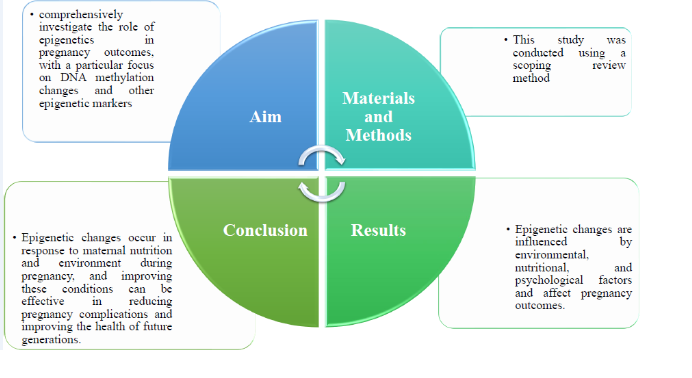
Background and purpose: Epigenetics is a key mechanism for regulating gene expression without altering the DNA sequence. It plays a crucial role in embryonic development and pregnancy outcomes. This study aimed to comprehensively investigate the role of epigenetics in pregnancy outcomes, with a particular focus on DNA methylation changes and other epigenetic markers.
Materials and methods: This study utilized a scoping review method, which involved formulating a research question, systematically searching scientific databases, selecting relevant articles, analyzing data, and tabulating the results. English-language articles were extracted from Scopus, PubMed, and the Web of Science) WOS (databases, and while Persian articles were sourced from SID and Google Scholar. The search was performed using keywords such as "Epigenetics," "Epigenetic Interventions," "DNA Methylation," "Histone Modification," "Non-coding RNA," "Pregnancy Outcome," "Prenatal Care," "Maternal Health," "Fetal Development," "Fetal Health," "Premature Birth," "Birth Weight," and their Persian equivalents.
Results: A total of 24 articles were selected for this scoping review. Study findings were categorized into three main groups: environmental and nutritional factors (12 studies), psychosocial factors (4 studies), and clinical-pathophysiological factors (8 studies). The results indicated that maternal nutrition (folic acid and DHA) and exposure to environmental pollutants and chemicals are associated with changes in fetal DNA methylation patterns; additionally, maternal stress and social support influence epigenetic changes in the placenta and newborn. Pregnancy complications such as preeclampsia and preterm birth were associated with epigenetic changes, including hypermethylation of placental functional genes and changes in non-coding RNA expression.
Conclusion: Epigenetic changes can have long-term effects on the health of the fetus and offspring. These modifications are particularly influenced by maternal nutrition and environmental factors during pregnancy. Improving these conditions may effectively reduce pregnancy complications and promote better health for future generations.
Materials and methods: This study utilized a scoping review method, which involved formulating a research question, systematically searching scientific databases, selecting relevant articles, analyzing data, and tabulating the results. English-language articles were extracted from Scopus, PubMed, and the Web of Science) WOS (databases, and while Persian articles were sourced from SID and Google Scholar. The search was performed using keywords such as "Epigenetics," "Epigenetic Interventions," "DNA Methylation," "Histone Modification," "Non-coding RNA," "Pregnancy Outcome," "Prenatal Care," "Maternal Health," "Fetal Development," "Fetal Health," "Premature Birth," "Birth Weight," and their Persian equivalents.
Results: A total of 24 articles were selected for this scoping review. Study findings were categorized into three main groups: environmental and nutritional factors (12 studies), psychosocial factors (4 studies), and clinical-pathophysiological factors (8 studies). The results indicated that maternal nutrition (folic acid and DHA) and exposure to environmental pollutants and chemicals are associated with changes in fetal DNA methylation patterns; additionally, maternal stress and social support influence epigenetic changes in the placenta and newborn. Pregnancy complications such as preeclampsia and preterm birth were associated with epigenetic changes, including hypermethylation of placental functional genes and changes in non-coding RNA expression.
Conclusion: Epigenetic changes can have long-term effects on the health of the fetus and offspring. These modifications are particularly influenced by maternal nutrition and environmental factors during pregnancy. Improving these conditions may effectively reduce pregnancy complications and promote better health for future generations.
Send email to the article author
| Rights and permissions | |
 |
This work is licensed under a Creative Commons Attribution-NonCommercial 4.0 International License. |

Articles Copyright © The Author(s). Owned by Mazandaran University of Medical Sciences.
Contact Us
Address: Journal Office, Building No. 2, Mazandaran University of Medical Sciences, Moallem Square, Sari.Tel: +98 (011)34484874 Postal code: 48175-866 E-Mail: jmums@mazums.ac.ir Telefax: +98 (011)33262679
