

Volume 35, Issue 253 (1-2026)
J Mazandaran Univ Med Sci 2026, 35(253): 88-93 |
Back to browse issues page



Download citation:
BibTeX | RIS | EndNote | Medlars | ProCite | Reference Manager | RefWorks
Send citation to:


BibTeX | RIS | EndNote | Medlars | ProCite | Reference Manager | RefWorks
Send citation to:
Ketabi K, Bojdi A, Saadatnia F, Amiri B, Akhlaghi S, Eftekharpour E, et al . Epidemiology and Antibiotic Resistance Patterns of Pathogens Causing Septic Arthritis in Hospitalized Patients at Mashhad Imam Reza Hospital: A Five-Year Retrospective Study. J Mazandaran Univ Med Sci 2026; 35 (253) :88-93
URL: http://jmums.mazums.ac.ir/article-1-21901-en.html
URL: http://jmums.mazums.ac.ir/article-1-21901-en.html
Kiana Ketabi 
 , Amin Bojdi , Fatemeh Saadatnia , Bazat Amiri , Saeed Akhlaghi , Elahe Eftekharpour , Nasrin Khosravi , Amin Rahimian , Mahnaz Arian
, Amin Bojdi , Fatemeh Saadatnia , Bazat Amiri , Saeed Akhlaghi , Elahe Eftekharpour , Nasrin Khosravi , Amin Rahimian , Mahnaz Arian
Abstract: (492 Views)
Background and purpose: Septic arthritis is a serious medical emergency that, if not diagnosed and treated promptly, can lead to irreversible joint damage and severe systemic complications. Accurate knowledge of the causative microorganisms and their antimicrobial resistance patterns is crucial for informing effective treatment strategies. This study was conducted to evaluate the distribution of pathogens and their resistance profiles in patients with septic arthritis hospitalized at Imam Reza Hospital, Mashhad, from 2011 to 2016.
Materials and methods: This retrospective cohort study involved a review of medical records of patients with a confirmed diagnosis of septic arthritis, based on clinical and laboratory criteria. Demographic characteristics, clinical manifestations, culture findings, and antibiotic susceptibility data were extracted and analysed according to two age groups: children (<15 years) and adults (≥15 years). Statistical analyses were performed, with significance set at P < 0.05.
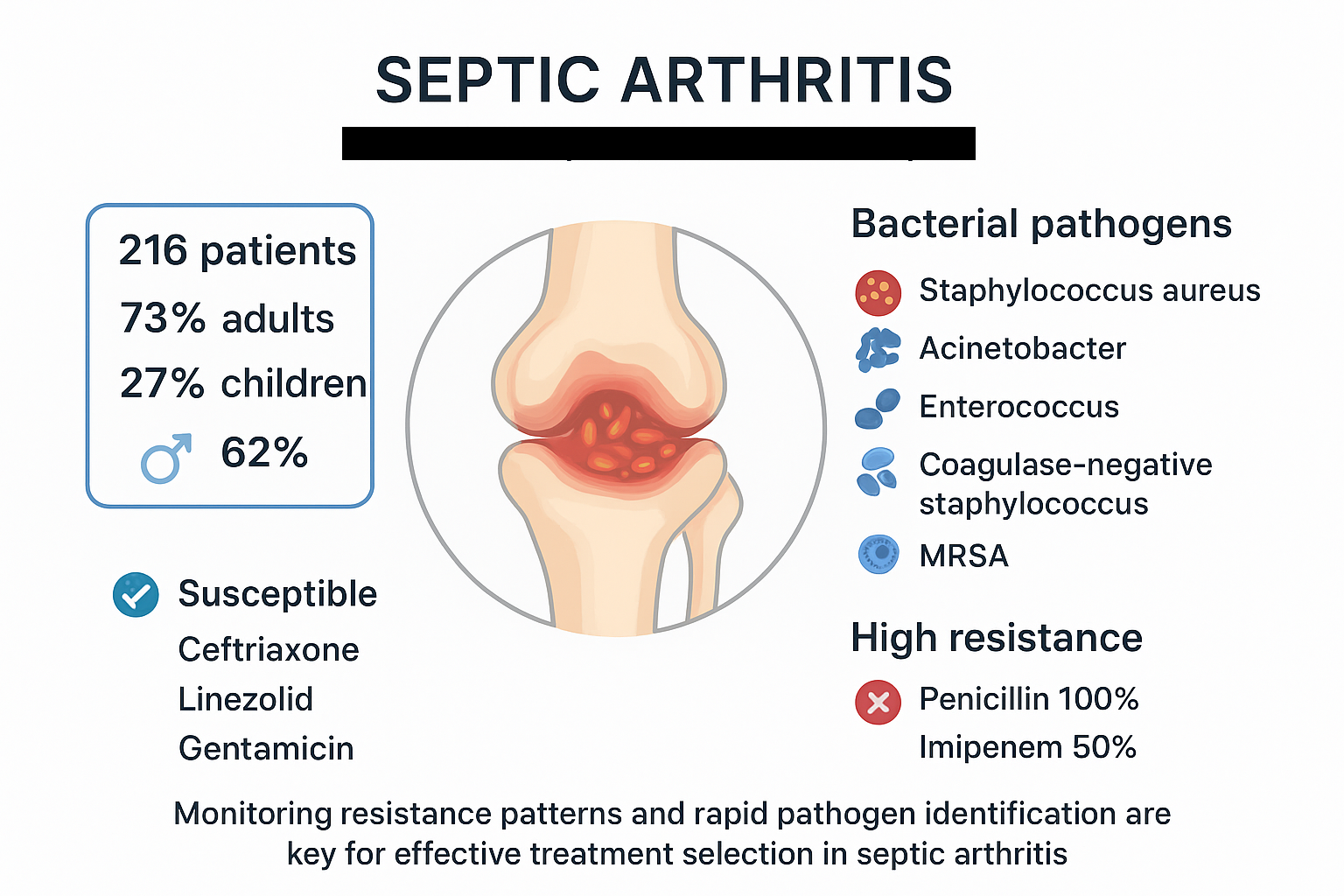
Results: A total of 216 patients, with a mean age of 22.42 ± 27.53 years, were included; of these, 158 were adults and 58 were children. The condition was more prevalent in males. Fever occurred more frequently in children, whereas joint pain was more prominent in adults. The knee was the most commonly affected joint, and positive blood cultures were observed more often in children. Staphylococcus aureus was the predominant pathogen, demonstrating high sensitivity to ceftriaxone, linezolid, and gentamicin, while exhibiting complete resistance to penicillin (100%) and partial resistance to imipenem (50%).
Conclusion: S. aureus is the predominant causative pathogen of septic arthritis across all age groups. Consequently, empirical antibiotic regimens should prioritise coverage against this organism, especially in settings with high rates of antimicrobial resistance.
Materials and methods: This retrospective cohort study involved a review of medical records of patients with a confirmed diagnosis of septic arthritis, based on clinical and laboratory criteria. Demographic characteristics, clinical manifestations, culture findings, and antibiotic susceptibility data were extracted and analysed according to two age groups: children (<15 years) and adults (≥15 years). Statistical analyses were performed, with significance set at P < 0.05.
Results: A total of 216 patients, with a mean age of 22.42 ± 27.53 years, were included; of these, 158 were adults and 58 were children. The condition was more prevalent in males. Fever occurred more frequently in children, whereas joint pain was more prominent in adults. The knee was the most commonly affected joint, and positive blood cultures were observed more often in children. Staphylococcus aureus was the predominant pathogen, demonstrating high sensitivity to ceftriaxone, linezolid, and gentamicin, while exhibiting complete resistance to penicillin (100%) and partial resistance to imipenem (50%).
Conclusion: S. aureus is the predominant causative pathogen of septic arthritis across all age groups. Consequently, empirical antibiotic regimens should prioritise coverage against this organism, especially in settings with high rates of antimicrobial resistance.
Type of Study: Brief Report |
Subject:
infection
Send email to the article author
| Rights and permissions | |
 |
This work is licensed under a Creative Commons Attribution-NonCommercial 4.0 International License. |

Articles Copyright © The Author(s). Owned by Mazandaran University of Medical Sciences.
Contact Us
Address: Journal Office, Building No. 2, Mazandaran University of Medical Sciences, Moallem Square, Sari.Tel: +98 (011)34484874 Postal code: 48175-866 E-Mail: jmums@mazums.ac.ir Telefax: +98 (011)33262679
