

Volume 35, Issue 253 (1-2026)
J Mazandaran Univ Med Sci 2026, 35(253): 94-102 |
Back to browse issues page



Download citation:
BibTeX | RIS | EndNote | Medlars | ProCite | Reference Manager | RefWorks
Send citation to:


BibTeX | RIS | EndNote | Medlars | ProCite | Reference Manager | RefWorks
Send citation to:
Asadi M, Gholami S, Montazeri M. Control and Prevention of Hydatid Cyst Disease in Iran:A Policy Brief. J Mazandaran Univ Med Sci 2026; 35 (253) :94-102
URL: http://jmums.mazums.ac.ir/article-1-22036-en.html
URL: http://jmums.mazums.ac.ir/article-1-22036-en.html


Abstract: (34 Views)
Hydatid cyst disease is one of the most important parasitic infections between humans and animals. The prevention and control of this disease in Iran face several challenges, including the ineffectiveness of the national prevention and control program, limitations in diagnosis and treatment, challenges in animal vaccine production, mismanagement of stray dog population control, suboptimal performance of traditional slaughterhouses in the hygienic disposal of infected organs, and the need to improve the quality and coverage of educational programs.
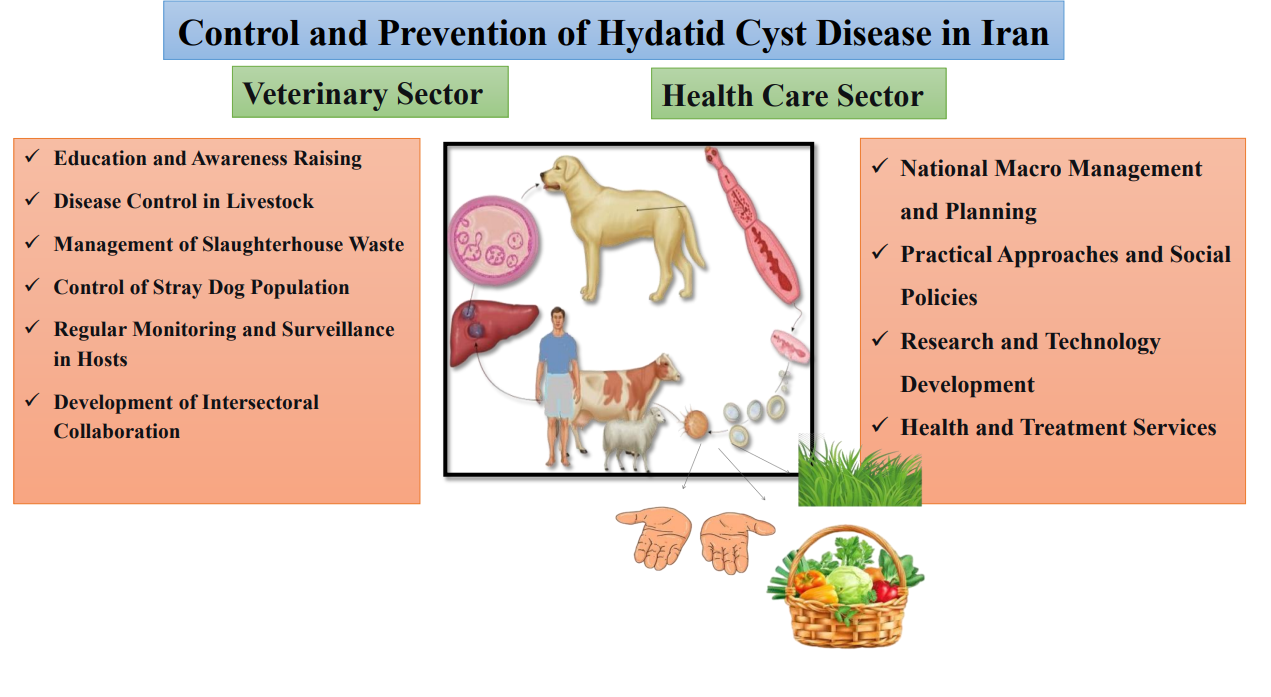
The researchers at the Toxoplasmosis Research Center affiliated with Mazandaran University of Medical Sciences have presented a brief policy brief, based on scientific evidence and operational experiences, divided into two sections: healthcare and veterinary medicine, and recommend developing a comprehensive and integrated program for the management and control of hydatid cyst using a scheduled approach
The necessary measures in the health sector of the country include four main components: national planning, implementation strategies and social policies, research and development initiatives, and healthcare delivery. In veterinary medicine, training livestock owners, livestock vaccination, repeated administration of praziquantel, prevention of informal or non-industrial slaughter, monitoring hygienic disposal of infected offal, restriction of dogs’ access to slaughterhouse offal, stray dog population control, periodic monitoring of host contamination, and fostering interdisciplinary collaboration between human and veterinary medicine are very important.
This approach, tailored to local conditions and aimed at reducing the burden of hydatid cyst disease, can significantly contribute to public health improvement and health system sustainability in Iran.
The researchers at the Toxoplasmosis Research Center affiliated with Mazandaran University of Medical Sciences have presented a brief policy brief, based on scientific evidence and operational experiences, divided into two sections: healthcare and veterinary medicine, and recommend developing a comprehensive and integrated program for the management and control of hydatid cyst using a scheduled approach
The necessary measures in the health sector of the country include four main components: national planning, implementation strategies and social policies, research and development initiatives, and healthcare delivery. In veterinary medicine, training livestock owners, livestock vaccination, repeated administration of praziquantel, prevention of informal or non-industrial slaughter, monitoring hygienic disposal of infected offal, restriction of dogs’ access to slaughterhouse offal, stray dog population control, periodic monitoring of host contamination, and fostering interdisciplinary collaboration between human and veterinary medicine are very important.
This approach, tailored to local conditions and aimed at reducing the burden of hydatid cyst disease, can significantly contribute to public health improvement and health system sustainability in Iran.
Subject:
parasitology
Send email to the article author
| Rights and permissions | |
 |
This work is licensed under a Creative Commons Attribution-NonCommercial 4.0 International License. |

Articles Copyright © The Author(s). Owned by Mazandaran University of Medical Sciences.
Contact Us
Address: Journal Office, Building No. 2, Mazandaran University of Medical Sciences, Moallem Square, Sari.Tel: +98 (011)34484874 Postal code: 48175-866 E-Mail: jmums@mazums.ac.ir Telefax: +98 (011)33262679
