

Volume 35, Issue 252 (12-2025)
J Mazandaran Univ Med Sci 2025, 35(252): 78-89 |
Back to browse issues page


Download citation:
BibTeX | RIS | EndNote | Medlars | ProCite | Reference Manager | RefWorks
Send citation to:


BibTeX | RIS | EndNote | Medlars | ProCite | Reference Manager | RefWorks
Send citation to:
Rostami-Maskopaee F, Navaeifar M R, Kelishadi R, Moosazadeh M, Mehrparvar A H, Mirmohammadkhani M, et al et al . Experiences and Challenges of PERSIAN Birth Cohort Centres During the COVID-19 Pandemic: A Qualitative Study. J Mazandaran Univ Med Sci 2025; 35 (252) :78-89
URL: http://jmums.mazums.ac.ir/article-1-22295-en.html
URL: http://jmums.mazums.ac.ir/article-1-22295-en.html
Fereshteh Rostami-Maskopaee 
 , Mohammad Reza Navaeifar , Roya Kelishadi , Mahmood Moosazadeh , Amir Houshang Mehrparvar , Majid Mirmohammadkhani , Hamid Hakimi , Seyede Shahrbanoo Daniali , Navid Danaei , Fatemeh Sadat Tabatabaei , Masoomeh Goodarzi-Khoigani , Shahrbanoo Pahlevanynejad , Azin Hajialibeig , Zohreh Rajabi , Mehran Asadi-Aliabadi , Mohammad Sadegh Rezai
, Mohammad Reza Navaeifar , Roya Kelishadi , Mahmood Moosazadeh , Amir Houshang Mehrparvar , Majid Mirmohammadkhani , Hamid Hakimi , Seyede Shahrbanoo Daniali , Navid Danaei , Fatemeh Sadat Tabatabaei , Masoomeh Goodarzi-Khoigani , Shahrbanoo Pahlevanynejad , Azin Hajialibeig , Zohreh Rajabi , Mehran Asadi-Aliabadi , Mohammad Sadegh Rezai
Abstract: (71 Views)
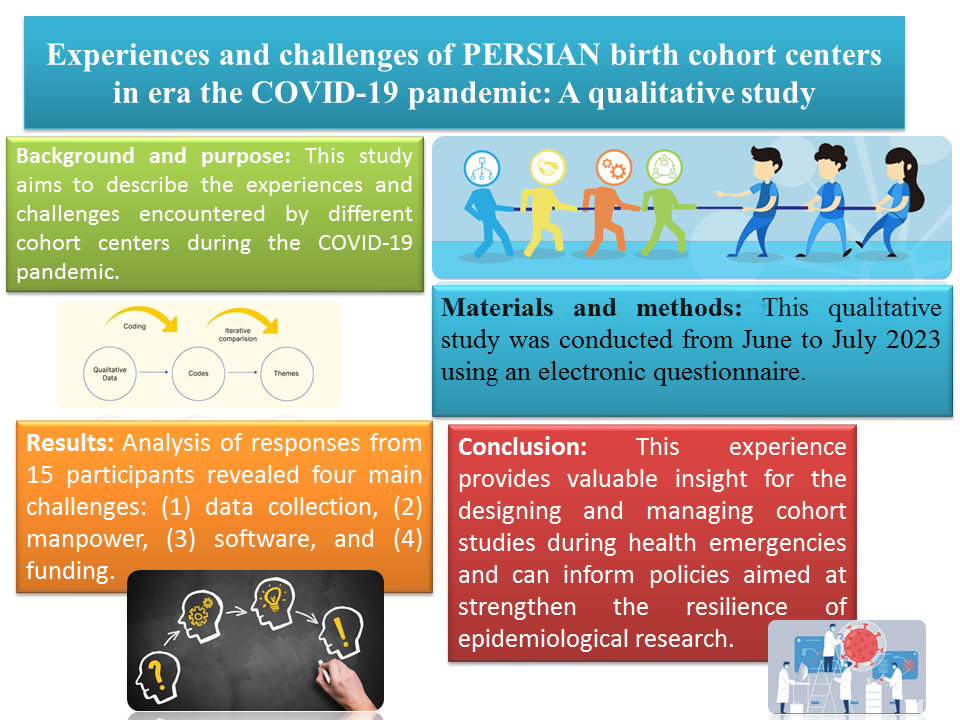
Background and purpose: Birth cohort studies collect extensive data from the preconception, pregnancy, and postnatal periods. The COVID-19 pandemic caused significant disruptions to many ongoing research projects, including the Persian Birth Cohort. This study aims to describe and analyse the experiences and challenges encountered by various cohort centres during the COVID-19 pandemic.
Materials and methods: This qualitative study was conducted between June and July 2023 using an electronic questionnaire. Participants included managers, supervisors, and experts from five cohort centres located in Isfahan, Yazd, Semnan, Rafsanjan, and Sari. After obtaining informed consent, basic demographic information was collected, and participants were asked to respond to open-ended questions within a two-week period. Data analysis was performed using a two-stage Delphi method and thematic analysis. The questionnaires were collected, transcribed, and coded to identify major themes.
Results: Analysis of responses from 15 participants revealed four main challenges: (1) data collection, (2) human resources, (3) software, and (4) funding. The most critical issue was the disruption of data collection, which significantly influenced the research process. The findings indicated that implementing flexible mechanisms for data recording and human resource management can help maintain continuity in cohort activities, during public health emergencies.
Conclusion: Despite the challenges and constraints imposed by the COVID-19 pandemic, the PERSIAN Birth Cohort successfully continued its work by maintaining its activities through the adoption of flexible strategies. This experience provides valuable insights into the design and management of cohort studies during public health emergencies and can inform policies aimed at strengthening the resilience of epidemiological research. Moreover, careful attention to statistical considerations and the improvement of data quality during crises is essential to preserve the consistency and validity of data across different centres.
Materials and methods: This qualitative study was conducted between June and July 2023 using an electronic questionnaire. Participants included managers, supervisors, and experts from five cohort centres located in Isfahan, Yazd, Semnan, Rafsanjan, and Sari. After obtaining informed consent, basic demographic information was collected, and participants were asked to respond to open-ended questions within a two-week period. Data analysis was performed using a two-stage Delphi method and thematic analysis. The questionnaires were collected, transcribed, and coded to identify major themes.
Results: Analysis of responses from 15 participants revealed four main challenges: (1) data collection, (2) human resources, (3) software, and (4) funding. The most critical issue was the disruption of data collection, which significantly influenced the research process. The findings indicated that implementing flexible mechanisms for data recording and human resource management can help maintain continuity in cohort activities, during public health emergencies.
Conclusion: Despite the challenges and constraints imposed by the COVID-19 pandemic, the PERSIAN Birth Cohort successfully continued its work by maintaining its activities through the adoption of flexible strategies. This experience provides valuable insights into the design and management of cohort studies during public health emergencies and can inform policies aimed at strengthening the resilience of epidemiological research. Moreover, careful attention to statistical considerations and the improvement of data quality during crises is essential to preserve the consistency and validity of data across different centres.
Subject:
health
Send email to the article author
| Rights and permissions | |
 |
This work is licensed under a Creative Commons Attribution-NonCommercial 4.0 International License. |

Articles Copyright © The Author(s). Owned by Mazandaran University of Medical Sciences.
Contact Us
Address: Journal Office, Building No. 2, Mazandaran University of Medical Sciences, Moallem Square, Sari.Tel: +98 (011)34484874 Postal code: 48175-866 E-Mail: jmums@mazums.ac.ir Telefax: +98 (011)33262679
