

Volume 35, Issue 253 (1-2026)
J Mazandaran Univ Med Sci 2026, 35(253): 103-109 |
Back to browse issues page



Download citation:
BibTeX | RIS | EndNote | Medlars | ProCite | Reference Manager | RefWorks
Send citation to:


BibTeX | RIS | EndNote | Medlars | ProCite | Reference Manager | RefWorks
Send citation to:
Ebrazeh A, Aghaali M. Revision and Strengthening of the Communicable Disease Surveillance System in Iran: Needs, Challenges,
and Policy Options. J Mazandaran Univ Med Sci 2026; 35 (253) :103-109
URL: http://jmums.mazums.ac.ir/article-1-22344-en.html
URL: http://jmums.mazums.ac.ir/article-1-22344-en.html


Abstract: (29 Views)
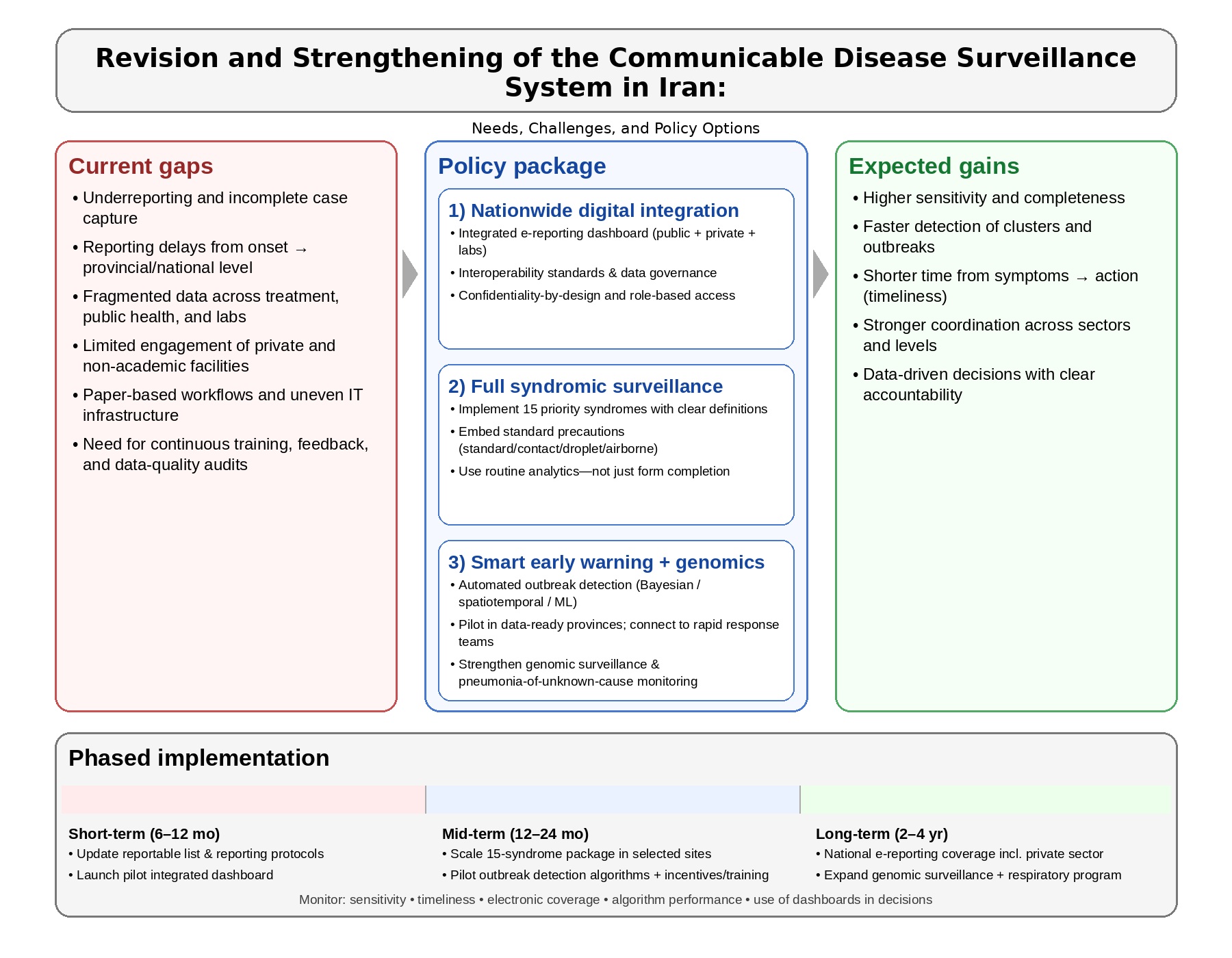
The communicable disease surveillance system has evolved over several decades; the basic infrastructure of the surveillance system, including the health network, headquarters structures, reporting systems, and national guidelines, has been established over recent decades, however, evidence suggests that sensitivity, completeness, and timeliness remain suboptimal across several domains. The COVID-19 pandemic further exposed these weaknesses and underscored the need to update surveillance protocols, enhance digitalization, and strengthen syndromic surveillance. The aim of this paper is to review existing evidence and propose policy recommendations to reinforce the national communicable disease surveillance system. This policy brief synthesizes Iranian research evidence, including field assessments; the experiences of managers and experts in district and provincial health centers in Qom; findings from quantitative and qualitative studies conducted in Iran over the past decade; a review of novel outbreak-detection methods; and an assessment of relevant Ministry of Health documents. Key findings were extracted, synthesized, and structured to inform policy options. Across the evidence base, underreporting, reporting delays, limited private-sector engagement, and fragmentation of data between treatment and public-health sectors were consistently observed. National syndromic surveillance guidelines specify a list of 15 priority syndromes and standard precautionary requirements (standard, contact, droplet, and airborne), which provide a framework to support earlier outbreak detection. Nevertheless, existing systems require functional revision and comprehensive digital transformation. The COVID-19 experience highlighted the critical importance of strengthening early-warning systems, expanding genomic surveillance, and localizing respiratory disease surveillance platforms. Improving the communicable disease surveillance system will require a coordinated package of interventions, including guideline revision, integration of electronic systems, training and incentivizing providers, ensuring data confidentiality, and developing automated outbreak-detection algorithms. A phased implementation of these measures is expected to substantially enhance system sensitivity and response speed. Rapid and systematic implementation of this package can significantly improve the timeliness and effectiveness of national disease surveillance.
Keywords: surveillance system, disease reporting, sensitivity, response time, outbreak detection, Iran
Subject:
Epidemiology
Send email to the article author
| Rights and permissions | |
 |
This work is licensed under a Creative Commons Attribution-NonCommercial 4.0 International License. |

Articles Copyright © The Author(s). Owned by Mazandaran University of Medical Sciences.
Contact Us
Address: Journal Office, Building No. 2, Mazandaran University of Medical Sciences, Moallem Square, Sari.Tel: +98 (011)34484874 Postal code: 48175-866 E-Mail: jmums@mazums.ac.ir Telefax: +98 (011)33262679
