

Volume 35, Issue 253 (1-2026)
J Mazandaran Univ Med Sci 2026, 35(253): 129-145 |
Back to browse issues page



Download citation:
BibTeX | RIS | EndNote | Medlars | ProCite | Reference Manager | RefWorks
Send citation to:


BibTeX | RIS | EndNote | Medlars | ProCite | Reference Manager | RefWorks
Send citation to:
Mazloomi S N, Ala S, Khaleghi F. Review of Challenges and Capacities of Utilizing Agricultural and Agro-Industrial By-Products for the Production of Functional, Bioactive and Value-Added Products. J Mazandaran Univ Med Sci 2026; 35 (253) :129-145
URL: http://jmums.mazums.ac.ir/article-1-22464-en.html
URL: http://jmums.mazums.ac.ir/article-1-22464-en.html


Abstract: (25 Views)
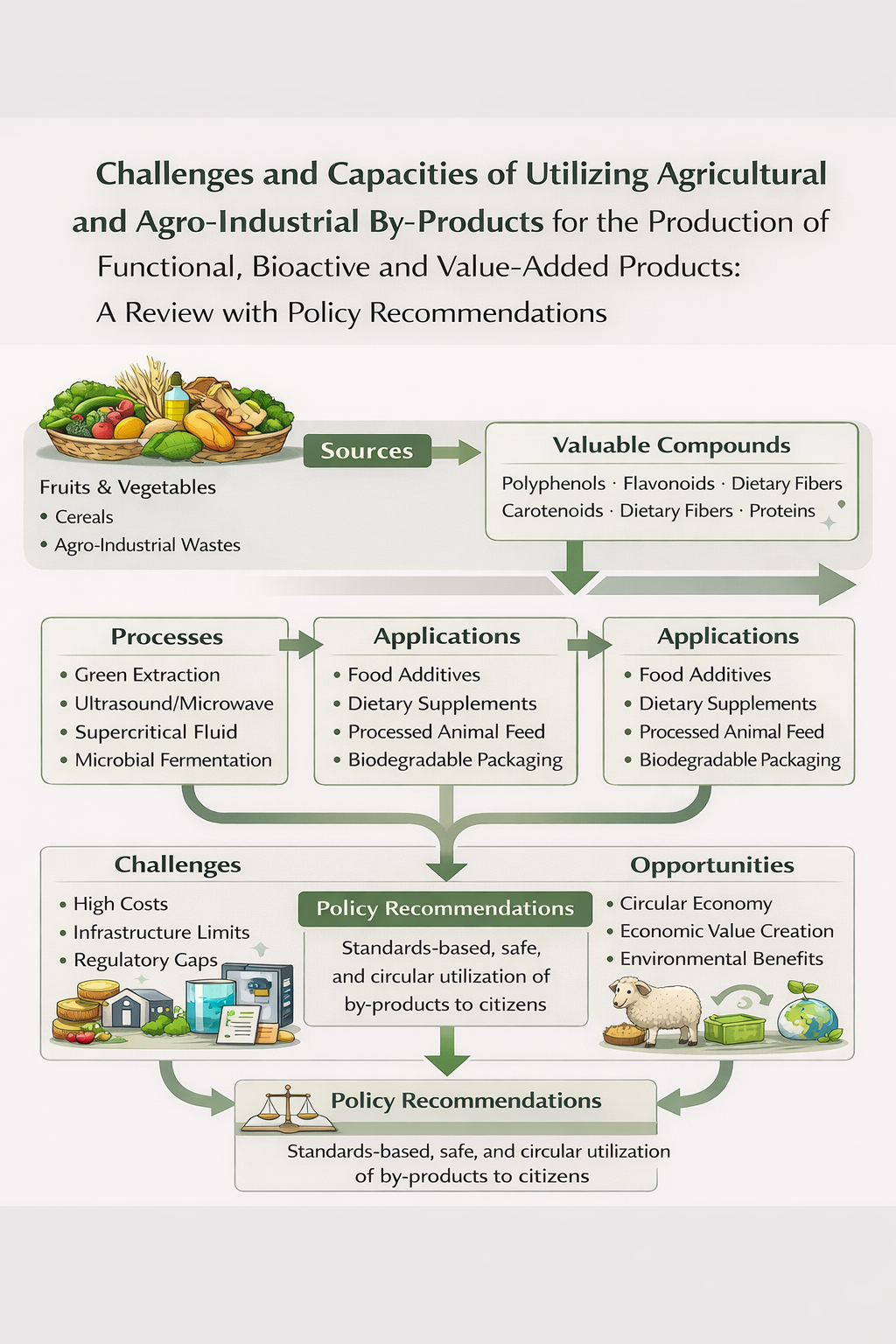
With the growth of the global population and the increasing demand for healthy and functional foods, agricultural and agro-industrial wastes generated during harvesting and processing have gained significant attention as potential sources of nutrients and bioactive compounds when managed and processed in a controlled manner. This review article analyzes studies published between 2020 and 2025 with the aim of examining the most important compounds present in these wastes, emerging technologies in the food processing industry, successful industrial applications in Iran and worldwide, as well as the challenges and opportunities associated with the safe, indirect, and standards-based utilization of these resources. The findings indicate that wastes from fruits, vegetables, cereals, and agro-industrial processes contain substantial amounts of polyphenols, flavonoids, carotenoids, dietary fibers, proteins, and essential fatty acids, which, following refining, decontamination, and quality control processes, these compounds can be utilized as approved food additives, raw materials for dietary supplement production, components of processed animal feed, and biodegradable packaging materials.The application of emerging technologies, including green extraction methods, microwave- and ultrasound-assisted extraction, supercritical fluid technologies, and microbial fermentation, provides effective opportunities to enhance the yield, stability, and quality of recovered compounds. Nevertheless, challenges such as high equipment costs, inadequate infrastructure, limited consumer acceptance, and the lack of comprehensive regulatory frameworks continue to hinder large-scale industrial development. This review demonstrates that waste management within a circular economy framework, supported by appropriate policies and consumer education, can generate considerable economic value as well as environmental and social benefits. The findings of this study may serve as a strategic reference for researchers, producers, and policymakers in advancing sustainable development and the commercialization of products derived from agricultural wastes.
Keywords: Agricultural waste, Industrial by-products, Bioactive compounds, Circular economy, Functional products
Type of Study: Review |
Subject:
Food industry
Send email to the article author
| Rights and permissions | |
 |
This work is licensed under a Creative Commons Attribution-NonCommercial 4.0 International License. |

Articles Copyright © The Author(s). Owned by Mazandaran University of Medical Sciences.
Contact Us
Address: Journal Office, Building No. 2, Mazandaran University of Medical Sciences, Moallem Square, Sari.Tel: +98 (011)34484874 Postal code: 48175-866 E-Mail: jmums@mazums.ac.ir Telefax: +98 (011)33262679
