

Volume 35, Issue 253 (1-2026)
J Mazandaran Univ Med Sci 2026, 35(253): 17-31 |
Back to browse issues page



Download citation:
BibTeX | RIS | EndNote | Medlars | ProCite | Reference Manager | RefWorks
Send citation to:


BibTeX | RIS | EndNote | Medlars | ProCite | Reference Manager | RefWorks
Send citation to:
Morad H, Katouli M, Davoodi A, Mahmoudnia F, Morad S, Moein N. Production and Pharmaceutical Application of Natural Chlorophyll Pigment from Marine Microalgae Chlorella vulgaris. J Mazandaran Univ Med Sci 2026; 35 (253) :17-31
URL: http://jmums.mazums.ac.ir/article-1-22522-en.html
URL: http://jmums.mazums.ac.ir/article-1-22522-en.html
Hamed Morad 
 , Mojtaba Katouli , Ali Davoodi , Fahime Mahmoudnia , Shaghayegh Morad , Narjesalsadat Moein
, Mojtaba Katouli , Ali Davoodi , Fahime Mahmoudnia , Shaghayegh Morad , Narjesalsadat Moein
Abstract: (423 Views)
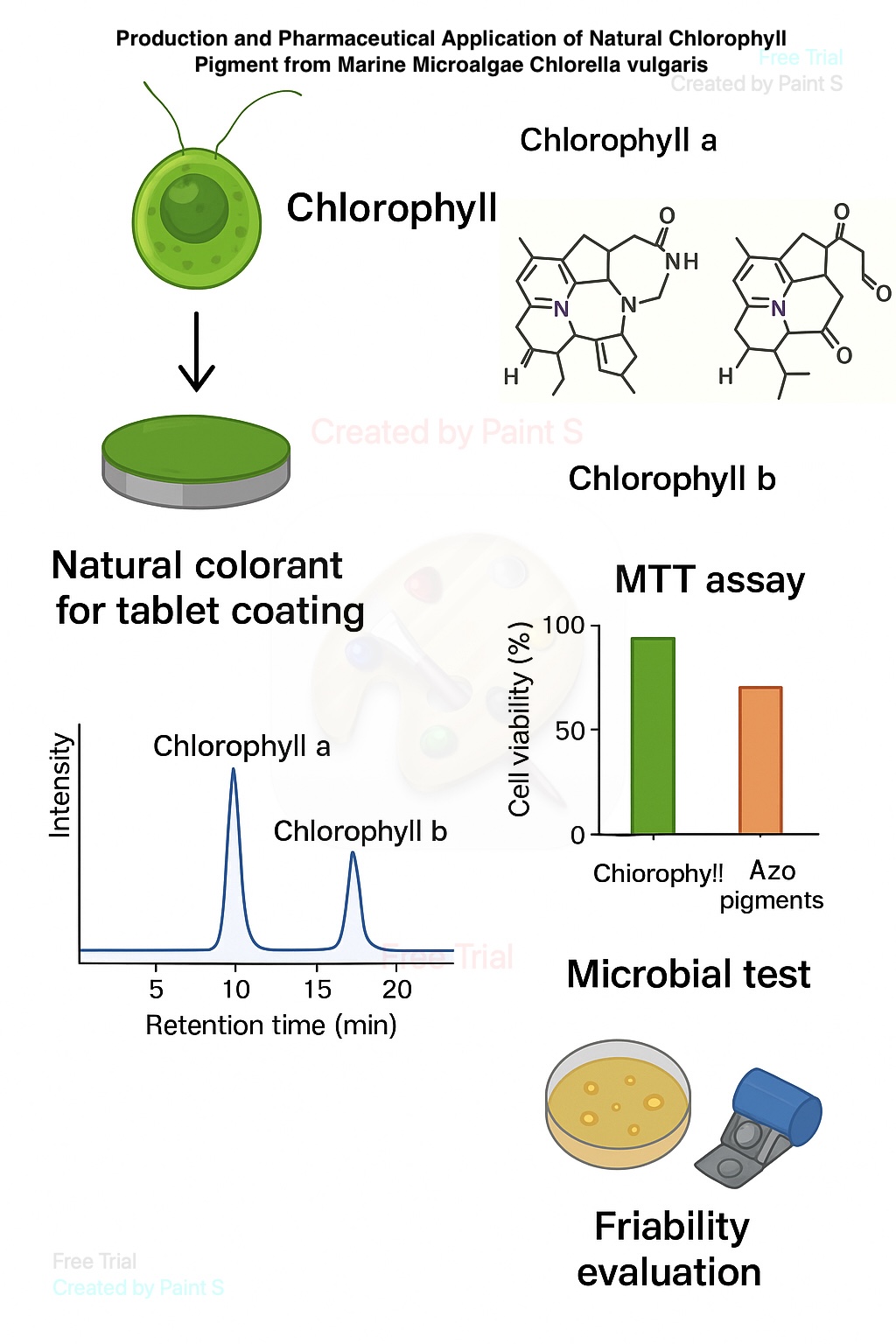
Background and purpose: Synthetic dyes, particularly azo compounds, are widely used in pharmaceutical coatings and other industries but are associated with cytotoxicity, genotoxicity, and allergic reactions. The increasing demand for safer and eco-friendly alternatives has directed attention toward natural pigments from microalgae. Thus, achieving a safe and high-quality coloring agent is still in the spotlight. This study aimed to extract chlorophyll pigment from Chlorella vulgaris and evaluate its safety and performance as a natural coloring agent in tablet coating formulations.
Materials and methods: C. vulgaris was cultured in Bold’s Basal Medium (BBM) under controlled light and aeration conditions. The biomass was lyophilized, and chlorophyll pigments were extracted using solvent extraction and identified by HPLC. Cytotoxicity was assessed on L929 fibroblast cells using the MTT assay. A film-coating formulation based on hydroxypropyl methylcellulose (HPMC) containing chlorophyll was prepared and compared with a control formulation containing a synthetic dye. The coated tablets were evaluated for color uniformity, mechanical stability (friability), and microbial safety.
Results: The extraction yield of chlorophyll a was approximately 87.8%. MTT assay results indicated no significant cytotoxicity at concentrations below 0.5 mg/mL, with cell viability above 95% (p > 0.05). Chlorophyll-coated tablets demonstrated uniform color distribution, satisfactory adhesion, and no visible surface defects. Microbial tests confirmed the absence of contamination in all coated samples.
Conclusion: Chlorophyll extracted from C. vulgaris represents a safe, biocompatible, and environmentally sustainable alternative to synthetic azo dyes in pharmaceutical coating formulations. The use of such natural pigments may improve patient safety and promote the development of greener, more acceptable pharmaceutical products.
Materials and methods: C. vulgaris was cultured in Bold’s Basal Medium (BBM) under controlled light and aeration conditions. The biomass was lyophilized, and chlorophyll pigments were extracted using solvent extraction and identified by HPLC. Cytotoxicity was assessed on L929 fibroblast cells using the MTT assay. A film-coating formulation based on hydroxypropyl methylcellulose (HPMC) containing chlorophyll was prepared and compared with a control formulation containing a synthetic dye. The coated tablets were evaluated for color uniformity, mechanical stability (friability), and microbial safety.
Results: The extraction yield of chlorophyll a was approximately 87.8%. MTT assay results indicated no significant cytotoxicity at concentrations below 0.5 mg/mL, with cell viability above 95% (p > 0.05). Chlorophyll-coated tablets demonstrated uniform color distribution, satisfactory adhesion, and no visible surface defects. Microbial tests confirmed the absence of contamination in all coated samples.
Conclusion: Chlorophyll extracted from C. vulgaris represents a safe, biocompatible, and environmentally sustainable alternative to synthetic azo dyes in pharmaceutical coating formulations. The use of such natural pigments may improve patient safety and promote the development of greener, more acceptable pharmaceutical products.
Type of Study: Research(Original) |
Subject:
Pharmacy
Send email to the article author
| Rights and permissions | |
 |
This work is licensed under a Creative Commons Attribution-NonCommercial 4.0 International License. |

Articles Copyright © The Author(s). Owned by Mazandaran University of Medical Sciences.
Contact Us
Address: Journal Office, Building No. 2, Mazandaran University of Medical Sciences, Moallem Square, Sari.Tel: +98 (011)34484874 Postal code: 48175-866 E-Mail: jmums@mazums.ac.ir Telefax: +98 (011)33262679
