

Volume 36, Issue 260 (9-2026)
J Mazandaran Univ Med Sci 2026, 36(260): 224-228 |
Back to browse issues page



Download citation:
BibTeX | RIS | EndNote | Medlars | ProCite | Reference Manager | RefWorks
Send citation to:


BibTeX | RIS | EndNote | Medlars | ProCite | Reference Manager | RefWorks
Send citation to:
Shoshtari M, Alemi A, kamyari N, Goudarzi G, Maleki H, Radmanesh E. Association between Particulate Matter Exposure, Electrocardiographic Parameters, and Coagulation Markers in Patients with Cardiovascular Disease. J Mazandaran Univ Med Sci 2026; 36 (260) :224-228
URL: http://jmums.mazums.ac.ir/article-1-22976-en.html
URL: http://jmums.mazums.ac.ir/article-1-22976-en.html
Maryam Shoshtari 
 , Ashraf Alemi , Naser Kamyari , Gholamreza Goudarzi , Heydar Maleki , Esmat Radmanesh
, Ashraf Alemi , Naser Kamyari , Gholamreza Goudarzi , Heydar Maleki , Esmat Radmanesh
Abstract: (28 Views)
Background and purpose: Air pollution is linked to an increased risk of cardiovascular disease and cardiovascular mortality. Further research is needed to clarify the specific pathways and mechanisms by which particulate matter exposure affects cardiac function and blood coagulation in patients with cardiovascular disease. This study aimed to investigate the relationship between particulate matter levels and electrocardiographic parameters and coagulation markers in patients with cardiovascular disease.
Materials and methods: This retrospective cross-sectional analytical study included 275 patients with cardiovascular disease who were hospitalized at educational hospitals affiliated with Abadan University of Medical Sciences between January and March 2023. Demographic characteristics and clinical data, including systolic and diastolic blood pressure, electrocardiographic parameters, and coagulation markers, were extracted from patients' medical records.
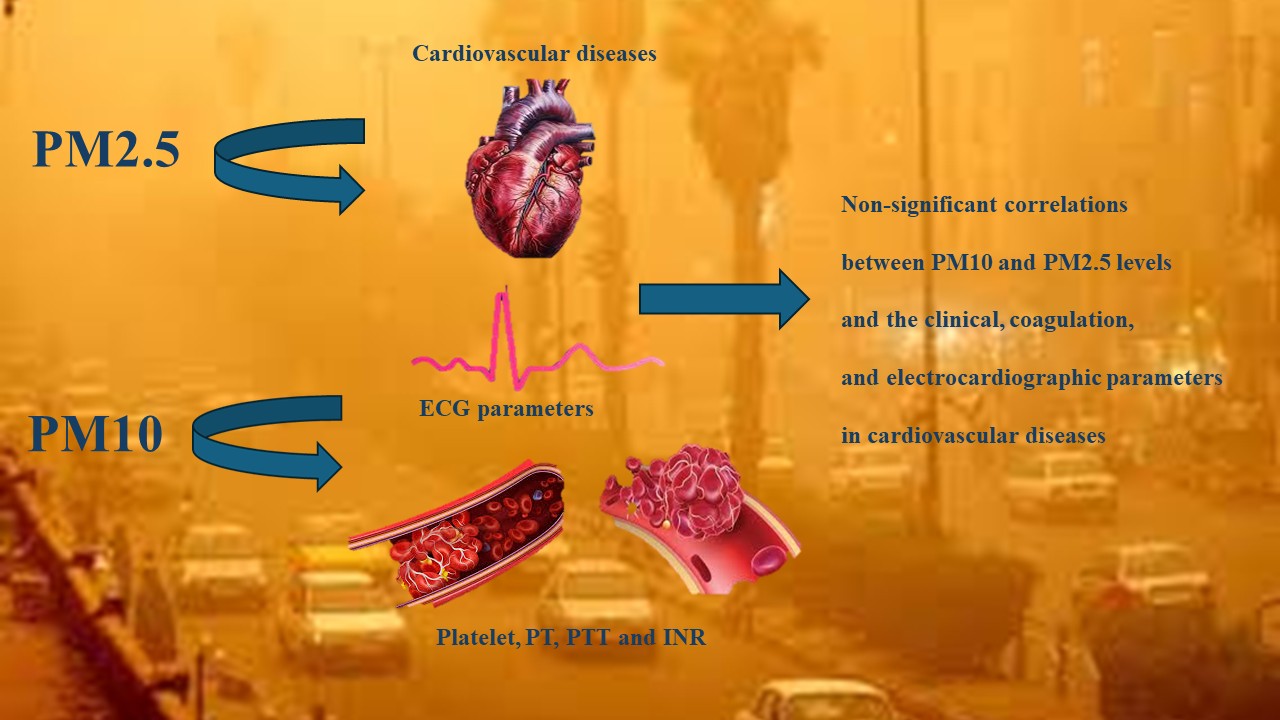
Results: The mean age of the participants was 59.69 ± 14.49 years, and 58.5% were male. Acute coronary syndromes were the most common diagnosis, accounting for 53.1% of participants. Pearson correlation analysis indicated no significant correlations between PM10 and PM2.5 levels and blood pressure, coagulation parameters (including PT, PTT, INR, and platelet count), or electrocardiographic parameters, such as the P-R interval, Q-T interval, and QRS complex.
Conclusion: This study found no statistically significant correlations between PM10 or PM2.5 concentrations and blood pressure, coagulation parameters, or electrocardiographic parameters. The findings highlight the complex interplay between environmental and clinical factors and suggest the need for longitudinal studies with larger sample sizes, more robust designs, and repeated measurements.
Materials and methods: This retrospective cross-sectional analytical study included 275 patients with cardiovascular disease who were hospitalized at educational hospitals affiliated with Abadan University of Medical Sciences between January and March 2023. Demographic characteristics and clinical data, including systolic and diastolic blood pressure, electrocardiographic parameters, and coagulation markers, were extracted from patients' medical records.
Results: The mean age of the participants was 59.69 ± 14.49 years, and 58.5% were male. Acute coronary syndromes were the most common diagnosis, accounting for 53.1% of participants. Pearson correlation analysis indicated no significant correlations between PM10 and PM2.5 levels and blood pressure, coagulation parameters (including PT, PTT, INR, and platelet count), or electrocardiographic parameters, such as the P-R interval, Q-T interval, and QRS complex.
Conclusion: This study found no statistically significant correlations between PM10 or PM2.5 concentrations and blood pressure, coagulation parameters, or electrocardiographic parameters. The findings highlight the complex interplay between environmental and clinical factors and suggest the need for longitudinal studies with larger sample sizes, more robust designs, and repeated measurements.
Type of Study: Brief Report |
Subject:
physiology
Send email to the article author
| Rights and permissions | |
 |
This work is licensed under a Creative Commons Attribution-NonCommercial 4.0 International License. |

Articles Copyright © The Author(s). Owned by Mazandaran University of Medical Sciences.
Contact Us
Address: Journal Office, Building No. 2, Mazandaran University of Medical Sciences, Moallem Square, Sari.Tel: +98 (011)34484874 Postal code: 48175-866 E-Mail: jmums@mazums.ac.ir Telefax: +98 (011)33262679
