

Volume 36, Issue 260 (9-2026)
J Mazandaran Univ Med Sci 2026, 36(260): 290-301 |
Back to browse issues page



Download citation:
BibTeX | RIS | EndNote | Medlars | ProCite | Reference Manager | RefWorks
Send citation to:


BibTeX | RIS | EndNote | Medlars | ProCite | Reference Manager | RefWorks
Send citation to:
Aali S, Farzizadeh R, Fahimi P, Nadimi R. Comparison of Changes in Muscle Strength, Physical Function, and Muscle Morphology Between People With Fibromyalgia Syndrome and Healthy Individuals: A Systematic Review. J Mazandaran Univ Med Sci 2026; 36 (260) :290-301
URL: http://jmums.mazums.ac.ir/article-1-23084-en.html
URL: http://jmums.mazums.ac.ir/article-1-23084-en.html


Abstract: (14 Views)
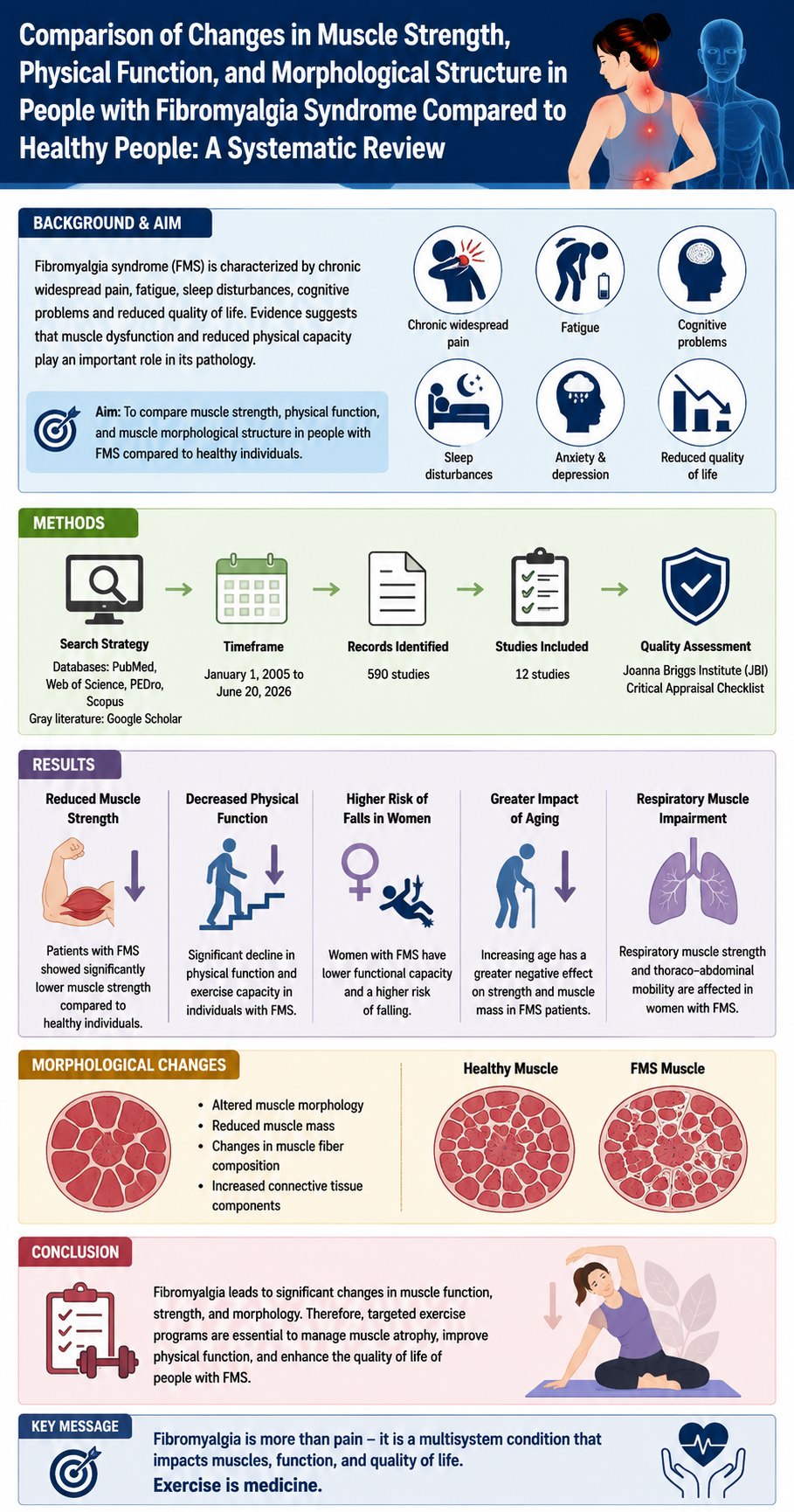
Background and purpose: Fibromyalgia is a clinical syndrome characterized by chronic pain, fatigue, and reduced quality of life. Although this disease is best known for widespread pain, studies show that muscle dysfunction and reduced physical capacity play an important role in its pathophysiology. The aim of this study was to investigate muscle function, strength, and structure in patients with fibromyalgia compared with healthy individuals.
Materials and methods: A comprehensive search was conducted in the PubMed, Web of Science, PEDro, and Scopus databases. The Google Scholar search engine was used to identify gray literature. The search covered the period from January 1, 2005, to June 20, 2026. Of the 590 studies identified, 12 eligible studies were critically assessed using the Joanna Briggs Institute (JBI) critical appraisal tools, and the results were synthesized to assess the consistency and validity of the findings.
Results: The assessments showed that patients with fibromyalgia experience a significant decline in physical function and muscle strength compared with healthy individuals. Women with this syndrome have lower functional capacity and are at higher risk of falling. In addition, factors such as increasing age have a greater negative impact on muscle strength and mass in these patients. Furthermore, respiratory muscle strength and thoracic-abdominal mobility are affected in women with fibromyalgia.
Conclusion: : In addition to causing pain, fibromyalgia is associated with significant changes in muscle function, strength, and morphology. Therefore, the prescription of targeted exercise programs may be important for addressing muscle atrophy, improving physical function, and enhancing the quality of life of these patients.
Materials and methods: A comprehensive search was conducted in the PubMed, Web of Science, PEDro, and Scopus databases. The Google Scholar search engine was used to identify gray literature. The search covered the period from January 1, 2005, to June 20, 2026. Of the 590 studies identified, 12 eligible studies were critically assessed using the Joanna Briggs Institute (JBI) critical appraisal tools, and the results were synthesized to assess the consistency and validity of the findings.
Results: The assessments showed that patients with fibromyalgia experience a significant decline in physical function and muscle strength compared with healthy individuals. Women with this syndrome have lower functional capacity and are at higher risk of falling. In addition, factors such as increasing age have a greater negative impact on muscle strength and mass in these patients. Furthermore, respiratory muscle strength and thoracic-abdominal mobility are affected in women with fibromyalgia.
Conclusion: : In addition to causing pain, fibromyalgia is associated with significant changes in muscle function, strength, and morphology. Therefore, the prescription of targeted exercise programs may be important for addressing muscle atrophy, improving physical function, and enhancing the quality of life of these patients.
Type of Study: Review |
Subject:
Sports biomechanics
Send email to the article author
| Rights and permissions | |
 |
This work is licensed under a Creative Commons Attribution-NonCommercial 4.0 International License. |

Articles Copyright © The Author(s). Owned by Mazandaran University of Medical Sciences.
Contact Us
Address: Journal Office, Building No. 2, Mazandaran University of Medical Sciences, Moallem Square, Sari.Tel: +98 (011)34484874 Postal code: 48175-866 E-Mail: jmums@mazums.ac.ir Telefax: +98 (011)33262679
