

Volume 36, Issue 257 (5-2026)
J Mazandaran Univ Med Sci 2026, 36(257): 42-51 |
Back to browse issues page


Download citation:
BibTeX | RIS | EndNote | Medlars | ProCite | Reference Manager | RefWorks
Send citation to:


BibTeX | RIS | EndNote | Medlars | ProCite | Reference Manager | RefWorks
Send citation to:
Ebrahimi Bahar E, Khodadadi I, Shafiee G, Abbasi E. Investigation of Opium-induced Changes in Lipid Profile and Hepatic Histopathology in Rats Receiving a Cholesterol-rich Diet. J Mazandaran Univ Med Sci 2026; 36 (257) :42-51
URL: http://jmums.mazums.ac.ir/article-1-19233-en.html
URL: http://jmums.mazums.ac.ir/article-1-19233-en.html


Abstract: (191 Views)
Background and purpose: Drug abuse is one of the most significant public health threats worldwide and may lead to liver damage and premature mortality. This study aimed to investigate the effects of opium on lipid profile and hepatic histopathological changes in rats receiving a high-fat diet.
Materials and methods: In this experimental study, 24 Wistar rats weighing 200-220 g were allocated into four groups (n = 6). To induce dependence, opium was dissolved in 1 mL of hot water and administered twice daily (morning and afternoon) for four weeks via oral gavage after cooling. At the end of the experiment, blood samples were collected for serum separation, and liver tissues were excised. Lipid profile parameters were measured using colorimetric methods. Hematoxylin and eosin staining was performed to evaluate histopathological changes in liver tissue. Data were analyzed using SPSS software and expressed as mean ± standard error of the mean (SEM).
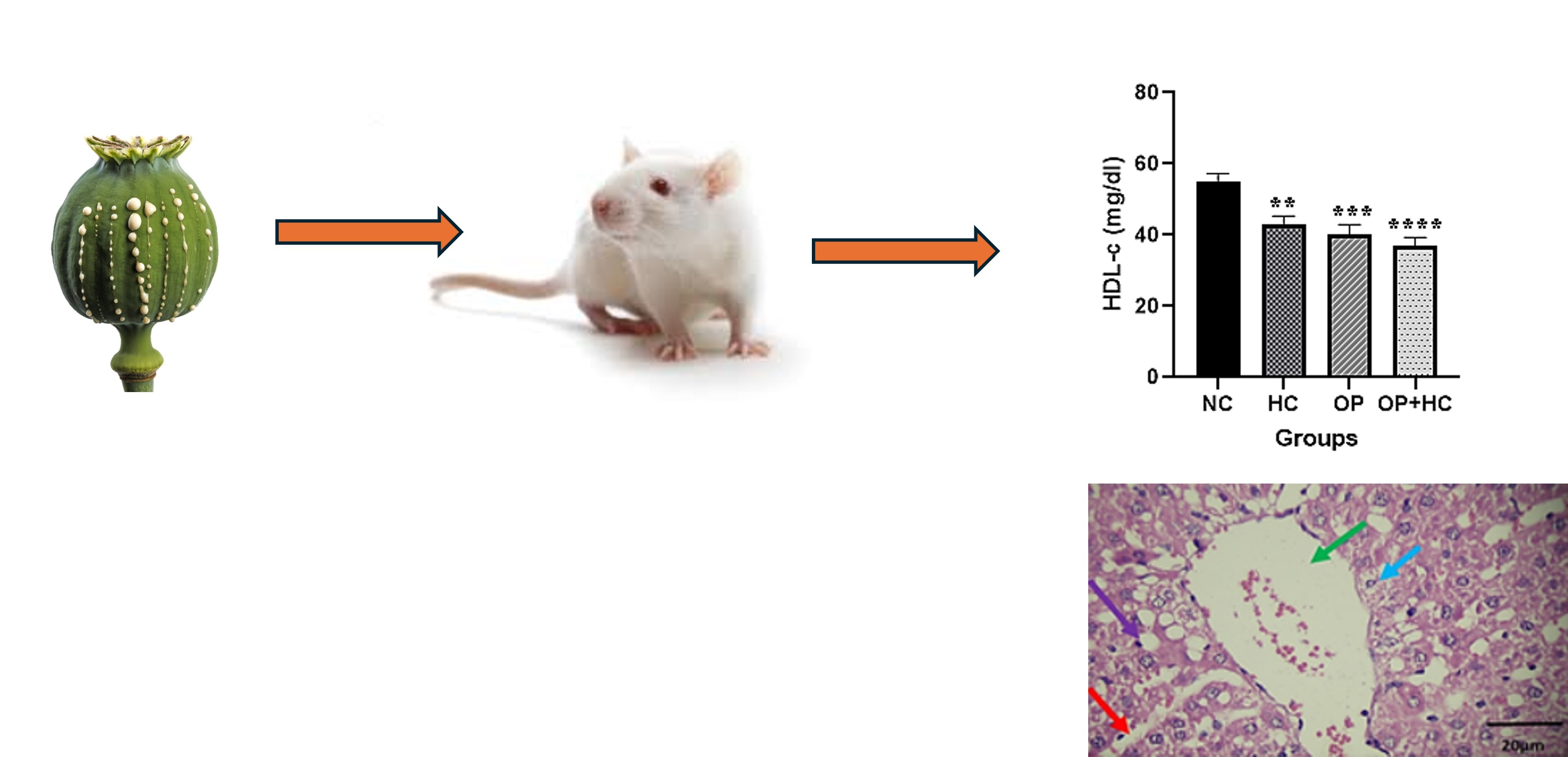
Results: The results of this study demonstrated that opium significantly reduced serum levels of triglycerides (P= 0.0019), HDL-C (P= 0.0004), and VLDL-C (P= 0.0019) in the opium-dependent group compared with the healthy control group (P< 0.05). Histopathological analysis revealed that opium induced disorganization, deformation, and destruction of hepatocytes, along with lymphocytic infiltration in liver tissue.
Conclusion: Although opium was associated with reductions in serum total cholesterol and triglycerides and may exhibit some metabolic effects, the histological findings of this study indicate that it exerts destructive effects on liver tissue.
Materials and methods: In this experimental study, 24 Wistar rats weighing 200-220 g were allocated into four groups (n = 6). To induce dependence, opium was dissolved in 1 mL of hot water and administered twice daily (morning and afternoon) for four weeks via oral gavage after cooling. At the end of the experiment, blood samples were collected for serum separation, and liver tissues were excised. Lipid profile parameters were measured using colorimetric methods. Hematoxylin and eosin staining was performed to evaluate histopathological changes in liver tissue. Data were analyzed using SPSS software and expressed as mean ± standard error of the mean (SEM).
Results: The results of this study demonstrated that opium significantly reduced serum levels of triglycerides (P= 0.0019), HDL-C (P= 0.0004), and VLDL-C (P= 0.0019) in the opium-dependent group compared with the healthy control group (P< 0.05). Histopathological analysis revealed that opium induced disorganization, deformation, and destruction of hepatocytes, along with lymphocytic infiltration in liver tissue.
Conclusion: Although opium was associated with reductions in serum total cholesterol and triglycerides and may exhibit some metabolic effects, the histological findings of this study indicate that it exerts destructive effects on liver tissue.
Type of Study: Research(Original) |
Subject:
Biology
Send email to the article author
| Rights and permissions | |
 |
This work is licensed under a Creative Commons Attribution-NonCommercial 4.0 International License. |

Articles Copyright © The Author(s). Owned by Mazandaran University of Medical Sciences.
Contact Us
Address: Journal Office, Building No. 2, Mazandaran University of Medical Sciences, Moallem Square, Sari.Tel: +98 (011)34484874 Postal code: 48175-866 E-Mail: jmums@mazums.ac.ir Telefax: +98 (011)33262679
