

Volume 36, Issue 260 (9-2026)
J Mazandaran Univ Med Sci 2026, 36(260): 219-223 |
Back to browse issues page



Download citation:
BibTeX | RIS | EndNote | Medlars | ProCite | Reference Manager | RefWorks
Send citation to:


BibTeX | RIS | EndNote | Medlars | ProCite | Reference Manager | RefWorks
Send citation to:
Sharifpour A, Javadi F, Fakhar M, Tabaripour R, Mehravaran H. Molecular Detection of Lophomonas in Sputum Samples from Patients with Chronic Obstructive Pulmonary Disease Referred to the Iranian National Registry Center for Lophomoniasis, Mazandaran, Northern Iran. J Mazandaran Univ Med Sci 2026; 36 (260) :219-223
URL: http://jmums.mazums.ac.ir/article-1-22209-en.html
URL: http://jmums.mazums.ac.ir/article-1-22209-en.html


Abstract: (24 Views)
Background and purpose: Chronic obstructive pulmonary disease (COPD) predisposes patients to opportunistic infections, including the emerging protozoan parasite Lophomonas. Given the challenges associated with the clinical and microscopic diagnosis of this parasite, this study aimed to determine the prevalence of Lophomonas infection among COPD patients using microscopic and molecular methods, including polymerase chain reaction (PCR), in Mazandaran Province, Iran.
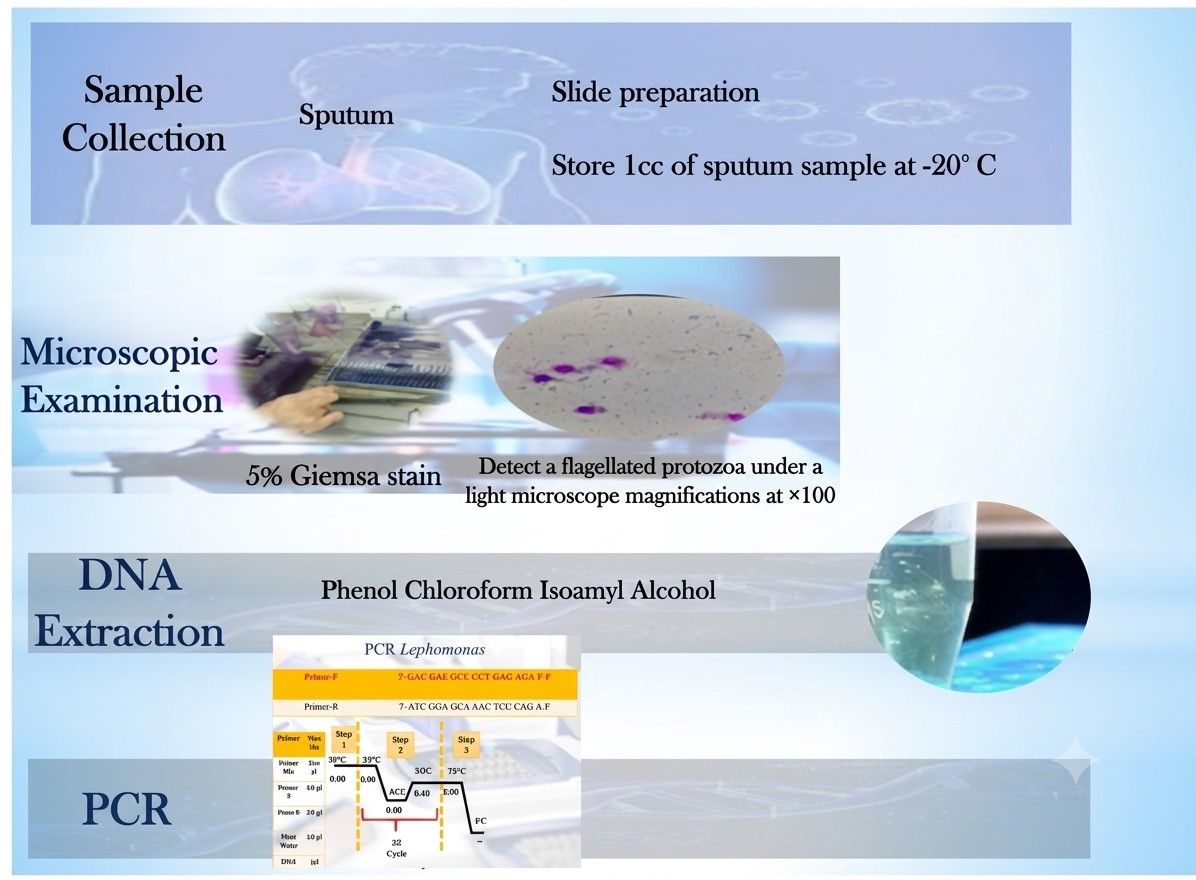
Materials and methods: In this case-control, registry-based study, sputum samples were collected from 50 adult patients with COPD (case group) and 50 age- and sex-matched healthy individuals (control group). Microscopic evaluation was performed using direct wet-mount examination of sputum samples treated with 0.5% N-acetylcysteine. DNA was manually extracted, and conventional PCR targeting the small subunit ribosomal RNA (SSU rRNA) gene was performed using specific primers to detect a 211-bp amplicon on a 1.5% agarose gel. Data were analyzed using SPSS version 24, and the chi-square test was used to assess associations between categorical variables.
Results: The mean age of the patients was 63.02± 9.43 years, and 92% were male. No positive cases were detected by microscopy, whereas PCR identified Lophomonas infection in five patients (10%). No positive cases were detected in the control group. No statistically significant association was observed between Lophomonas infection and demographic variables, medication history (including corticosteroid and antibiotic use), or clinical symptoms (P>0.05).
Conclusion: This study demonstrates the presence of opportunistic Lophomonas infection among COPD patients. Given the potential for false-negative microscopic results due to the morphological similarity of Lophomonas to ciliated respiratory epithelial cells, the use of molecular methods such as PCR may improve diagnostic accuracy and should be considered in clinical settings.
Materials and methods: In this case-control, registry-based study, sputum samples were collected from 50 adult patients with COPD (case group) and 50 age- and sex-matched healthy individuals (control group). Microscopic evaluation was performed using direct wet-mount examination of sputum samples treated with 0.5% N-acetylcysteine. DNA was manually extracted, and conventional PCR targeting the small subunit ribosomal RNA (SSU rRNA) gene was performed using specific primers to detect a 211-bp amplicon on a 1.5% agarose gel. Data were analyzed using SPSS version 24, and the chi-square test was used to assess associations between categorical variables.
Results: The mean age of the patients was 63.02± 9.43 years, and 92% were male. No positive cases were detected by microscopy, whereas PCR identified Lophomonas infection in five patients (10%). No positive cases were detected in the control group. No statistically significant association was observed between Lophomonas infection and demographic variables, medication history (including corticosteroid and antibiotic use), or clinical symptoms (P>0.05).
Conclusion: This study demonstrates the presence of opportunistic Lophomonas infection among COPD patients. Given the potential for false-negative microscopic results due to the morphological similarity of Lophomonas to ciliated respiratory epithelial cells, the use of molecular methods such as PCR may improve diagnostic accuracy and should be considered in clinical settings.
Type of Study: Brief Report |
Subject:
parasitology
Send email to the article author
| Rights and permissions | |
 |
This work is licensed under a Creative Commons Attribution-NonCommercial 4.0 International License. |

Articles Copyright © The Author(s). Owned by Mazandaran University of Medical Sciences.
Contact Us
Address: Journal Office, Building No. 2, Mazandaran University of Medical Sciences, Moallem Square, Sari.Tel: +98 (011)34484874 Postal code: 48175-866 E-Mail: jmums@mazums.ac.ir Telefax: +98 (011)33262679
